\n
## Photograph: Humanoid Robot in Dynamic Pose
### Overview
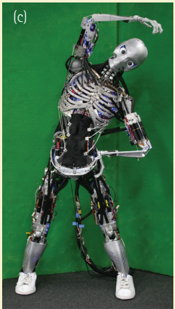
The image depicts a full-body view of a humanoid robot in a dynamic, leaning pose against a green screen background. The robot's internal structure is partially exposed, revealing a complex network of wiring, actuators, and mechanical components. The robot appears to be mid-motion, with one arm raised and the body bent at the waist.
### Components/Axes
There are no axes or legends present in this image. The only label is "(c)" in the top-left corner, likely indicating a copyright or figure designation.
### Detailed Analysis or Content Details
The robot is constructed from a combination of metallic and composite materials. The head and limbs are covered in a smooth, grey material, likely plastic or a composite. The torso is more open, revealing a black central structure surrounded by a white ring. Numerous cables and wires are visible, connecting various components. The legs are articulated with multiple joints, and the feet are white and relatively flat. The robot's pose suggests flexibility and a degree of balance control. The green screen background is a uniform shade of green.
* **Head:** Smooth, grey, humanoid shape with visible features (eyes, nose).
* **Torso:** Black central structure with a white ring around it. Exposed wiring and mechanical components.
* **Arms:** Articulated with multiple joints. One arm is raised, the other is bent.
* **Legs:** Articulated with multiple joints.
* **Feet:** White, flat.
* **Background:** Uniform green color.
* **Label:** "(c)" in the top-left corner.
### Key Observations
The robot's exposed internal structure is a key feature. It highlights the complexity of its design and the integration of various mechanical and electrical components. The dynamic pose suggests advanced control systems and balance capabilities. The green screen background indicates the image may be intended for compositing or visual effects.
### Interpretation
This image likely serves to showcase the capabilities of a humanoid robot, particularly its mechanical design and range of motion. The exposed internal structure is not necessarily indicative of a finished product, but rather a demonstration of the underlying technology. The use of a green screen suggests the robot may be intended for use in virtual environments or simulations. The image does not provide quantitative data, but rather a qualitative representation of the robot's physical characteristics and potential functionality. The "(c)" label suggests the image is protected by copyright. The robot's design appears to prioritize functionality and articulation over aesthetic appeal, suggesting it is intended for research or practical applications rather than consumer use.