## Algorithm: 2p-prop
### Overview
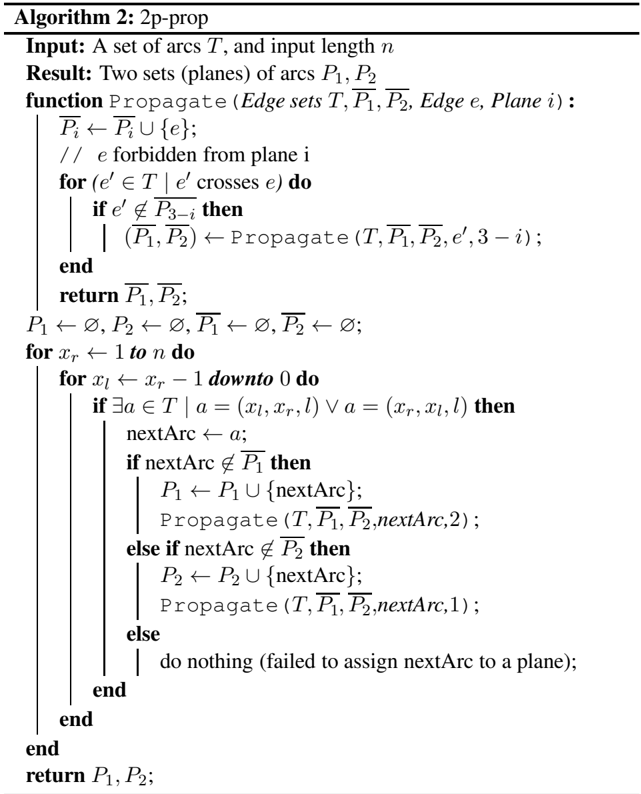
The image presents the pseudocode for an algorithm named "2p-prop". It details the input, result, and the steps involved in the algorithm, including a function called "Propagate". The algorithm appears to be related to assigning arcs to two sets (planes) denoted as P1 and P2.
### Components/Axes
* **Algorithm Name:** 2p-prop
* **Input:** A set of arcs T, and input length n
* **Result:** Two sets (planes) of arcs P1, P2
* **Function:** Propagate (Edge sets T, P1, P2, Edge e, Plane i)
* P̄i ← P̄i U {e};
* // e forbidden from plane i
* for (e' ∈ T | e' crosses e) do
* if e' ∉ P3-i then
* (P̄1, P̄2) ← Propagate (T, P̄1, P̄2, e', 3 - i);
* return P̄1, P̄2;
* P1 ← Ø, P2 ← Ø, P̄1 ← Ø, P̄2 ← Ø;
* for xr ← 1 to n do
* for xl ← xr - 1 downto 0 do
* if ∃a ∈ T | a = (xl, xr, l) ∨ a = (xr, xl, l) then
* nextArc ← a;
* if nextArc ∉ P̄1 then
* P1 ← P1 U {nextArc};
* Propagate (T, P̄1, P̄2, nextArc, 2);
* else if nextArc ∉ P̄2 then
* P2 ← P2 U {nextArc};
* Propagate (T, P̄1, P̄2, nextArc, 1);
* else
* do nothing (failed to assign nextArc to a plane);
* return P1, P2;
### Detailed Analysis or ### Content Details
The algorithm initializes two sets, P1 and P2, and their complements P̄1 and P̄2, to empty sets. It then iterates through a range defined by the input length 'n' using nested loops. Inside the loops, it checks for the existence of an arc 'a' in the set 'T' that satisfies a specific condition related to 'xl', 'xr', and 'l'. If such an arc exists, it's assigned to 'nextArc'. The algorithm then attempts to add 'nextArc' to either P1 or P2, based on whether it's already present in their complements P̄1 or P̄2, respectively. The "Propagate" function is called after adding an arc to either P1 or P2. If 'nextArc' cannot be assigned to either plane, the algorithm does nothing. Finally, the algorithm returns the sets P1 and P2.
### Key Observations
* The algorithm uses a function called "Propagate" recursively.
* The algorithm attempts to assign arcs to two sets (planes) based on certain conditions.
* The algorithm includes nested loops that iterate through a range defined by the input length 'n'.
* The algorithm uses complements of the sets P1 and P2 (P̄1 and P̄2) to determine where to assign arcs.
### Interpretation
The algorithm "2p-prop" appears to be designed to partition a set of arcs 'T' into two sets (planes) P1 and P2. The "Propagate" function likely enforces constraints or propagates information based on the edge sets and the assigned plane. The nested loops and the conditions involving 'xl', 'xr', and 'l' suggest that the algorithm considers the spatial relationships or properties of the arcs. The use of complements P̄1 and P̄2 indicates a strategy to avoid assigning the same arc to both planes. The algorithm's overall goal is to assign arcs to planes while satisfying certain constraints, potentially related to geometric or topological properties.