## Pseudocode: 2p-prop Algorithm
### Overview
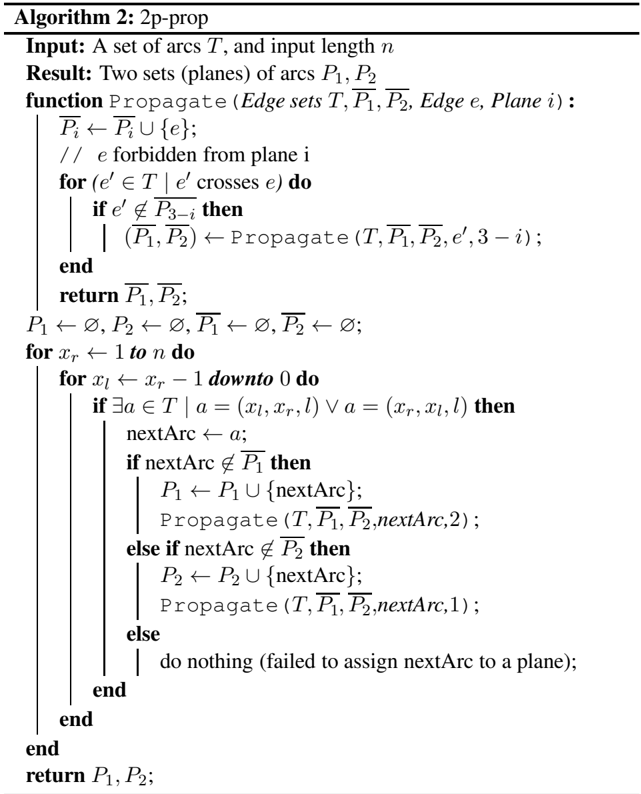
The image depicts pseudocode for an algorithm named "2p-prop" designed to process a set of arcs (edges) and partition them into two planes (P₁ and P₂) based on specific propagation rules. The algorithm iterates over input arcs, checks for crossings, and recursively updates the planes using a `Propagate` function.
### Components/Axes
- **Input**:
- `T`: A set of arcs (edges).
- `n`: Input length (integer).
- **Result**:
- Two sets of arcs: `P₁` and `P₂` (planes).
- **Function**:
- `Propagate(Edge sets T, P₁, P₂, Edge e, Plane i)`:
- Updates `Pᵢ` by adding edge `e` if it is not forbidden from plane `i`.
- Recursively processes crossing arcs in `T` to propagate changes to `P₁` and `P₂`.
### Detailed Analysis
1. **Initialization**:
- `P₁`, `P₂`, and their complements (`P̄₁`, `P̄₂`) are initialized as empty sets.
2. **Outer Loop**:
- Iterates `x_r` from `1` to `n`.
3. **Inner Loop**:
- For each `x_r`, iterates `x_l` from `x_r - 1` down to `0`.
4. **Arc Selection**:
- For each arc `a` in `T` where `a = (x_l, x_r, l)` and `a = (x_r, x_l, l)`, compute `nextArc = a`.
5. **Plane Assignment**:
- If `nextArc ∉ P₁`, add it to `P₁` and call `Propagate(T, P₁, P₂, nextArc, 2)`.
- Else if `nextArc ∉ P₂`, add it to `P₂` and call `Propagate(T, P₁, P₂, nextArc, 1)`.
- Else, no action is taken (failed to assign `nextArc` to a plane).
6. **Recursive Propagation**:
- The `Propagate` function is called recursively with updated planes and parameters.
### Key Observations
- The algorithm prioritizes assigning arcs to `P₁` before `P₂`.
- Recursive propagation ensures that changes to one plane may affect the other.
- Arcs that cannot be assigned to either plane are ignored.
### Interpretation
This algorithm appears to solve a graph partitioning problem, where arcs are assigned to two planes (`P₁` and `P₂`) while avoiding conflicts (e.g., forbidden edges). The recursive `Propagate` function suggests a depth-first approach to resolving dependencies between arcs. The use of `x_r` and `x_l` implies a focus on directional or layered relationships in the graph. The algorithm’s efficiency depends on how quickly it resolves conflicts during propagation.
**Note**: The pseudocode uses mathematical notation (e.g., `∪`, `∈`, `∉`) and set operations, indicating a formal, algorithmic design. No numerical data or visual trends are present, as this is a textual representation of logic.