## Diagram: Human Memory vs. LLM-driven AI Memory
### Overview
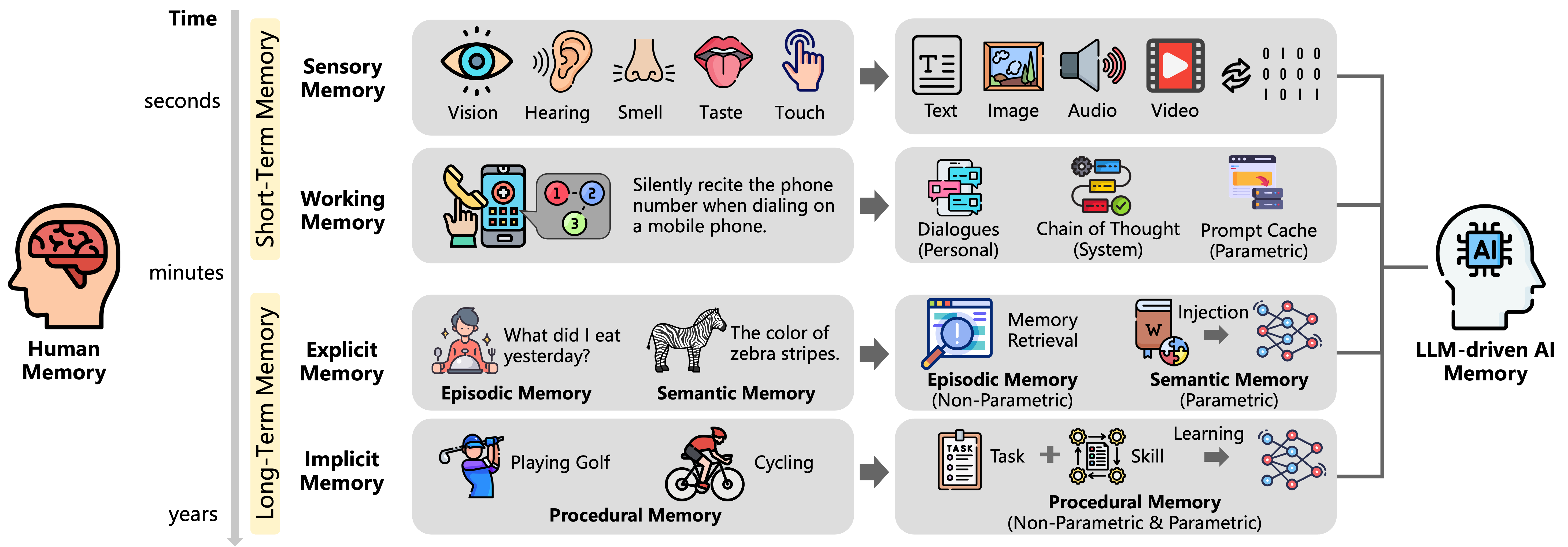
The image is a diagram comparing human memory to LLM-driven AI memory. It categorizes human memory into sensory, short-term (working), and long-term (explicit and implicit) memory, illustrating each with examples. It then draws parallels to how these memory types are implemented in LLM-driven AI.
### Components/Axes
* **Vertical Axis:** Time, ranging from seconds (top) to years (bottom).
* **Left Side:** Human Memory, represented by a head with a brain inside.
* **Memory Categories (Human):**
* Sensory Memory (seconds)
* Short-Term Memory (minutes)
* Long-Term Memory (years)
* Explicit Memory
* Implicit Memory
* **Right Side:** LLM-driven AI Memory, represented by a head with an "AI" chip inside.
* **Memory Types (AI):**
* Dialogues (Personal)
* Chain of Thought (System)
* Prompt Cache (Parametric)
* Episodic Memory (Non-Parametric)
* Semantic Memory (Parametric)
* Procedural Memory (Non-Parametric & Parametric)
### Detailed Analysis or Content Details
**Human Memory:**
* **Sensory Memory (seconds):**
* Vision: An eye icon.
* Hearing: An ear icon.
* Smell: A nose icon.
* Taste: A tongue icon.
* Touch: A hand icon touching a screen.
* These sensory inputs are then converted to: Text, Image, Audio, Video.
* **Working Memory (minutes):**
* A hand using a phone. The phone displays a keypad with numbers 1, 2, and 3 highlighted.
* Text: "Silently recite the phone number when dialing on a mobile phone."
* **Explicit Memory (years):**
* Episodic Memory: A person sitting at a table with food. Text: "What did I eat yesterday?"
* Semantic Memory: A zebra. Text: "The color of zebra stripes."
* **Implicit Memory (years):**
* Procedural Memory: A person playing golf and a person cycling.
**LLM-driven AI Memory:**
* **Dialogues (Personal):** Represented by chat bubbles.
* **Chain of Thought (System):** Represented by interconnected blocks with a gear.
* **Prompt Cache (Parametric):** Represented by a computer screen with a magnifying glass.
* **Episodic Memory (Non-Parametric):** Represented by a computer screen with a magnifying glass and an exclamation point. Text: "Memory Retrieval"
* **Semantic Memory (Parametric):** Represented by a book with the letter "W" on it, an injection symbol, and a network diagram.
* **Procedural Memory (Non-Parametric & Parametric):** Represented by a task list, a skill icon, and a network diagram. Text: "Task + Skill", "Learning"
### Key Observations
* The diagram visually maps different types of human memory to corresponding concepts in LLM-driven AI memory.
* The time scale on the left indicates the duration for which each type of memory is typically retained.
* The diagram distinguishes between parametric and non-parametric memory types in the context of AI.
### Interpretation
The diagram illustrates an analogy between human memory and the memory mechanisms implemented in LLM-driven AI systems. It suggests that AI memory can be categorized and structured in ways that mirror human cognitive processes. The diagram highlights the different types of memory, their time scales, and their corresponding representations in both human and artificial systems. The distinction between parametric and non-parametric memory in AI suggests different approaches to storing and retrieving information, with parametric memory likely referring to learned parameters within the model and non-parametric memory referring to external data stores or retrieval mechanisms. The diagram implies that AI systems are being designed to mimic the complexity and functionality of human memory.