## Diagram: Comparative Architecture of Human Memory and LLM-Driven AI Memory
### Overview
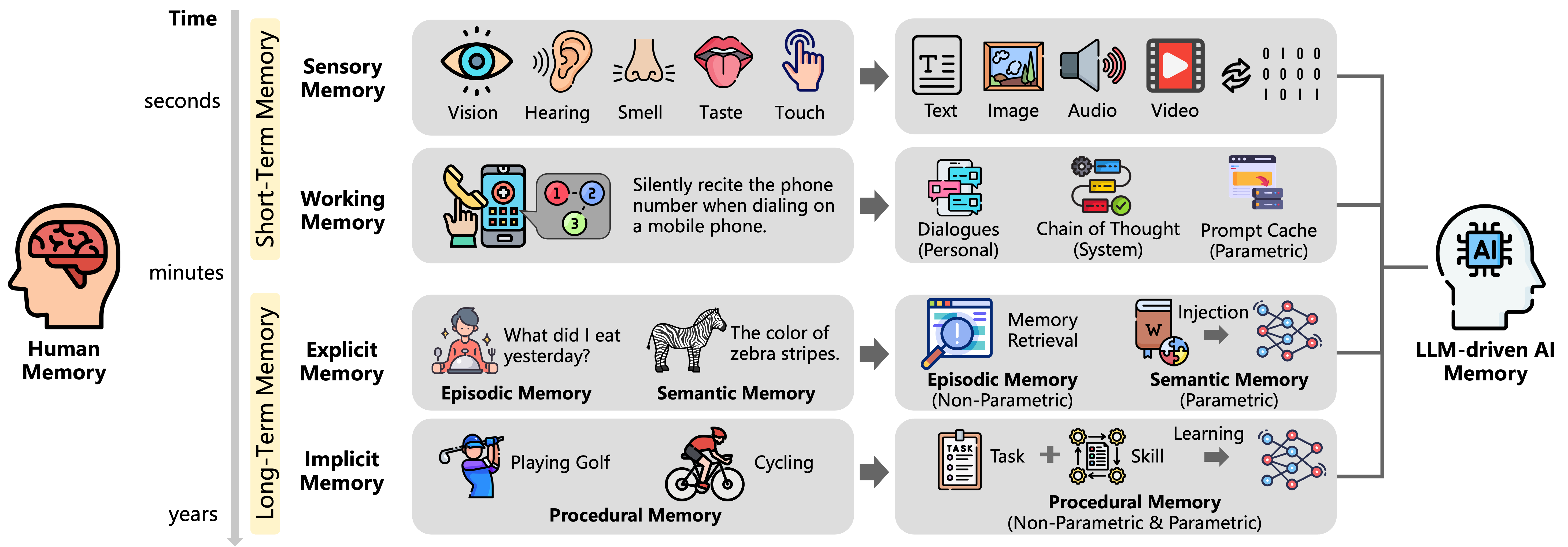
This is a conceptual diagram illustrating a direct analogy between the components and functions of human memory systems and the corresponding memory architectures in Large Language Model (LLM)-driven AI systems. The diagram is structured as a flowchart, mapping human cognitive processes on the left to their AI equivalents on the right, connected by arrows indicating a conceptual translation or inspiration.
### Components/Axes
The diagram is organized into three main vertical sections:
1. **Left Column (Human Memory):** Features a human head silhouette with a brain icon, labeled "Human Memory." A vertical timeline axis runs alongside it, marked with durations: "seconds," "minutes," and "years."
2. **Central Column (Human Memory Types):** This is the core of the human side, divided into two major categories aligned with the timeline:
* **Short-Term Memory** (yellow background, aligned with "seconds" and "minutes"):
* **Sensory Memory**
* **Working Memory**
* **Long-Term Memory** (yellow background, aligned with "years"):
* **Explicit Memory**
* **Implicit Memory**
3. **Right Column (LLM-driven AI Memory):** Features a head silhouette with a computer chip icon labeled "AI," under the title "LLM-driven AI Memory." This column lists the AI analogues for each human memory type.
### Detailed Analysis
The diagram establishes a one-to-one mapping between human and AI memory components:
**1. Sensory Memory (Human) → Multimodal Data Processing (AI)**
* **Human Side:** Represented by icons for the five senses: **Vision** (eye), **Hearing** (ear), **Smell** (nose), **Taste** (tongue), **Touch** (hand).
* **AI Side:** Maps to the processing of different data modalities: **Text** (document icon), **Image** (picture icon), **Audio** (speaker icon), **Video** (film strip icon), and a binary data icon (0s and 1s with a refresh symbol).
**2. Working Memory (Human) → Contextual Processing Systems (AI)**
* **Human Side:** Illustrated with an example: "Silently recite the phone number when dialing on a mobile phone." Icons show a hand dialing a phone and a thought bubble with numbers 1, 2, 3.
* **AI Side:** Maps to three systems:
* **Dialogues (Personal):** Represented by chat bubble icons.
* **Chain of Thought (System):** Represented by a gear/process flow icon.
* **Prompt Cache (Parametric):** Represented by a browser window with a database icon.
**3. Explicit Memory (Human) → Structured Knowledge Retrieval (AI)**
* **Human Side:** Divided into two sub-types:
* **Episodic Memory:** Example: "What did I eat yesterday?" with an icon of a person thinking about a meal.
* **Semantic Memory:** Example: "The color of zebra stripes." with an icon of a zebra.
* **AI Side:** Maps to two corresponding systems:
* **Memory Retrieval (Non-Parametric):** Labeled under **Episodic Memory (Non-Parametric)**, represented by a magnifying glass over a document.
* **Injection (Parametric):** Labeled under **Semantic Memory (Parametric)**, represented by a book (W) injecting data into a neural network icon.
**4. Implicit Memory (Human) → Skill and Task Learning (AI)**
* **Human Side:** Labeled as **Procedural Memory**, with examples: **Playing Golf** (golfer icon) and **Cycling** (cyclist icon).
* **AI Side:** Maps to **Procedural Memory (Non-Parametric & Parametric)**, represented by a flow: **Task** (clipboard icon) + **Skill** (gear/process icon) → **Learning** → a neural network icon.
### Key Observations
* **Temporal Hierarchy:** The diagram explicitly links memory types to their duration in humans (seconds for sensory, minutes for working, years for long-term), a dimension not explicitly assigned to the AI components.
* **Parametric vs. Non-Parametric:** The AI side makes a critical technical distinction, labeling components as either **Parametric** (stored within model weights, e.g., Prompt Cache, Semantic Memory) or **Non-Parametric** (external retrieval, e.g., Episodic Memory).
* **Flow Direction:** The arrows consistently flow from the human cognitive model to the AI architecture, suggesting the AI design is inspired by or analogous to human cognition.
* **Visual Grouping:** Each human memory type is contained within a light gray rounded rectangle, with its corresponding AI components in a matching rectangle to the right, creating clear visual pairs.
### Interpretation
This diagram serves as a pedagogical tool to explain the complex architecture of AI memory by grounding it in the familiar framework of human psychology. It suggests that modern LLM-driven AI systems are not monolithic but are composed of specialized subsystems that mirror the functional divisions of human memory.
The mapping implies that:
1. **AI "Senses"** are its input modalities (text, vision, audio).
2. **AI "Working Memory"** is its active context window and processing mechanisms (dialogue history, chain-of-thought reasoning, cached prompts).
3. **AI "Long-Term Memory"** is split between **explicit knowledge** (retrieved from external databases or injected during training) and **implicit procedural knowledge** (skills learned through task execution).
The most significant insight is the explicit labeling of **Parametric** vs. **Non-Parametric** memory in AI. This highlights a fundamental architectural choice: whether knowledge is baked into the model's parameters (parametric, like human semantic memory) or looked up dynamically from an external source (non-parametric, like human episodic memory retrieval). The diagram argues that a robust AI memory system requires both, just as human cognition does.