## Comparison Diagram: Human Memory vs. AI Memory Architecture
### Overview
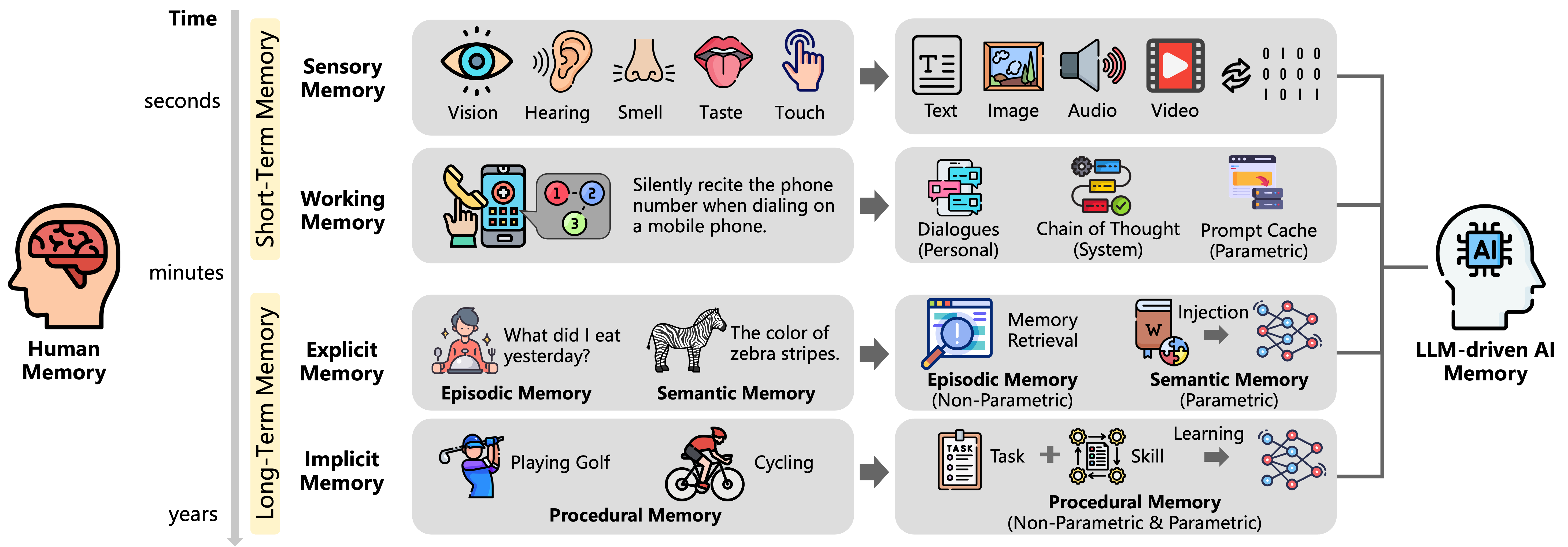
This diagram illustrates a conceptual comparison between human memory systems and AI memory architectures, organized along a temporal axis (seconds to years) and functional categories. It highlights parallels and differences in memory processing between biological and artificial systems, with explicit flow arrows indicating information pathways.
### Components/Axes
**Left Axis (Human Memory):**
- **Time Scale:** Seconds → Minutes → Years
- **Memory Types:**
- **Short-Term Memory**
- Sensory Memory (Vision, Hearing, Smell, Taste, Touch)
- Working Memory (Phone number recitation example)
- **Long-Term Memory**
- Explicit Memory
- Episodic Memory ("What did I eat yesterday?")
- Semantic Memory ("Color of zebra stripes")
- Implicit Memory
- Procedural Memory (Golf, Cycling)
**Right Axis (AI Memory):**
- **Memory Types:**
- **Short-Term Memory**
- Text, Image, Audio, Video
- Dialogues (Personal), Chain of Thought (System), Prompt Cache (Parametric)
- **Long-Term Memory**
- Episodic Memory (Non-Parametric)
- Semantic Memory (Parametric)
- Procedural Memory (Non-Parametric & Parametric)
- **AI-Specific Elements:**
- LLM-Driven AI Memory (Central node with "AI" icon)
- Flow arrows connecting human memory types to AI equivalents
### Detailed Analysis
**Human Memory Flow:**
1. **Sensory Input → Short-Term Memory:**
- Vision (eye icon) → Hearing (ear icon) → Smell (nose icon) → Taste (tongue icon) → Touch (hand icon)
- Example: Silently reciting a phone number (working memory)
2. **Short-Term → Long-Term Memory:**
- Explicit Memory: Episodic (dinner recall) and Semantic (zebra facts)
- Implicit Memory: Procedural skills (golf swing, cycling)
**AI Memory Flow:**
1. **Sensory Input → Short-Term Memory:**
- Text, Image, Audio, Video → Dialogues → Chain of Thought → Prompt Cache
2. **Short-Term → Long-Term Memory:**
- Episodic Memory (Non-Parametric) → Semantic Memory (Parametric) → Procedural Memory (Hybrid)
- Key Processes: Memory Retrieval → Injection → Learning → Task+Skill
**Notable Connections:**
- Arrows show bidirectional flow between human and AI systems (e.g., "Sensory Memory" → "Text/Image/Audio/Video" in AI)
- LLM-Driven AI Memory acts as a central hub integrating all memory types
### Key Observations
1. **Temporal Parallels:** Both systems categorize memory by duration (seconds/minutes/years), but AI compresses long-term memory into parametric/non-parametric frameworks.
2. **Functional Mapping:**
- Human Sensory Memory ↔ AI Text/Image/Audio/Video
- Human Working Memory ↔ AI Dialogues/Chain of Thought
- Human Episodic Memory ↔ AI Episodic Memory (Non-Parametric)
3. **AI-Specific Innovations:**
- Prompt Cache (Parametric) and Injection mechanisms
- Hybrid Procedural Memory combining non-parametric and parametric elements
### Interpretation
This diagram reveals a **convergent architecture** between human and AI memory systems, with AI explicitly modeling human cognitive processes through:
- **Parametric Memory:** Data-driven, scalable storage (e.g., Semantic Memory, Prompt Cache)
- **Non-Parametric Memory:** Experience-based recall (e.g., Episodic Memory, Task+Skill)
- **Hybrid Systems:** Procedural Memory bridges both approaches, mirroring human implicit learning.
The LLM-Driven AI Memory node suggests that large language models serve as the foundational framework for integrating these memory types, enabling AI to simulate human-like recall and learning. Notably, AI's "Injection" process (connecting memory retrieval to semantic networks) implies active knowledge synthesis absent in human biology.
**Critical Insight:** While human memory evolves through biological adaptation, AI memory relies on algorithmic optimization, creating a hybrid system where parametric efficiency complements non-parametric depth. This raises questions about AI's ability to replicate human intuition versus its computational scalability.