## Code Snippet: Theorem Definitions
### Overview
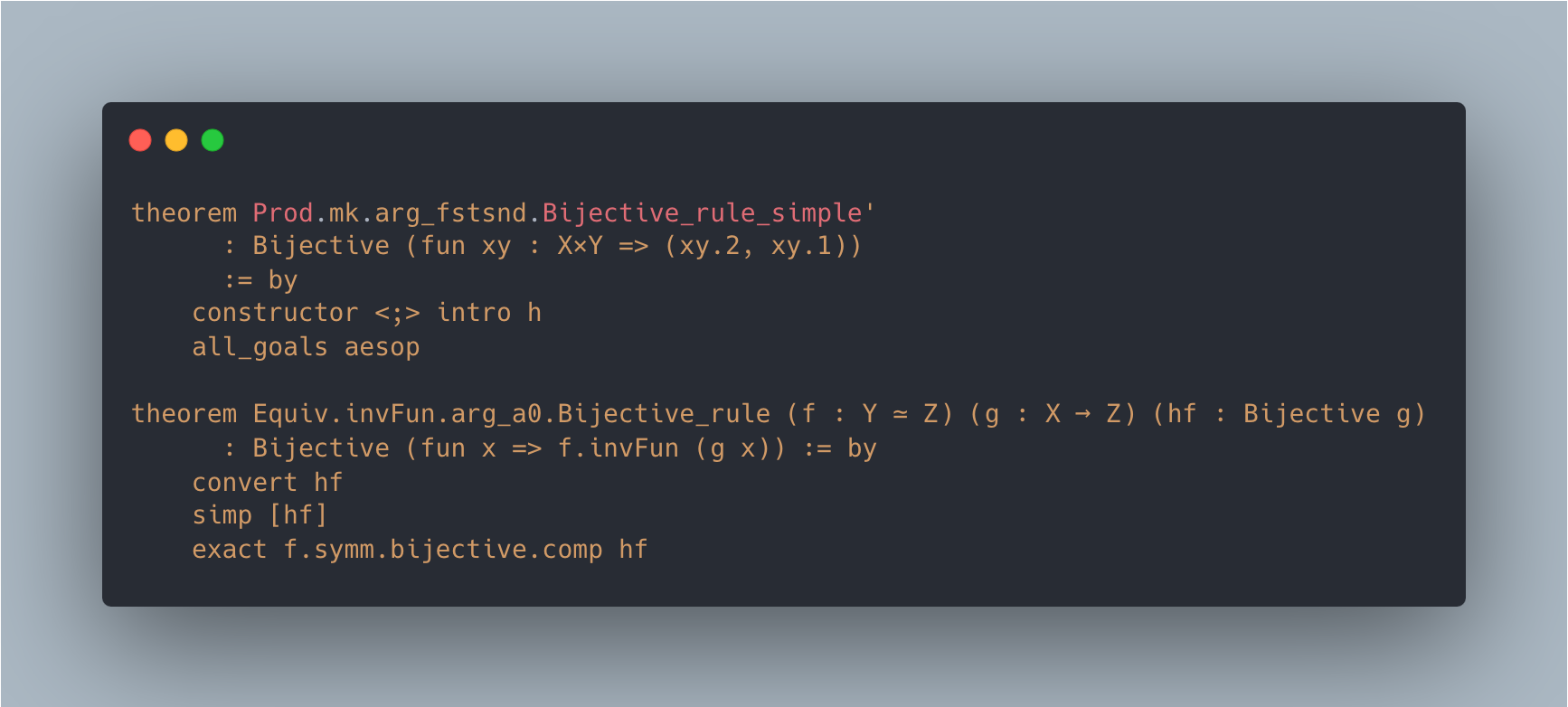
The image displays a code snippet, likely from a formal verification system or proof assistant, defining two theorems related to bijective functions. The code uses a specific syntax for defining theorems, their types, and proof strategies.
### Components/Axes
* **Window Decoration:** The code is presented within a window-like frame, with three circles in the top-left corner (red, yellow, green), mimicking window controls.
* **Code:** The main content is the code itself, consisting of theorem definitions and proof tactics.
### Detailed Analysis or ### Content Details
**Theorem 1:**
* **Name:** `Prod.mk.arg_fstsnd.Bijective_rule_simple'`
* **Type:** `Bijective (fun xy: XxY => (xy.2, xy.1))`
* This states that the function which takes a pair `xy` from the product type `XxY` and returns the pair `(xy.2, xy.1)` (swapping the elements) is bijective.
* **Proof:**
* `:= by` indicates the start of the proof.
* `constructor <;> intro h` suggests using a constructor tactic followed by introducing a hypothesis `h`.
* `all_goals aesop` applies the `aesop` tactic to all remaining goals.
**Theorem 2:**
* **Name:** `Equiv.invFun.arg_a0.Bijective_rule (f : Y ≃ Z) (g : X → Z) (hf : Bijective g)`
* This theorem takes three arguments:
* `f : Y ≃ Z`: An equivalence (bijection) between types `Y` and `Z`.
* `g : X → Z`: A function from type `X` to type `Z`.
* `hf : Bijective g`: A hypothesis stating that the function `g` is bijective.
* **Type:** `Bijective (fun x => f.invFun (g x))`
* This states that the function which takes an `x` of type `X` and returns `f.invFun (g x)` is bijective. Here, `f.invFun` is the inverse function of `f`, and `g x` is the application of `g` to `x`.
* **Proof:**
* `:= by` indicates the start of the proof.
* `convert hf` attempts to convert the goal to match the hypothesis `hf`.
* `simp [hf]` simplifies the goal using the hypothesis `hf`.
* `exact f.symm.bijective.comp hf` completes the proof by applying a composition of functions.
### Key Observations
* The code defines two theorems related to bijective functions.
* The first theorem demonstrates that swapping the elements of a pair results in a bijective function.
* The second theorem demonstrates that the composition of a function with the inverse of an equivalence (bijection) results in a bijective function.
* The code uses specific tactics (`constructor`, `intro`, `aesop`, `convert`, `simp`, `exact`) to prove the theorems.
### Interpretation
The code snippet showcases formal theorem definitions and their proofs within a formal verification system. The theorems relate to properties of bijective functions, specifically concerning swapping elements in a pair and composing functions with inverses. The use of tactics indicates an interactive proof process, where the user guides the system to construct a formal proof. The theorems likely form part of a larger library of mathematical results within the system.