\n
## Screenshot: Code Snippet - Theorem Definitions
### Overview
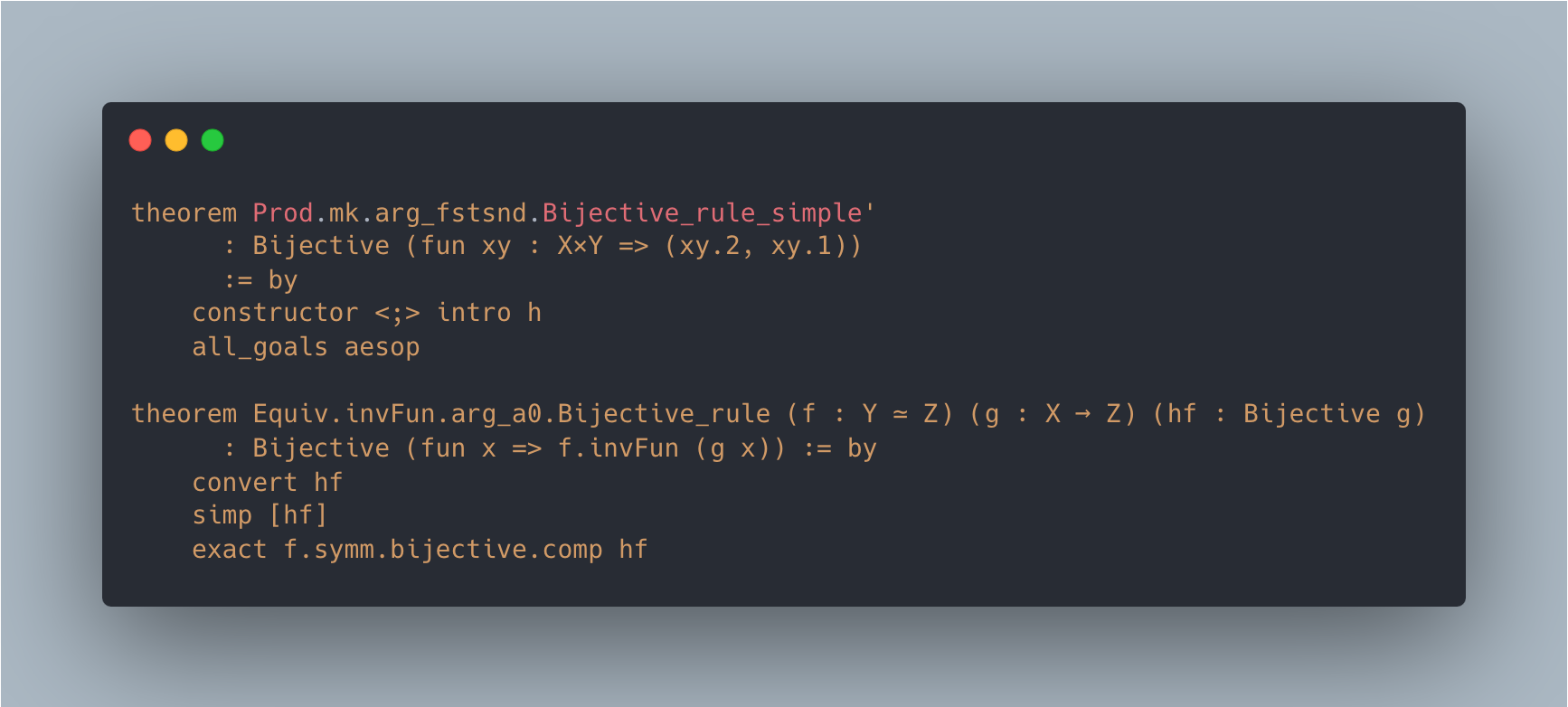
The image is a screenshot of a code editor displaying two theorem definitions, likely from a formal proof assistant system like Lean. The code appears to be related to mathematical logic and function properties (bijectivity). The background is dark, and the text is light-colored for readability. There are three colored dots in the top-left corner (red, orange, green).
### Components/Axes
There are no axes or traditional chart components. The screenshot consists entirely of text-based code. The key elements are:
* **Theorem Names:** `Prod.mk.arg_fstsnd.Bijective_rule_simple'` and `Equiv.invFun.arg_a0.Bijective_rule`
* **Type Signatures:** These define the input and output types of the functions involved. They use notation like `X x Y`, `(xy,2, xy,1)`, `Y = Z`, `X -> Z`.
* **Proof Commands:** Commands like `:= by`, `constructor <;>`, `intro h`, `all_goals aesop`, `convert hf`, `simp [hf]`, `exact f.symm.bijective.comp hf` are used to construct the formal proof.
### Detailed Analysis or Content Details
**Theorem 1: `Prod.mk.arg_fstsnd.Bijective_rule_simple'`**
* **Statement:** `Bijective (fun xy : XxY => (xy.2, xy.1))`
* **Proof:**
* `:= by` - Indicates the start of the proof.
* `constructor <;>` - Likely uses a constructor to build the proof.
* `intro h` - Introduces a hypothesis `h`.
* `all_goals aesop` - Applies the `aesop` tactic to all proof goals.
**Theorem 2: `Equiv.invFun.arg_a0.Bijective_rule`**
* **Statement:** `Bijective (fun x => f.invFun (g x))`
* **Context:** `(f : Y = Z) (g : X -> Z) (hf : Bijective g)`
* **Proof:**
* `:= by` - Indicates the start of the proof.
* `convert hf` - Attempts to convert the current goal to match the hypothesis `hf`.
* `simp [hf]` - Simplifies the goal using the hypothesis `hf`.
* `exact f.symm.bijective.comp hf` - Completes the proof using a composition of functions and the hypothesis `hf`.
### Key Observations
* The code uses a formal, symbolic notation common in proof assistants.
* The theorems relate to the bijectivity (one-to-one correspondence) of functions.
* The proofs are concise and rely on automated tactics (`aesop`, `simp`) and strategic conversions.
* The colored dots in the top-left corner do not appear to be part of the code itself and are likely indicators of the editor's state or configuration.
### Interpretation
The screenshot demonstrates a snippet of formal mathematical reasoning. The theorems define and prove properties of functions, specifically their bijectivity. The use of a proof assistant allows for rigorous verification of these properties. The code is not directly interpretable without understanding the underlying mathematical concepts and the specific syntax of the proof assistant being used. The `aesop` tactic suggests an attempt to automate parts of the proof process, while the `convert` and `simp` commands indicate manual steps to transform the goal into a solvable form. The `exact` command signifies the completion of the proof by matching the current goal to a known result. The presence of type signatures and hypotheses highlights the importance of precise definitions and assumptions in formal proofs.