## Question Analysis: Geometry Translation
### Overview
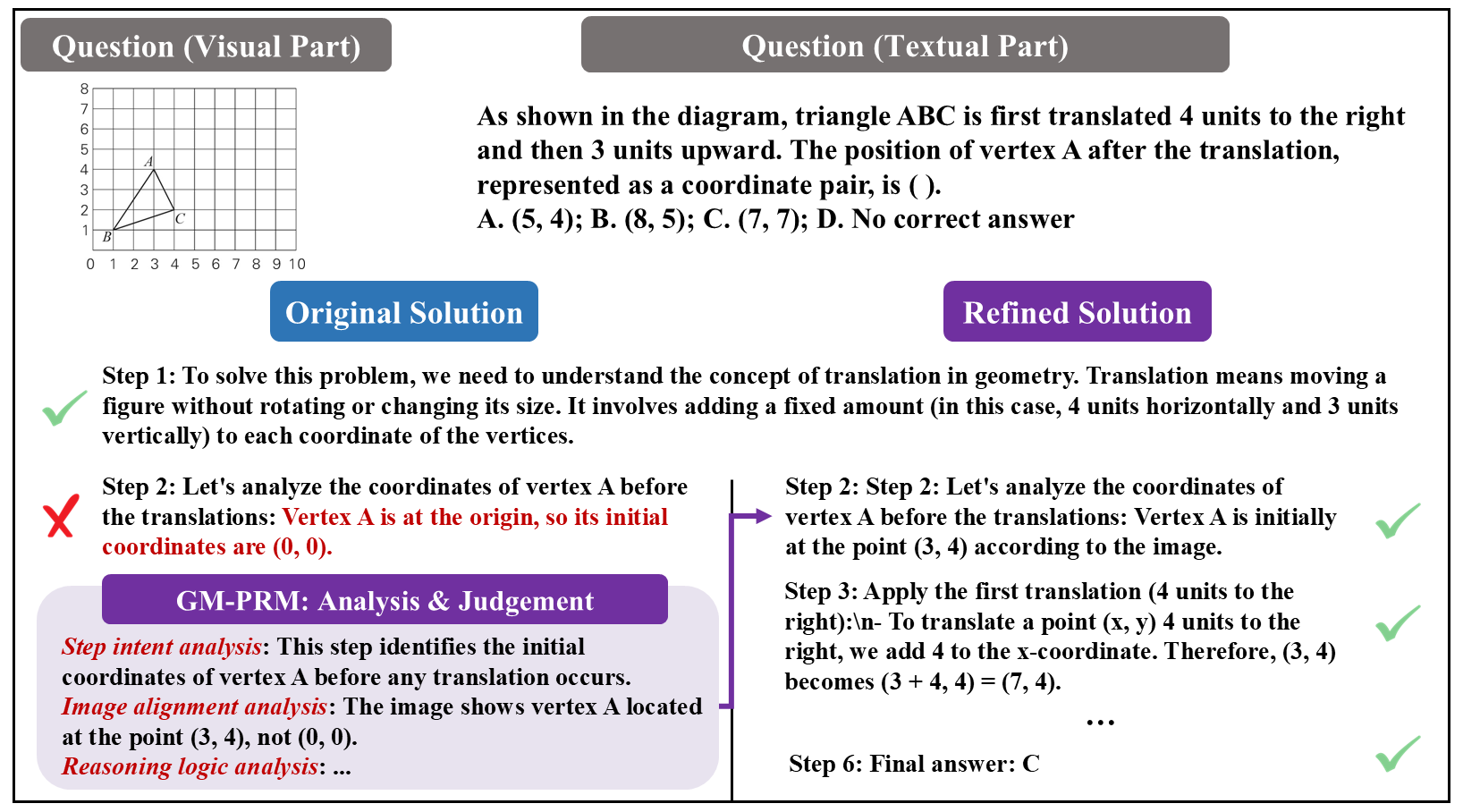
The image presents a geometry problem involving the translation of a triangle on a coordinate plane. It includes a visual representation of the triangle, the problem statement, and two proposed solutions: an "Original Solution" and a "Refined Solution." The image also contains an analysis and judgement section (GM-PRM) that evaluates the original solution.
### Components/Axes
* **Question (Visual Part):** A coordinate plane with x and y axes ranging from 0 to 10 and 0 to 8 respectively. Triangle ABC is plotted on the plane.
* Vertex A is located at (3, 4).
* Vertex B is located at (1, 1).
* Vertex C is located at (4, 2).
* **Question (Textual Part):** The problem statement describes a translation of triangle ABC: "As shown in the diagram, triangle ABC is first translated 4 units to the right and then 3 units upward. The position of vertex A after the translation, represented as a coordinate pair, is ( )."
* Multiple-choice options are provided:
* A. (5, 4)
* B. (8, 5)
* C. (7, 7)
* D. No correct answer
* **Original Solution:** A step-by-step solution that incorrectly identifies the initial coordinates of vertex A.
* Step 1: General statement about translation.
* Step 2: Incorrectly claims vertex A is at the origin (0, 0).
* **Refined Solution:** A step-by-step solution that correctly identifies the initial coordinates of vertex A and applies the translation.
* Step 2: Correctly identifies vertex A's initial coordinates as (3, 4).
* Step 3: Applies the translation of 4 units to the right, resulting in (7, 4).
* Step 6: States the final answer as C.
* **GM-PRM: Analysis & Judgement:** An analysis of the original solution.
* Step intent analysis: Identifies the initial coordinates of vertex A.
* Image alignment analysis: Correctly states that the image shows vertex A at (3, 4), not (0, 0).
* Reasoning logic analysis: Incomplete.
### Detailed Analysis or Content Details
* **Visual Part:** The coordinate plane provides a visual representation of the triangle's initial position. The grid lines are spaced at integer intervals.
* **Textual Part:** The problem statement clearly defines the translation to be performed.
* **Original Solution:** The error lies in Step 2, where it incorrectly assumes vertex A is at the origin.
* **Refined Solution:** The refined solution correctly identifies the initial coordinates and applies the translation. Adding 4 to the x-coordinate of (3, 4) results in (7, 4). Then adding 3 to the y-coordinate of (7, 4) results in (7, 7).
* **GM-PRM:** The analysis correctly identifies the error in the original solution's Step 2.
### Key Observations
* The "Original Solution" makes a fundamental error in identifying the initial coordinates of vertex A.
* The "Refined Solution" provides a correct step-by-step solution to the problem.
* The GM-PRM analysis accurately pinpoints the error in the "Original Solution."
### Interpretation
The image highlights the importance of accurately interpreting visual information in geometry problems. The "Original Solution" fails because it misidentifies the coordinates of vertex A on the coordinate plane. The "Refined Solution" demonstrates the correct application of translation principles. The GM-PRM analysis serves as a validation tool, confirming the error in the initial approach. The problem demonstrates a simple geometric translation, but emphasizes the need for careful observation and accurate application of geometric principles.