\n
## Geometry Problem: Translation of a Triangle
### Overview
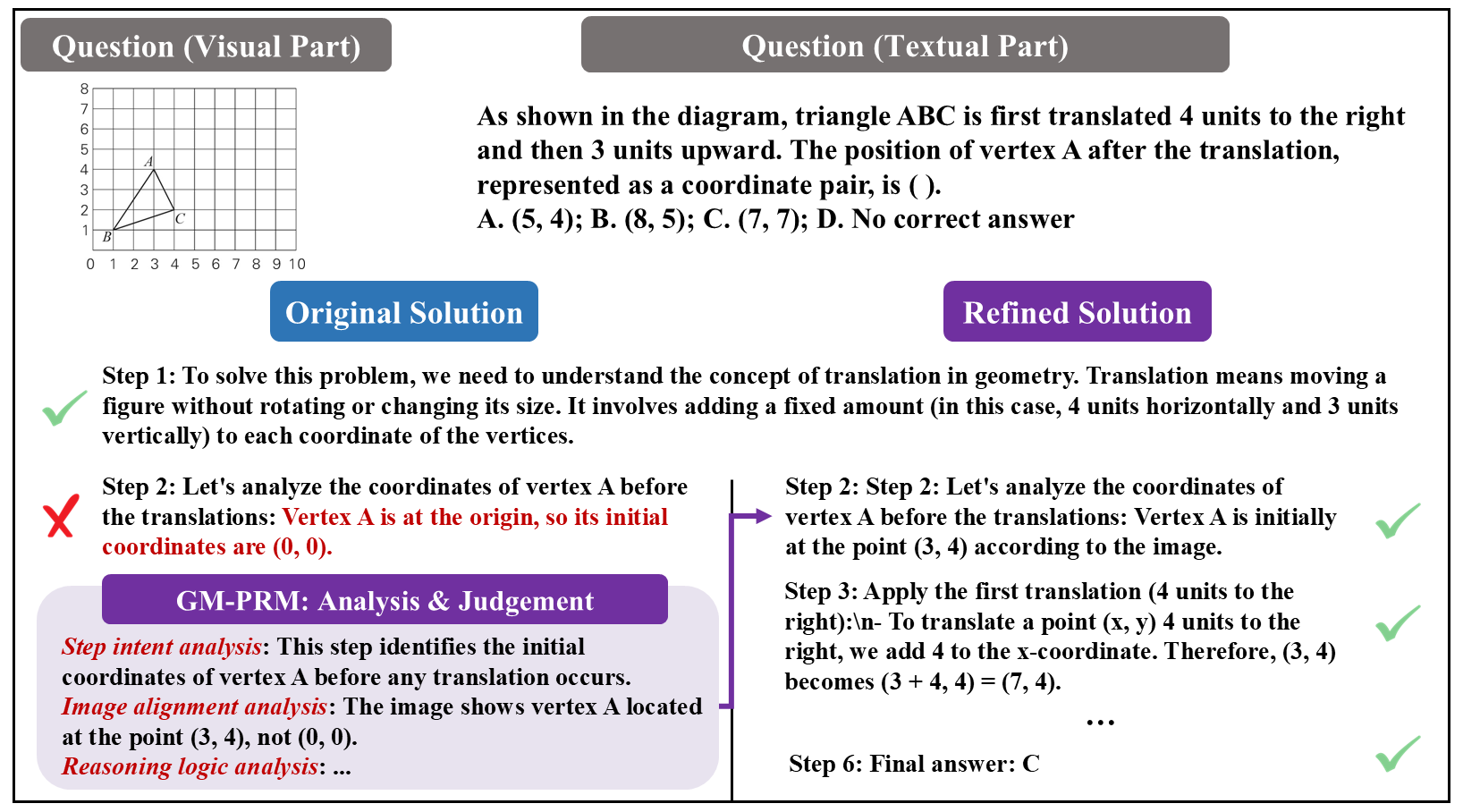
The image presents a geometry problem involving the translation of a triangle ABC on a coordinate plane. It includes a visual representation of the triangle and its translation, a textual problem statement with multiple-choice answers, an "Original Solution" with step-by-step explanations and feedback, and a "Refined Solution" with corrected steps. The image also features a section labeled "GM-PRM: Analysis & Judgement" providing meta-cognitive analysis of the solution steps.
### Components/Axes
* **Coordinate Plane:** X-axis ranges from 0 to 10, Y-axis ranges from 0 to 8.
* **Triangle ABC:** Vertices are approximately A(3,4), B(8,1), and C(1,1).
* **Translated Triangle:** The translated triangle has vertices approximately at A'(7,7), B'(12,4), and C'(5,4).
* **Problem Statement:** Textual description of the translation and question.
* **Multiple Choice Answers:** A. (5,4); B. (8,5); C. (7,7); D. No correct answer.
* **Original Solution:** Step-by-step solution with checkmarks and crosses indicating correctness.
* **Refined Solution:** Corrected step-by-step solution.
* **GM-PRM: Analysis & Judgement:** Meta-cognitive analysis of the solution steps.
### Detailed Analysis or Content Details
**1. Problem Statement:**
"As shown in the diagram, triangle ABC is first translated 4 units to the right and then 3 units upwards. The position of vertex A after the translation, represented as a coordinate pair is ()."
**2. Original Solution:**
* **Step 1:** "To solve this problem, we need to understand the concept of translation in geometry. Translation means moving a figure without rotating or changing its size. It involves adding a fixed amount (in this case, 4 units horizontally and 3 units vertically) to each coordinate of the vertices." - Marked with a green checkmark.
* **Step 2:** "Let's analyze the coordinates of vertex A before the translations: Vertex A is at the origin, so its initial coordinates are (0, 0)." - Marked with a red cross.
**3. Refined Solution:**
* **Step 2:** "Let's analyze the coordinates of vertex A before the translations: Vertex A is initially at the point (3, 4) according to the image." - Marked with a green checkmark.
* **Step 3:** "Apply the first translation (4 units to the right): x- To translate a point (x, y) 4 units to the right, we add 4 to the x-coordinate. Therefore, (3, 4) becomes (3 + 4, 4) = (7, 4)." - Marked with a green checkmark.
* **Step 6:** "Final answer: C"
**4. GM-PRM: Analysis & Judgement:**
* **Statement analysis:** "This step identifies the initial coordinates of vertex A before any translation occurs."
* **Image alignment analysis:** "The image shows vertex A located at the point (3, 4), not (0, 0)."
* **Reasoning logic analysis:** "..." (truncated)
**5. Coordinate Values (Approximate):**
* A: (3, 4)
* B: (8, 1)
* C: (1, 1)
* A': (7, 7)
* B': (12, 4)
* C': (5, 4)
### Key Observations
* The original solution incorrectly identified the initial coordinates of vertex A as (0,0) instead of (3,4).
* The refined solution correctly applies the translation rules to find the new coordinates of vertex A.
* The GM-PRM section provides valuable feedback on the reasoning process.
* The correct answer is C. (7,7).
### Interpretation
The image demonstrates a common geometry problem involving translations. The inclusion of both an incorrect and a corrected solution, along with the "GM-PRM" analysis, highlights the importance of careful observation and accurate application of mathematical principles. The problem tests the understanding of coordinate plane geometry and the concept of translation. The GM-PRM section is a novel approach to teaching problem-solving skills by explicitly analyzing the reasoning behind each step. The image serves as a learning tool, showcasing a common mistake and how to correct it. The visual representation of the triangle and its translation aids in understanding the concept. The problem is designed to assess the student's ability to translate a geometric figure and determine the new coordinates of its vertices. The error in the original solution emphasizes the importance of accurately reading the information presented in the diagram.