## [Diagram]: Geometry Translation Problem with Solution Analysis
### Overview
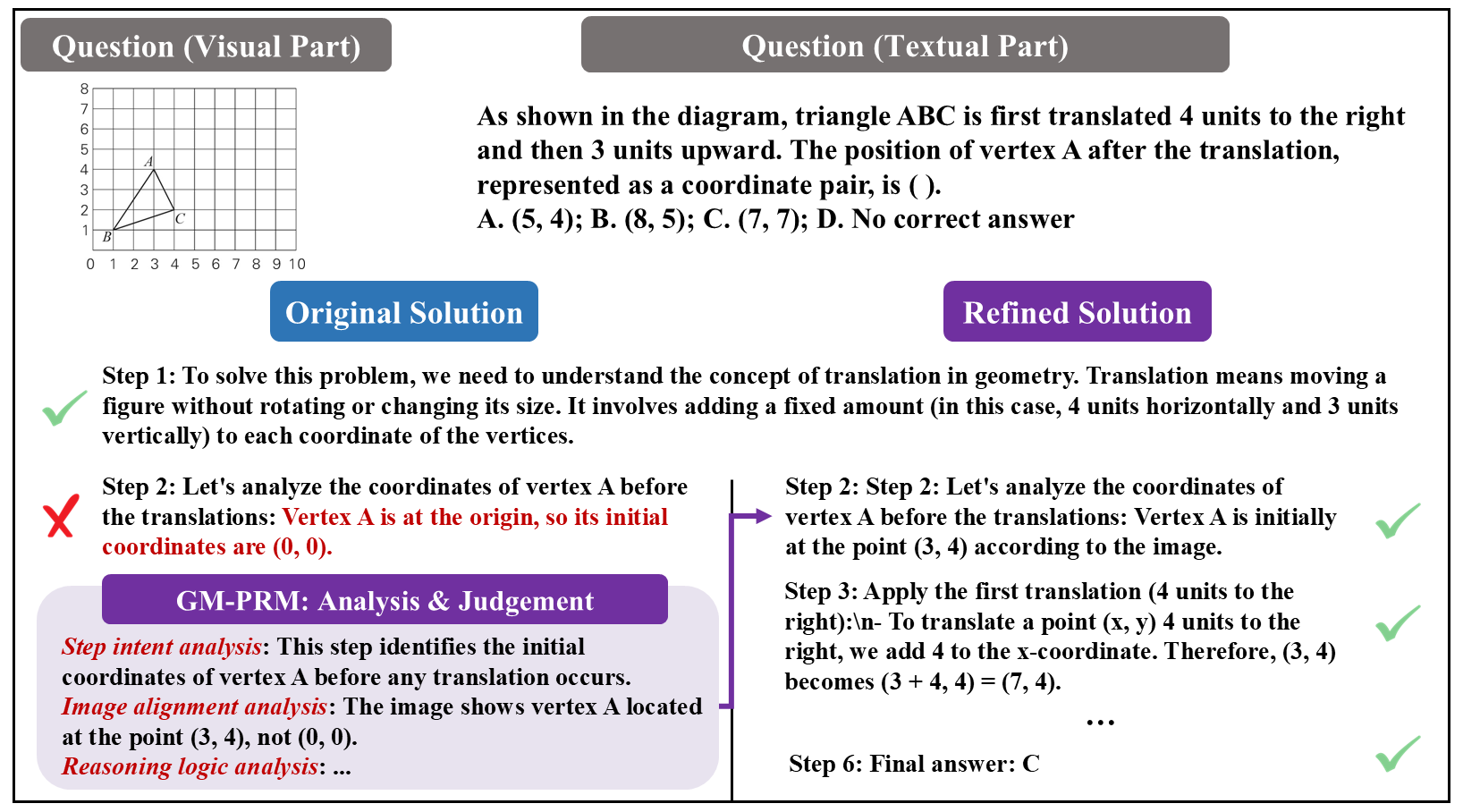
The image is an educational diagram presenting a geometry problem about translating a triangle on a coordinate plane. It includes the problem statement, a visual representation, and a comparative analysis of an incorrect ("Original") and a corrected ("Refined") solution path. The diagram is structured to highlight a common error in coordinate identification and the subsequent logical correction.
### Components/Axes
The image is segmented into several distinct regions:
1. **Header Section (Top):**
* **Left Box (Gray):** Labeled "Question (Visual Part)". Contains a coordinate grid.
* **Right Box (Gray):** Labeled "Question (Textual Part)". Contains the problem text.
2. **Problem Statement (Textual Part):**
* **Text:** "As shown in the diagram, triangle ABC is first translated 4 units to the right and then 3 units upward. The position of vertex A after the translation, represented as a coordinate pair, is ( )."
* **Multiple Choice Options:** "A. (5, 4); B. (8, 5); C. (7, 7); D. No correct answer"
3. **Visual Part (Coordinate Grid):**
* **Axes:** X-axis labeled from 0 to 10. Y-axis labeled from 0 to 8.
* **Triangle ABC:** Plotted on the grid.
* **Vertex A:** Located at coordinate **(3, 4)**.
* **Vertex B:** Located at coordinate **(1, 1)**.
* **Vertex C:** Located at coordinate **(4, 2)**.
* The triangle is drawn with solid lines connecting these points.
4. **Solution Comparison Section (Middle):**
* **Left Column (Blue Header):** "Original Solution".
* **Right Column (Purple Header):** "Refined Solution".
* **Annotations:** Green checkmarks (✓) indicate correct steps. A red cross (X) indicates an incorrect step.
5. **GM-PRM Analysis Box (Bottom Left, Purple Header):**
* **Title:** "GM-PRM: Analysis & Judgement".
* Contains three analysis points in red italic text.
### Detailed Analysis / Content Details
**Original Solution (Incorrect Path):**
* **Step 1 (✓):** "To solve this problem, we need to understand the concept of translation in geometry. Translation means moving a figure without rotating or changing its size. It involves adding a fixed amount (in this case, 4 units horizontally and 3 units vertically) to each coordinate of the vertices."
* **Step 2 (X):** "Let's analyze the coordinates of vertex A before the translations: **Vertex A is at the origin, so its initial coordinates are (0, 0).**" (This text is highlighted in red, indicating the error).
**GM-PRM: Analysis & Judgement (Error Diagnosis):**
* **Step intent analysis:** "This step identifies the initial coordinates of vertex A before any translation occurs."
* **Image alignment analysis:** "The image shows vertex A located at the point (3, 4), not (0, 0)."
* **Reasoning logic analysis:** "..." (The text trails off with an ellipsis).
**Refined Solution (Corrected Path):**
* **Step 2 (✓):** "Let's analyze the coordinates of vertex A before the translations: Vertex A is initially at the point (3, 4) according to the image."
* **Step 3 (✓):** "Apply the first translation (4 units to the right):\n- To translate a point (x, y) 4 units to the right, we add 4 to the x-coordinate. Therefore, (3, 4) becomes (3 + 4, 4) = (7, 4)."
* **Ellipsis (...):** Indicates omitted intermediate steps.
* **Step 6 (✓):** "Final answer: C" (This corresponds to option C. (7, 7)).
### Key Observations
1. **Critical Error Source:** The primary mistake in the original solution was misidentifying the initial coordinates of vertex A from the graph, assuming it was at the origin (0,0) instead of its actual plotted position (3,4).
2. **Visual-Textual Alignment:** The diagram emphasizes the necessity of cross-referencing textual problem statements with visual data (the graph) to obtain correct initial conditions.
3. **Pedagogical Structure:** The layout is designed for teaching, using color-coded headers (blue vs. purple), symbolic markers (✓/X), and a dedicated analysis box to dissect the reasoning flaw.
4. **Implied Final Calculation:** Although steps 4 and 5 are omitted (indicated by "..."), the final answer "C" implies the complete calculation: Starting at (3,4), translate right 4 → (7,4), then translate up 3 → (7,7).
### Interpretation
This diagram serves as a case study in mathematical problem-solving, specifically targeting the common pitfall of not accurately extracting information from a provided visual. It demonstrates a **Peircean investigative process**:
* **Abduction:** The original solver made an incorrect abductive leap, assuming vertex A was at the origin without verifying against the graph.
* **Deduction:** The refined solution correctly deduces the translation rule (add to coordinates) but only after establishing the correct premise (A is at (3,4)).
* **Induction:** The GM-PRM analysis inductively identifies the class of error ("Image alignment analysis") to prevent similar mistakes.
The underlying message is that in technical and mathematical reasoning, **the integrity of the initial data point is paramount**. A flawless logical process (Step 1 of the original solution) built upon a faulty premise (Step 2's error) will inevitably produce an incorrect result. The "Refined Solution" corrects the foundational premise, allowing the subsequent logical steps to yield the valid answer, (7,7). The diagram effectively argues for meticulousness in the initial "reading" of a problem, whether textual or visual.