\n
## Box Plot: NSGA-II with N=n+1 on LOTZ
### Overview
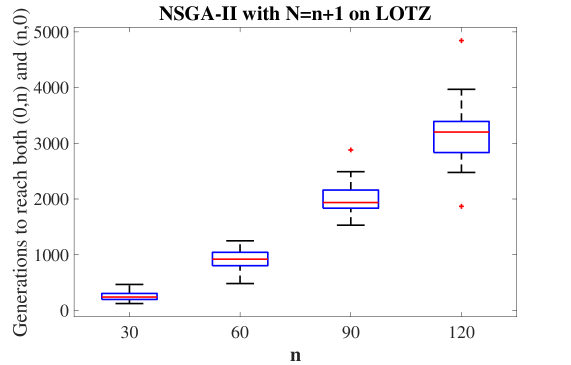
This image is a box plot chart illustrating the performance of the NSGA-II (Non-dominated Sorting Genetic Algorithm II) on the LOTZ (Leading Ones, Trailing Zeros) multi-objective optimization problem. The chart specifically measures the number of generations required for the algorithm to find both optimal points (0, n) and (n, 0) as the problem size `n` increases. The title "NSGA-II with N=n+1" suggests the population size `N` was set to `n+1` for each run.
### Components/Axes
* **Chart Title:** "NSGA-II with N=n+1 on LOTZ" (Top center).
* **X-Axis:**
* **Label:** "n" (Bottom center).
* **Categories/Markers:** Four discrete values: 30, 60, 90, 120.
* **Y-Axis:**
* **Label:** "Generations to reach both (0,n) and (n,0)" (Left side, rotated vertically).
* **Scale:** Linear scale from 0 to 5000, with major tick marks at intervals of 1000 (0, 1000, 2000, 3000, 4000, 5000).
* **Legend:** Not present. The chart contains a single data series represented by box plots.
* **Data Series:** Four box plots, one for each value of `n`. Each box plot is blue with a red median line. Outliers are marked with red '+' symbols.
### Detailed Analysis
The chart displays the distribution of the number of generations (a measure of computational effort) over multiple runs of the algorithm for each problem size `n`.
**For n = 30:**
* **Trend:** The distribution is very low and compact.
* **Data Points (Approximate):**
* Median (red line): ~200 generations.
* Interquartile Range (IQR, blue box): ~100 to ~300 generations.
* Whiskers (black dashed lines): Extend from ~50 to ~500 generations.
* Outliers: None visible.
**For n = 60:**
* **Trend:** The distribution shifts upward and spreads out compared to n=30.
* **Data Points (Approximate):**
* Median: ~900 generations.
* IQR: ~750 to ~1050 generations.
* Whiskers: Extend from ~500 to ~1250 generations.
* Outliers: None visible.
**For n = 90:**
* **Trend:** The distribution continues to shift upward and spread further.
* **Data Points (Approximate):**
* Median: ~1950 generations.
* IQR: ~1750 to ~2150 generations.
* Whiskers: Extend from ~1500 to ~2500 generations.
* Outliers: One outlier at approximately 2900 generations (red '+' above the top whisker).
**For n = 120:**
* **Trend:** The distribution shows the highest median and the largest spread.
* **Data Points (Approximate):**
* Median: ~3200 generations.
* IQR: ~2900 to ~3400 generations.
* Whiskers: Extend from ~2500 to ~4000 generations.
* Outliers: Two outliers visible. One at approximately 1900 generations (below the bottom whisker) and one at approximately 4800 generations (above the top whisker).
### Key Observations
1. **Clear Positive Correlation:** There is a strong, positive, and seemingly non-linear relationship between the problem size `n` and the median number of generations required. As `n` increases, the computational effort increases substantially.
2. **Increasing Variance:** The spread of the data (IQR and whisker length) increases with `n`. This indicates that the algorithm's performance becomes more variable and less predictable for larger problem instances.
3. **Presence of Outliers:** Outliers appear at `n=90` and `n=120`, suggesting that while most runs follow a trend, occasional runs can be significantly faster or slower than typical.
4. **Scalability Indicator:** The plot visually demonstrates the scalability challenge of the NSGA-II algorithm (with population size N=n+1) on the LOTZ problem. The growth in required generations appears to be super-linear.
### Interpretation
This box plot provides a statistical summary of algorithmic performance, moving beyond simple averages to show the distribution of outcomes. The data suggests that the LOTZ problem becomes exponentially harder for the NSGA-II algorithm as the problem dimension `n` grows. The increasing median reflects the growing difficulty, while the increasing variance indicates that the algorithm's reliability decreases with scale—some runs get "lucky" and find the optima quickly (lower outliers), while others struggle significantly (upper outliers).
From a Peircean investigative perspective, this chart is an **index** of computational cost. It points directly to the relationship between problem scale and resource consumption. The **iconic** representation (the box plots) allows for immediate visual comparison of distributions. The underlying **symbolic** knowledge (understanding NSGA-II and LOTZ) is required to interpret *why* this trend exists: the search space grows combinatorially with `n`, making it harder for the algorithm to locate the specific, disconnected optimal points (0,n) and (n,0).
**Notable Anomaly:** The outlier at ~1900 generations for `n=120` is particularly interesting. It represents a run that performed as well as the *median* run for `n=90`, despite the problem being larger. This could be due to favorable random initialization or a lucky sequence of genetic operations, highlighting the stochastic nature of the algorithm.