## 3D Model Diagram: Annotated Infant Pose
### Overview
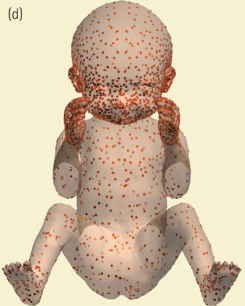
The image depicts a 3D-rendered model of an infant in a seated position. The model is covered with numerous small red dots distributed across its surface. The infant is oriented with its back facing the viewer, legs spread apart, and hands raised near the face. The background is a plain, light beige color. A label "(d)" is visible in the top-left corner of the image.
### Components/Axes
- **Primary Elements**:
- 3D infant model (neutral pose, seated).
- Red dot markers (distributed across the entire body).
- Label "(d)" in the top-left corner.
- **Axes/Scales**:
- No explicit axes, scales, or numerical markers present.
- No legend or key explaining the red dots.
- **Spatial Grounding**:
- Label "(d)" is positioned in the top-left corner, outside the main model.
- Red dots are uniformly distributed across the model’s surface, with no apparent pattern or clustering.
### Detailed Analysis
- **Model Features**:
- The infant’s posture is anatomically neutral: legs spread, hands near the face, and a relaxed torso.
- Red dots are evenly spaced but vary slightly in density, with higher concentrations near joints (e.g., knees, elbows) and the head.
- **Textual Elements**:
- Only the label "(d)" is present, with no additional annotations, legends, or textual descriptions.
- No numerical values, categories, or data tables are visible.
### Key Observations
1. The red dots likely represent tracking markers or data points for motion analysis, but their purpose is undefined due to the absence of a legend.
2. The model’s pose suggests a focus on posture or movement study, though no motion data is visually represented.
3. The lack of contextual elements (e.g., environment, scale references) limits interpretability.
### Interpretation
The image appears to be a placeholder or template for a motion-capture or biomechanical study. The red dots may correspond to sensor placements for tracking joint angles or body movements, but without a legend or accompanying data, their exact function remains speculative. The neutral pose and absence of dynamic elements suggest the model is intended for baseline analysis rather than active motion study. The label "(d)" implies this is part of a series (e.g., panels a-d), but no other panels are provided for cross-reference.
**Note**: No factual or numerical data is present in the image. The description is limited to visible structural and positional details.