## Bar Chart: Counts by Methodological Category and Approach
### Overview
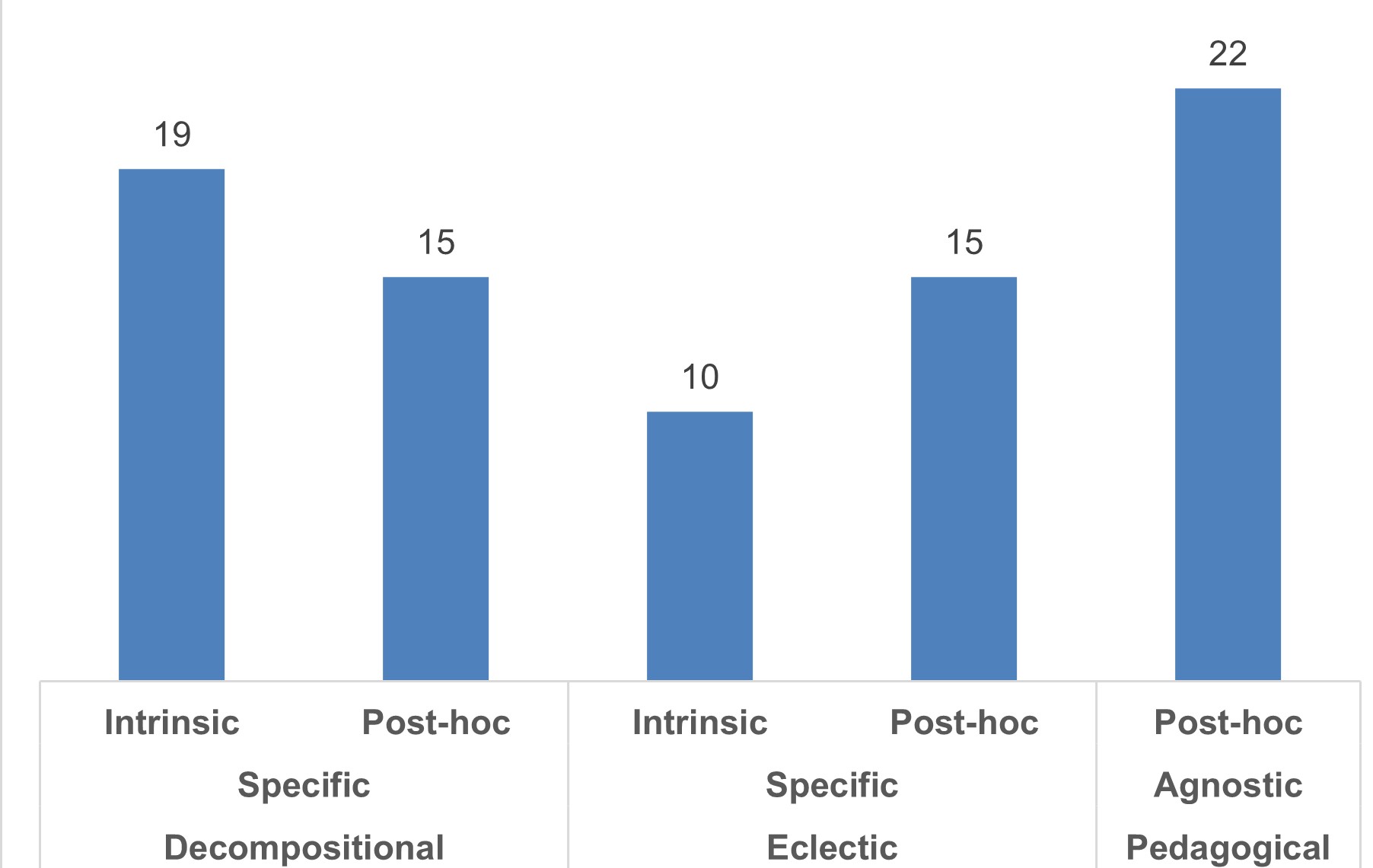
This is a vertical bar chart displaying numerical counts for five distinct categories. The categories are grouped into three broader methodological frameworks, as indicated by the labels on the x-axis. Each bar is annotated with its exact numerical value at the top.
### Components/Axes
* **X-Axis (Categorical):** The axis is divided into three main sections, each containing one or two sub-categories. The labels are arranged in a hierarchical, multi-line format.
* **Section 1 (Left):** "Specific Decompositional"
* Sub-category 1: "Intrinsic"
* Sub-category 2: "Post-hoc"
* **Section 2 (Center):** "Specific Eclectic"
* Sub-category 1: "Intrinsic"
* Sub-category 2: "Post-hoc"
* **Section 3 (Right):** "Agnostic Pedagogical"
* Sub-category 1: "Post-hoc"
* **Y-Axis (Numerical):** The vertical axis represents a count or frequency. While the axis line and scale markers are not visible, the numerical values are explicitly labeled on top of each bar, providing precise data points. The scale appears to range from 0 to at least 22.
* **Legend:** There is no separate legend. The categories are defined solely by the x-axis labels.
* **Data Series:** There is a single data series represented by blue bars. All bars are the same color.
### Detailed Analysis
The chart presents the following data points, listed from left to right:
1. **Bar 1 (Far Left):**
* **Category:** Intrinsic (under Specific Decompositional)
* **Value:** 19
* **Visual Trend:** This is the second-tallest bar in the chart.
2. **Bar 2:**
* **Category:** Post-hoc (under Specific Decompositional)
* **Value:** 15
* **Visual Trend:** This bar is shorter than the "Intrinsic" bar within the same "Specific Decompositional" group.
3. **Bar 3 (Center):**
* **Category:** Intrinsic (under Specific Eclectic)
* **Value:** 10
* **Visual Trend:** This is the shortest bar in the entire chart.
4. **Bar 4:**
* **Category:** Post-hoc (under Specific Eclectic)
* **Value:** 15
* **Visual Trend:** This bar is taller than the "Intrinsic" bar within the same "Specific Eclectic" group and is equal in height to the "Post-hoc" bar in the "Specific Decompositional" group.
5. **Bar 5 (Far Right):**
* **Category:** Post-hoc (under Agnostic Pedagogical)
* **Value:** 22
* **Visual Trend:** This is the tallest bar in the chart.
### Key Observations
* **Highest Value:** The "Post-hoc" approach within the "Agnostic Pedagogical" framework has the highest count (22).
* **Lowest Value:** The "Intrinsic" approach within the "Specific Eclectic" framework has the lowest count (10).
* **Intra-Group Comparison:**
* In the **"Specific Decompositional"** group, the "Intrinsic" approach (19) has a higher count than the "Post-hoc" approach (15).
* In the **"Specific Eclectic"** group, the pattern reverses: the "Post-hoc" approach (15) has a higher count than the "Intrinsic" approach (10).
* **Inter-Group Comparison:** The "Post-hoc" approach appears in three different frameworks with varying counts: 15 (Specific Decompositional), 15 (Specific Eclectic), and 22 (Agnostic Pedagogical).
### Interpretation
The data suggests a comparison of the frequency or application of different methodological approaches ("Intrinsic" vs. "Post-hoc") across three broader frameworks ("Specific Decompositional," "Specific Eclectic," and "Agnostic Pedagogical").
* **Framework Dominance:** The "Agnostic Pedagogical" framework, represented by a single "Post-hoc" category, shows the highest overall count, indicating it may be the most prevalent or frequently cited method in the context this data represents.
* **Approach Preference:** There is no universal preference for "Intrinsic" or "Post-hoc" approaches. The preference is contingent on the broader methodological framework. "Intrinsic" is favored within "Specific Decompositional" methods, while "Post-hoc" is favored within "Specific Eclectic" methods and is the sole approach shown for "Agnostic Pedagogical" methods.
* **Notable Anomaly:** The "Specific Eclectic" framework shows the largest disparity between its two approaches (10 vs. 15), suggesting a stronger leaning towards post-hoc methods within that eclectic context compared to the decompositional context.
* **Potential Implication:** If this chart represents, for example, the number of research studies or models using these approaches, it implies that post-hoc methods are more commonly applied in pedagogical and eclectic settings, while intrinsic methods are more common in decompositional settings. The high count for "Post-hoc Agnostic Pedagogical" could signal a trend towards flexible, outcome-oriented methods in educational or general-purpose applications.