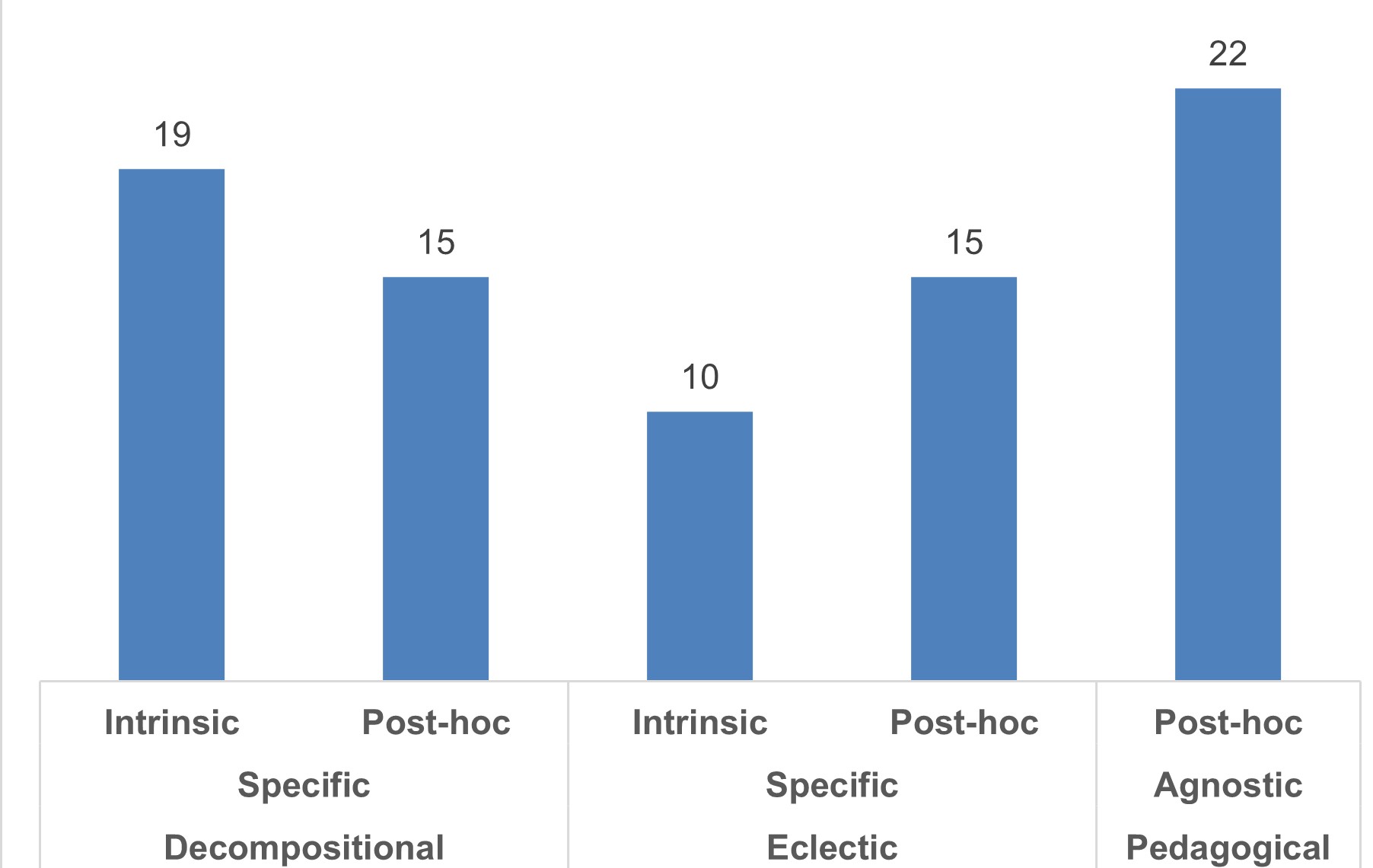
## Bar Chart: Distribution of Papers by Approach Type and Specificity
### Overview
The chart displays a comparative analysis of academic papers categorized by two dimensions:
1. **Approach Type** (Intrinsic vs. Post-hoc)
2. **Specificity** (Specific vs. Agnostic)
Values represent the number of papers in each category, with a clear emphasis on Post-hoc approaches showing higher counts.
---
### Components/Axes
- **X-Axis (Categories)**:
- Intrinsic (Specific, Decompositional)
- Post-hoc (Specific, Agnostic, Pedagogical)
- **Y-Axis (Values)**: "Number of Papers" (quantitative scale)
- **Legend**:
- **Blue**: Specific
- **Gray**: Agnostic
- Positioned at the bottom-right corner.
---
### Detailed Analysis
1. **Intrinsic Approach**:
- **Specific (Decompositional)**: 19 papers (blue bar).
- **Agnostic (Eclectic)**: 10 papers (gray bar).
2. **Post-hoc Approach**:
- **Specific**: 15 papers (blue bar).
- **Agnostic (Pedagogical)**: 22 papers (gray bar).
---
### Key Observations
- **Post-hoc dominance**: Post-hoc approaches outnumber Intrinsic in both Specific (15 vs. 19) and Agnostic (22 vs. 10) categories.
- **Agnostic surge**: Agnostic papers (22) significantly exceed Intrinsic-Agnostic (10), suggesting a trend toward broader applicability.
- **Specificity trade-off**: Specific approaches (19 + 15 = 34) still outnumber Agnostic (10 + 22 = 32), but the gap narrows.
---
### Interpretation
1. **Post-hoc prevalence**: The higher counts for Post-hoc (37 total) vs. Intrinsic (29) suggest a research preference for methods that operate after the fact, possibly due to practical applicability or ease of implementation.
2. **Agnostic growth**: The 22 Agnostic papers (Post-hoc) indicate a shift toward generalizable frameworks, potentially reflecting industry demands for adaptable solutions.
3. **Specificity balance**: While Specific approaches remain dominant, the Agnostic category’s rapid growth (10 → 22) signals emerging interest in cross-domain methodologies.
**Notable Outlier**: The 22 Agnostic Post-hoc papers stand out as the highest value, suggesting a potential inflection point in research focus.