## Flow Diagram: Task Execution with Reflection
### Overview
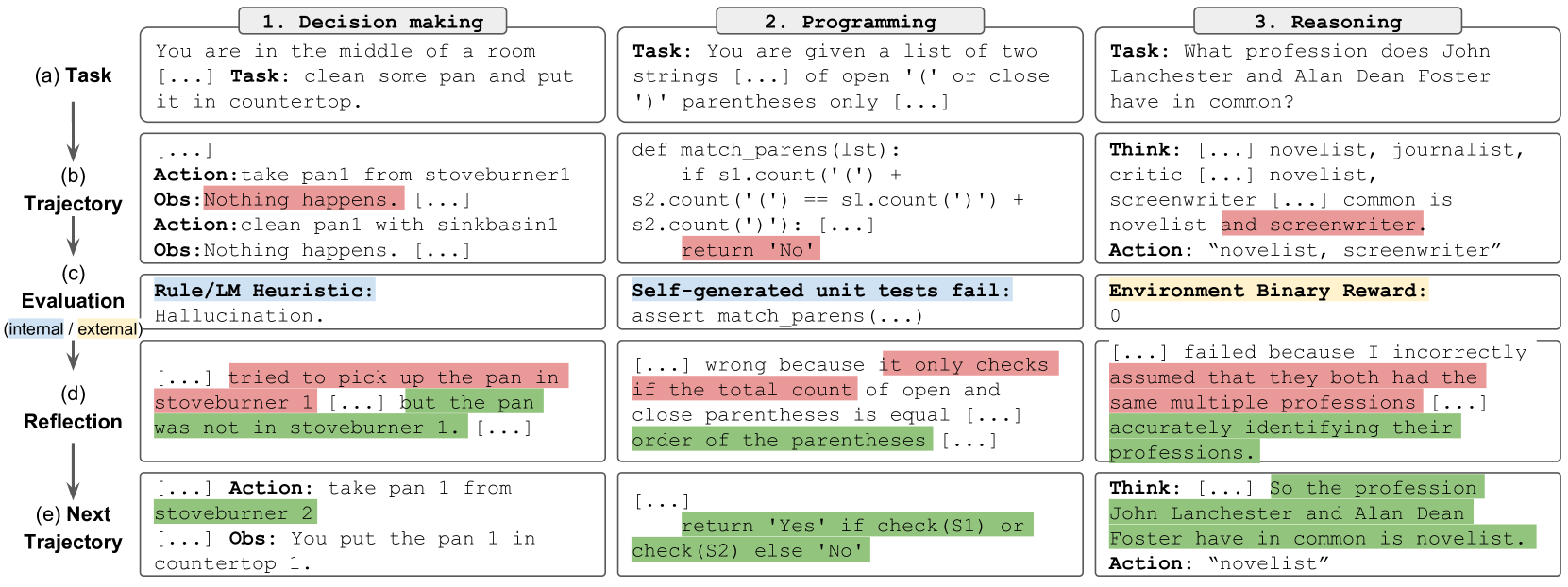
The image presents a flow diagram illustrating task execution with reflection, across three different task domains: Decision making, Programming, and Reasoning. The diagram highlights the iterative process of task execution, observation, evaluation, reflection, and subsequent trajectory adjustment.
### Components/Axes
* **Nodes**: The diagram uses nodes to represent different stages in the task execution process. These stages are labeled (a) Task, (b) Trajectory, (c) Evaluation, (d) Reflection, and (e) Next Trajectory.
* **Flow Direction**: Arrows indicate the flow of the process from Task to Trajectory, Evaluation, Reflection, and finally Next Trajectory.
* **Task Domains**: The diagram is divided into three columns, each representing a different task domain:
* Column 1: Decision making
* Column 2: Programming
* Column 3: Reasoning
* **Node Content**: Each node contains textual information describing the state, action, observation, evaluation, or reflection relevant to the specific task domain.
* **Color Coding**: Text within the nodes is highlighted with colors, including red, green, and light blue. The colors appear to signify different aspects of the information, such as errors (red) and confirmations (green).
* **Evaluation Labels**: The labels "(internal / external)" for the evaluation stage, and "Rule/LM Heuristic", "Self-generated unit tests fail:", and "Environment Binary Reward:" respectively.
### Detailed Analysis
**Decision Making (Column 1)**
* **(a) Task**: "You are in the middle of a room [...] Task: clean some pan and put it in countertop."
* **(b) Trajectory**:
* "Action: take panl from stoveburner1"
* "Obs: Nothing happens. [...]"
* "Action: clean panl with sinkbasinl"
* "Obs: Nothing happens. [...]"
* **(c) Evaluation**: "Rule/LM Heuristic: Hallucination."
* **(d) Reflection**: "[...] tried to pick up the pan in stoveburner 1 [...] but the pan was not in stoveburner 1. [...]" (The phrases "tried to pick up the pan in stoveburner 1" is highlighted in red, and "was not in stoveburner 1" is highlighted in green).
* **(e) Next Trajectory**:
* "Action: take pan 1 from stoveburner 2" (The phrase "stoveburner 2" is highlighted in green).
* "Obs: You put the pan 1 in countertop 1."
**Programming (Column 2)**
* **(a) Task**: "Task: You are given a list of two strings [...] of open '(' or close ')' parentheses only [...]"
* **(b) Trajectory**:
```
def match_parens (1st):
if sl.count('(') +
s2.count('(') == s1.count(')') +
s2.count(')'): [...]
return 'No'
```
* **(c) Evaluation**: "Self-generated unit tests fail: assert match_parens(...)"
* **(d) Reflection**: "[...] wrong because it only checks if the total count of open and close parentheses is equal [...] order of the parentheses [...]" (The phrase "wrong because it only checks if the total count of open and close parentheses is equal" is highlighted in red, and "order of the parentheses" is highlighted in green).
* **(e) Next Trajectory**:
* "[...] return 'Yes' if check(S1) or check(S2) else 'No'" (The phrase "Yes" is highlighted in green, and "No" is highlighted in red).
**Reasoning (Column 3)**
* **(a) Task**: "Task: What profession does John Lanchester and Alan Dean Foster have in common?"
* **(b) Trajectory**: "Think: [...] novelist, journalist, critic [...] novelist, screenwriter [...] common is novelist and screenwriter. Action: 'novelist, screenwriter'" (The phrase "novelist and screenwriter" is highlighted in red).
* **(c) Evaluation**: "Environment Binary Reward: 0"
* **(d) Reflection**: "[...] failed because I incorrectly assumed that they both had the same multiple professions [...] accurately identifying their professions." (The phrases "failed because I incorrectly assumed that they both had the same multiple professions" is highlighted in red, and "accurately identifying their professions" is highlighted in green).
* **(e) Next Trajectory**: "Think: [...] So the profession John Lanchester and Alan Dean Foster have in common is novelist. Action: 'novelist'" (The phrase "John Lanchester and Alan Dean Foster have in common is novelist" is highlighted in green).
### Key Observations
* The diagram illustrates a closed-loop system where the outcome of an action is evaluated, and this evaluation informs subsequent actions.
* Each task domain demonstrates a different type of challenge and reflection.
* The color coding highlights errors (red) and correct deductions/actions (green).
* The evaluation stage provides a metric or heuristic for assessing the outcome of the trajectory.
### Interpretation
The diagram demonstrates a generalized problem-solving approach applicable across diverse domains. It emphasizes the importance of reflection and iterative refinement in achieving a desired outcome. The examples provided highlight how different types of errors can occur (hallucination in decision-making, logic errors in programming, incorrect assumptions in reasoning) and how these errors can be identified and corrected through reflection and subsequent adjustments to the trajectory. The diagram underscores the cyclical nature of learning and problem-solving, where each iteration builds upon previous experiences and leads to improved performance.