## Diagram: State Transition Flowchart
### Overview
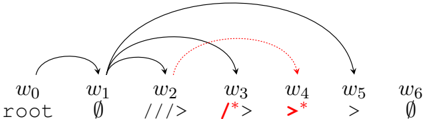
The image depicts a directed graph with seven nodes (`w0` to `w6`) connected by arrows. Nodes are labeled with identifiers and symbols, suggesting a state machine or process flow. Arrows indicate transitions, with some marked as optional (dashed lines) or mandatory (solid lines).
### Components/Axes
- **Nodes**:
- `w0`: Labeled "root" (starting point).
- `w1`: Symbol `∅` (empty set, possibly representing a null/terminated state).
- `w2`: Symbol `////>` (sequence of slashes, likely a path or delimiter).
- `w3`: Symbol `/*>` (wildcard or conditional transition).
- `w4`: Symbol `>*` (postfix wildcard).
- `w5`: Symbol `>` (simple transition).
- `w6`: Symbol `∅` (mirroring `w1`, possibly a terminal state).
- **Arrows**:
- Solid arrows: Mandatory transitions (e.g., `w0 → w1`, `w1 → w2`).
- Dashed arrows: Optional/alternative paths (e.g., `w2 → w3`, `w3 → w4`).
- **Legend**: No explicit legend, but symbols (`∅`, `////>`, `/*>`, `>*`, `>`) likely encode transition rules.
### Detailed Analysis
1. **Node Labels and Symbols**:
- `w0` (root) initiates the flow.
- `w1` (`∅`) may represent an empty or invalid state.
- `w2` (`////>`) could denote a path traversal or delimiter.
- `w3` (`/*>`) and `w4` (`>*`) suggest wildcard or conditional logic.
- `w5` (`>`) is a generic transition.
- `w6` (`∅`) mirrors `w1`, possibly a terminal state.
2. **Transition Flow**:
- The primary path follows `w0 → w1 → w2 → w3 → w4 → w5 → w6`.
- Dashed arrows (`w2 → w3`, `w3 → w4`) imply optional branches.
- No cycles or loops are present; the flow is linear with optional deviations.
### Key Observations
- The diagram lacks numerical data but emphasizes symbolic transitions.
- The use of `∅` at `w1` and `w6` suggests start/end states or error conditions.
- Wildcard symbols (`/*>`, `>*`) indicate flexibility in transitions.
### Interpretation
This flowchart likely models a state machine or process with conditional logic. The root (`w0`) progresses through states, with optional paths (`w2 → w3`, `w3 → w4`) allowing deviations. The terminal state (`w6`) mirrors the initial `∅` state (`w1`), possibly indicating a reset or failure condition. The symbols (`////>`, `/*>`, `>*`) may represent specific operations (e.g., path traversal, wildcard matching) critical to the system’s behavior.
**Note**: No numerical values or explicit data points are present; the diagram focuses on symbolic relationships and flow logic.