## Maze and Sokoban Puzzle Solutions
### Overview
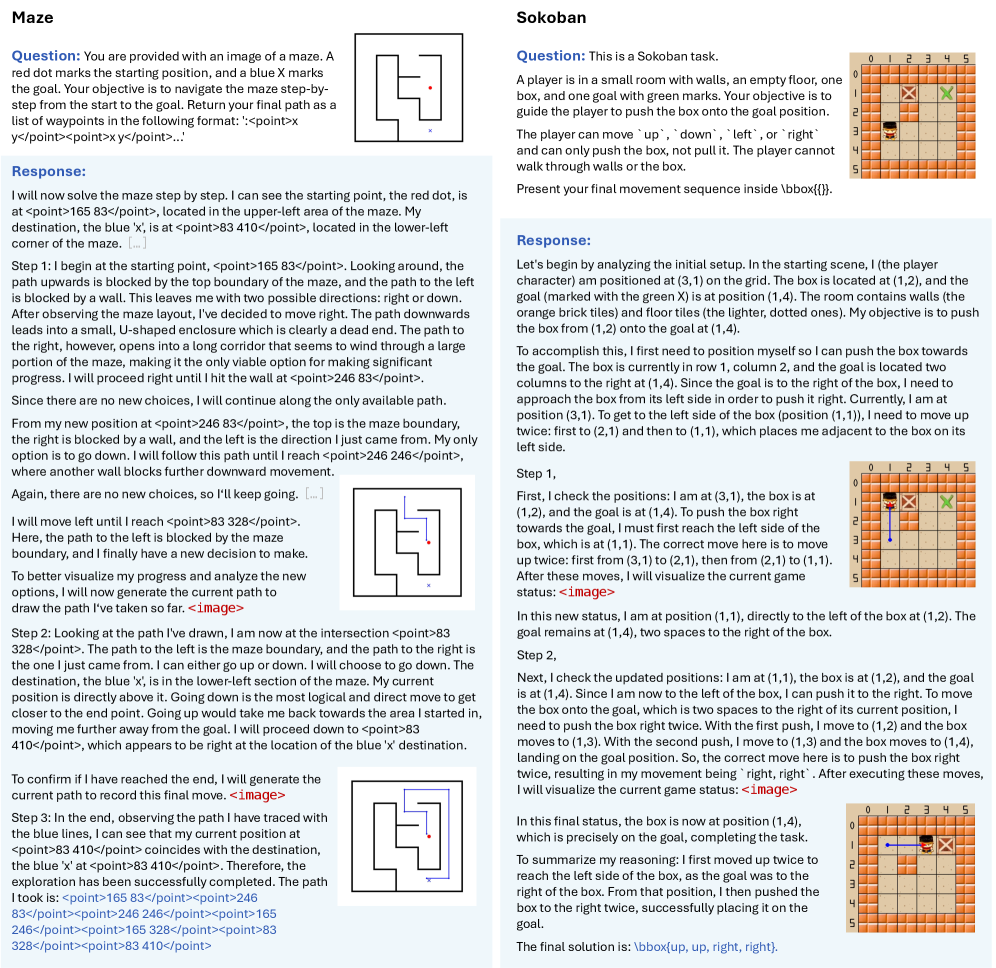
The image presents solutions to two different puzzles: a maze and a Sokoban puzzle. The maze solution involves finding a path from a red dot to a blue 'X', while the Sokoban solution involves pushing a box onto a goal position in a grid-based environment.
### Components/Axes
**Maze:**
* **Starting Point:** Marked by a red dot. Located in the upper-left area of the maze.
* **Goal:** Marked by a blue 'X'. Located in the lower-left corner of the maze.
* **Maze Structure:** Consists of paths and walls.
**Sokoban:**
* **Player:** Represented by a character. Starts at position (3,1).
* **Box:** Starts at position (1,2).
* **Goal:** Marked with green 'X's. Located at position (1,4).
* **Grid:** A 5x6 grid (0-4 on x-axis, 0-5 on y-axis) representing the room.
* **Walls:** Represented by orange brick tiles.
* **Floor:** Represented by lighter, dotted tiles.
### Detailed Analysis or ### Content Details
**Maze Solution:**
The solution is presented as a series of steps, with the path described textually and visually. The path is also given as a list of waypoints:
* <point>165 83</point>
* <point>246 83</point>
* <point>246 246</point>
* <point>165 246</point>
* <point>165 328</point>
* <point>83 328</point>
* <point>83 410</point>
**Sokoban Solution:**
The solution is presented in two steps:
* **Step 1:** The player moves up twice from (3,1) to (1,1) to get to the left side of the box.
* **Step 2:** The player pushes the box right twice from (1,2) to (1,4), landing on the goal position.
The final solution is given as a sequence of moves: \bbox{up, up, right, right}.
### Key Observations
* The maze solution is described in detail, with each step explained.
* The Sokoban solution is concise, focusing on the key moves required to solve the puzzle.
* The images accompanying the solutions provide visual confirmation of the steps taken.
### Interpretation
The image demonstrates the solutions to two different types of puzzles. The maze solution highlights the process of navigating a complex path, while the Sokoban solution demonstrates strategic planning to manipulate objects in a constrained environment. The combination of textual descriptions and visual aids makes the solutions easy to understand.