## Screenshot: AI Problem-Solving Dialogue
### Overview
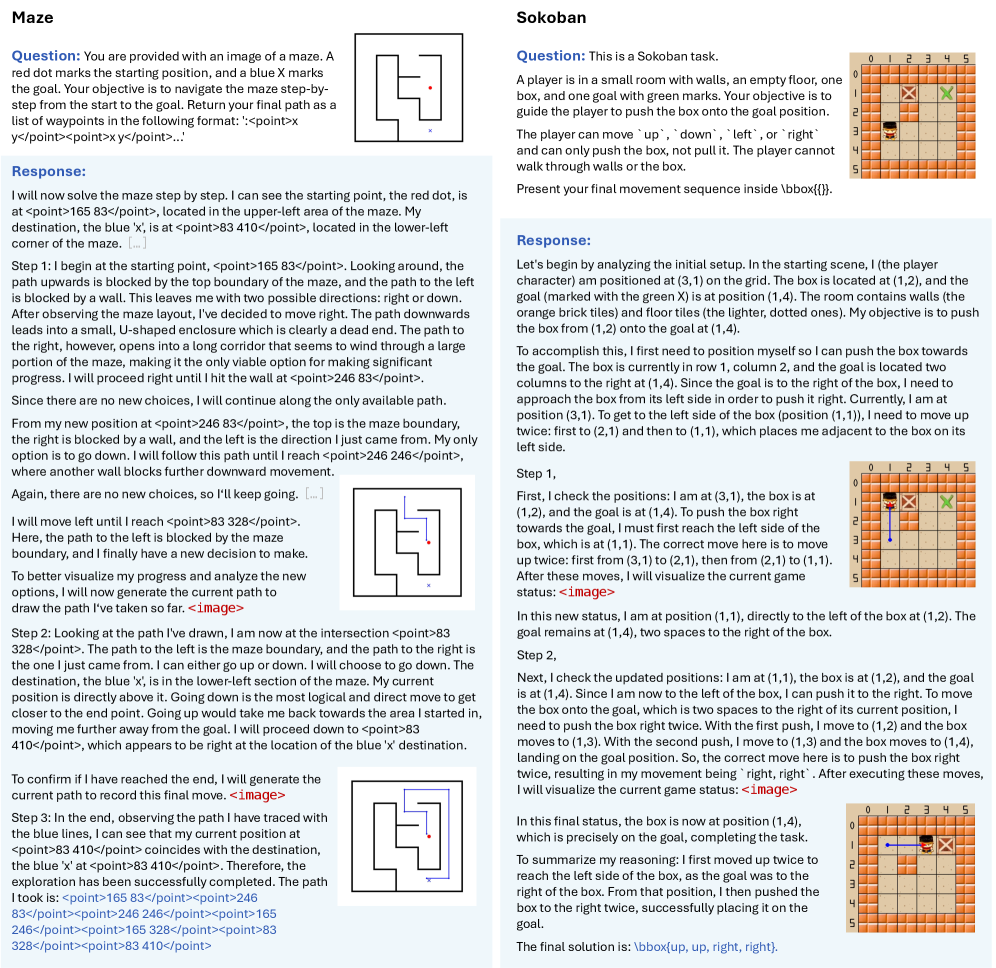
The image shows a technical dialogue between a user and an AI assistant solving two distinct problems:
1. **Maze Navigation**: Finding a path from a red dot (start) to a blue X (goal) in a grid.
2. **Sokoban Puzzle**: Pushing a box to a goal position in a grid with walls and obstacles.
Both responses include step-by-step reasoning, positional coordinates, and code-like sequences representing movements.
---
### Components/Axes
#### Maze Section
- **Question**:
- Task: Navigate a maze from a red dot (start) to a blue X (goal).
- Input: Grid with walls (blocked paths), start (red dot), and goal (blue X).
- Output: List of waypoints in format `:x/y/<point>x y/<point>y...`.
- **Response**:
- Step-by-step pathfinding using coordinate analysis (e.g., `point=165 83`, `point=246 83`).
- Code-like sequences (e.g., `bbx[up, up, right]`) to represent movements.
- Visualizations of maze progress (e.g., `image` tags for path diagrams).
#### Sokoban Section
- **Question**:
- Task: Push a box (marked `X`) to a goal (marked `O`) in a grid with walls (`#`) and floor tiles (`.`).
- Constraints: Player can only push the box, not pull it.
- Output: Sequence of movements in format `bbx[direction1, direction2, ...]`.
- **Response**:
- Step-by-step analysis of player and box positions (e.g., `(3,1)`, `(1,2)`).
- Code-like sequences (e.g., `bbx[up, up, right]`) to represent pushes.
- Visualizations of grid states (e.g., `image` tags for grid snapshots).
---
### Detailed Analysis
#### Maze Solution
1. **Start**: Red dot at `(165, 83)`.
2. **Path**:
- Move right to `(246, 83)` (blocked above, left, and below).
- Move down to `(246, 246)` (blocked left and right).
- Move down to `(246, 328)` (blocked left).
- Move left to `(83, 328)` (blocked left and below).
- Move down to `(83, 410)` (goal reached).
3. **Final Path**: `bbx[right, right, down, down, left, down]`.
#### Sokoban Solution
1. **Initial State**:
- Player at `(3,1)`, box at `(1,2)`, goal at `(1,4)`.
2. **Steps**:
- **Step 1**: Move left to `(2,1)`, then up to `(1,1)`.
- **Step 2**: Push box right twice to `(1,4)` (goal).
3. **Final Sequence**: `bbx[up, up, right]`.
---
### Key Observations
1. **Maze**:
- The AI uses coordinate tracking to navigate blocked paths.
- The final path avoids dead ends by prioritizing open corridors.
2. **Sokoban**:
- The AI calculates box movements by analyzing player proximity and grid constraints.
- The solution requires precise sequencing to avoid blocking the box.
3. **Code Sequences**:
- Both responses use `bbx[]` syntax to encode movements, suggesting a domain-specific language for pathfinding.
---
### Interpretation
- **Problem-Solving Methodology**:
The AI breaks down complex spatial problems into discrete steps, using positional coordinates and grid constraints to guide decisions.
- **Code Representation**:
The `bbx[]` syntax likely represents a "bounded box" or "bounded movement" framework, abstracting directional actions for automation.
- **Visual Aids**:
The `image` tags imply dynamic visualization of progress, though the actual diagrams are not fully visible in the screenshot.
- **Limitations**:
The responses assume perfect grid knowledge (e.g., no hidden walls), which may not reflect real-world uncertainty.
This dialogue demonstrates an AI’s ability to decompose spatial reasoning tasks into algorithmic steps, leveraging coordinate systems and constrained movement logic.