## Text Analysis: Coin Flip Logic Problems
### Overview
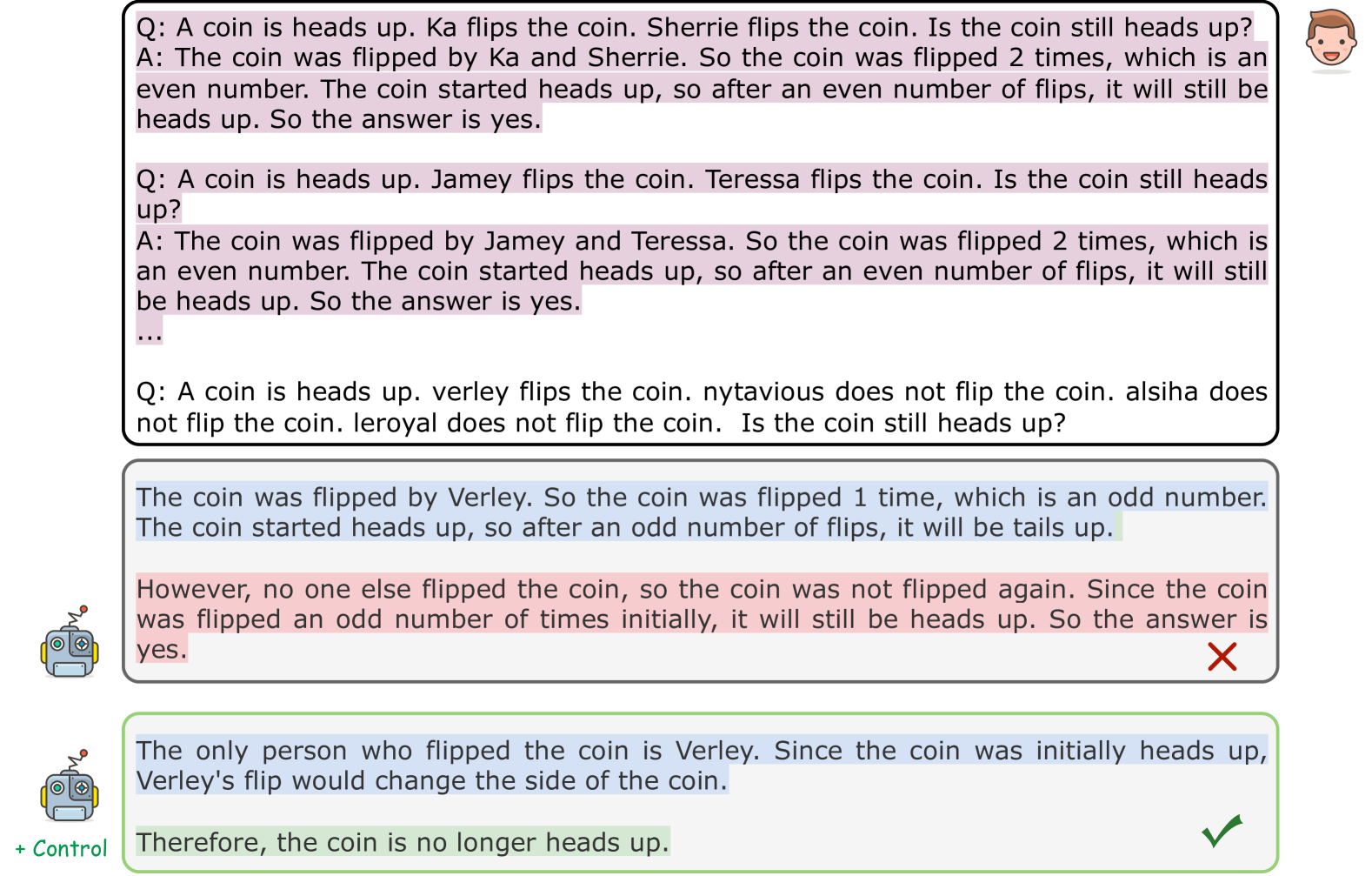
The image presents a series of logic problems involving coin flips and their solutions. Each problem poses a scenario where a coin starts heads up and is flipped by different people. The task is to determine if the coin is still heads up after the flips. The image shows examples of correct and incorrect reasoning, marked with checkmarks and crosses.
### Components/Axes
* **Questions (Q):** Each question describes a scenario with a coin initially heads up and a sequence of coin flips by different individuals.
* **Answers (A):** Each answer provides a logical explanation to determine whether the coin remains heads up.
* **Feedback:** A green checkmark indicates a correct answer, while a red "X" indicates an incorrect answer.
* **Control:** A "+ Control" label is present next to the robot icon on the last answer.
### Detailed Analysis or ### Content Details
**Problem 1:**
* **Question:** "A coin is heads up. Ka flips the coin. Sherrie flips the coin. Is the coin still heads up?"
* **Answer:** "The coin was flipped by Ka and Sherrie. So the coin was flipped 2 times, which is an even number. The coin started heads up, so after an even number of flips, it will still be heads up. So the answer is yes."
* **Feedback:** (Implied correct, no explicit mark)
**Problem 2:**
* **Question:** "A coin is heads up. Jamey flips the coin. Teressa flips the coin. Is the coin still heads up?"
* **Answer:** "The coin was flipped by Jamey and Teressa. So the coin was flipped 2 times, which is an even number. The coin started heads up, so after an even number of flips, it will still be heads up. So the answer is yes."
* **Feedback:** (Implied correct, no explicit mark)
**Problem 3:**
* **Question:** "A coin is heads up. verley flips the coin. nytavious does not flip the coin. alsiha does not flip the coin. leroyal does not flip the coin. Is the coin still heads up?"
* **Incorrect Answer:** "The coin was flipped by Verley. So the coin was flipped 1 time, which is an odd number. The coin started heads up, so after an odd number of flips, it will be tails up. However, no one else flipped the coin, so the coin was not flipped again. Since the coin was flipped an odd number of times initially, it will still be heads up. So the answer is yes."
* **Feedback:** Red "X" indicating the answer is incorrect.
**Problem 4:**
* **Correct Answer:** "The only person who flipped the coin is Verley. Since the coin was initially heads up, Verley's flip would change the side of the coin. Therefore, the coin is no longer heads up."
* **Feedback:** Green checkmark indicating the answer is correct.
### Key Observations
* The problems focus on the parity (even or odd) of the number of flips to determine the final state of the coin.
* The incorrect answer in Problem 3 makes a logical error by stating that an odd number of flips initially means the coin will still be heads up, which is wrong.
* The correct answer in Problem 4 correctly identifies that a single flip changes the state of the coin.
### Interpretation
The image illustrates a basic logic puzzle involving coin flips. The key concept is that an even number of flips returns the coin to its initial state, while an odd number of flips reverses it. The image highlights the importance of accurate reasoning and attention to detail when solving such problems. The presence of a "+ Control" label on the last answer suggests that this is the "controlled" or correct solution, likely used for comparison or training purposes.