## Screenshot: Coin Flip Logic Puzzle Interaction
### Overview
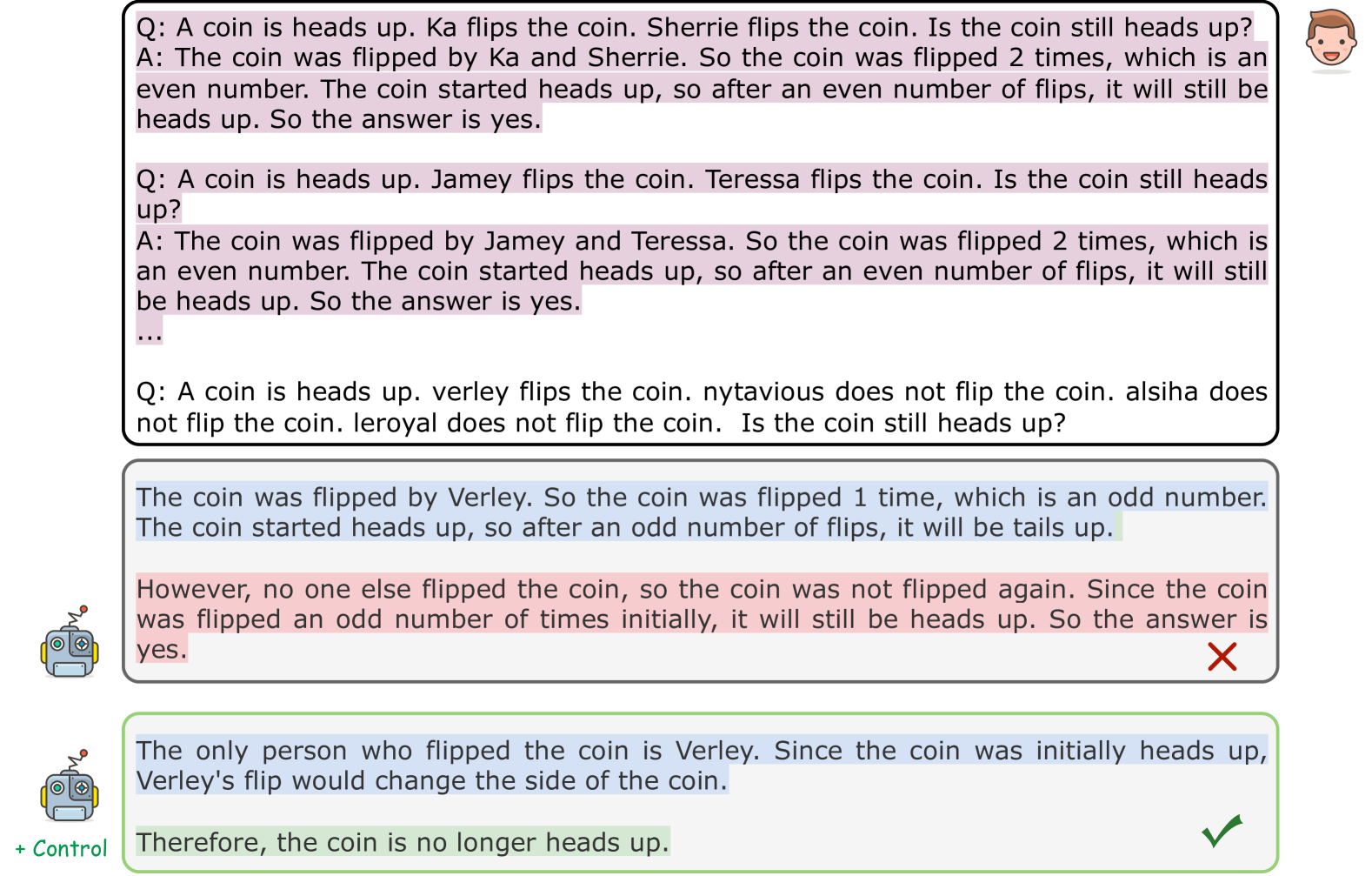
The image shows a conversational interface where a user poses three coin-flip logic puzzles to an AI assistant. Each puzzle involves determining whether a coin remains heads up after a series of flips. The interface uses color-coded highlights (pink, blue, green) to differentiate reasoning paths, with robot icons and checkmarks/Xs indicating correctness. The final answer is marked as correct with a green checkmark.
---
### Components/Axes
1. **Primary Elements**:
- **Question Boxes**: Black-bordered text boxes labeled "Q:" for user queries.
- **Answer Boxes**: Gray-bordered text boxes labeled "A:" for AI responses.
- **Color Highlights**:
- **Pink**: Used in the first two answers to emphasize reasoning about even/odd flips.
- **Blue**: Highlights critical reasoning steps in the third answer.
- **Green**: Marks the correct final answer and its reasoning.
- **Robot Icons**:
- **Blue Robot**: Appears in the third answer box, associated with a red "X" (incorrect).
- **Green Robot**: Appears in the fourth answer box, associated with a green checkmark (correct).
2. **Annotations**:
- **Checkmarks/Xs**: Visual indicators of answer validity.
- **Ellipses ("...")**: Indicates continuation of reasoning in the second answer.
---
### Detailed Analysis
#### User Queries (Q:)
1. **Query 1**:
- *"A coin is heads up. Ka flips the coin. Sherrie flips the coin. Is the coin still heads up?"*
- **Key Text**: "The coin was flipped 2 times... it will still be heads up. So the answer is yes."
2. **Query 2**:
- *"A coin is heads up. Jamey flips the coin. Teresa flips the coin. Is the coin still heads up?"*
- **Key Text**: "The coin was flipped 2 times... it will still be heads up. So the answer is yes."
3. **Query 3**:
- *"A coin is heads up. Verley flips the coin. nytavious does not flip the coin. alsiha does not flip the coin. Is the coin still heads up?"*
- **Key Text**: "The coin was flipped 1 time... it will be tails up. However, no one else flipped the coin... So the answer is yes." (Incorrect, marked with red "X").
#### AI Responses (A:)
1. **Response 1** (Pink Highlight):
- Correctly identifies even flips preserve the initial state.
2. **Response 2** (Pink Highlight):
- Repeats the even-flip logic but omits explicit conclusion.
3. **Response 3** (Blue Highlight):
- Incorrectly concludes the coin remains heads up despite odd flips. Contains contradictory reasoning:
- *"The coin was flipped 1 time... it will be tails up."*
- *"Since the coin was flipped an odd number of times initially, it will still be heads up."*
4. **Response 4** (Green Highlight + Checkmark):
- Correctly identifies Verley’s single flip changes the state:
- *"The only person who flipped the coin is Verley. Since the coin was initially heads up, Verley’s flip would change the side of the coin. Therefore, the coin is no longer heads up."*
---
### Key Observations
1. **Color Coding**:
- Pink highlights basic even/odd flip logic.
- Blue highlights flawed reasoning in the incorrect answer.
- Green highlights the correct final answer and its reasoning.
2. **Logical Errors**:
- The third answer (marked incorrect) contains contradictory statements about odd flips, suggesting a misunderstanding of parity effects on coin states.
3. **Correct Reasoning**:
- The fourth answer correctly applies the principle that an odd number of flips (1 flip) changes the coin’s state from heads to tails.
---
### Interpretation
The interaction demonstrates a logic puzzle where the AI initially struggles with odd-flip scenarios but ultimately resolves the correct answer by isolating the single flip event. The color coding and robot icons serve as visual aids to distinguish reasoning quality. The critical insight is that **only an odd number of total flips (not just initial flips) determines the final state**, and the fourth answer correctly applies this principle by focusing on Verley’s solitary flip. The incorrect answer (third response) highlights a common pitfall: conflating the number of flips with the parity of flips performed by specific individuals.