## Diagram: GPU-Host Memory Architecture
### Overview
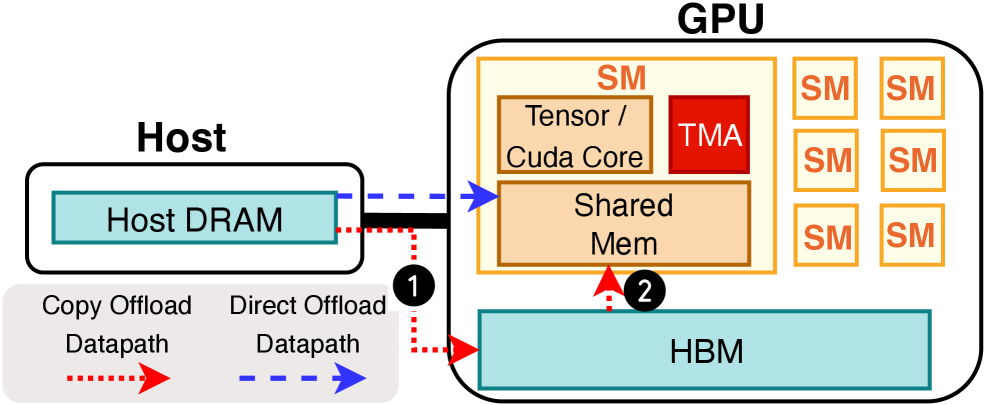
The diagram illustrates the data flow and memory hierarchy between a host system and a GPU, highlighting offload mechanisms and memory components. Key elements include Host DRAM, GPU architecture (SMs, Tensor Core, TMA), Shared Memory (Shared Mem), and High Bandwidth Memory (HBM). Arrows indicate data pathways with distinct styles for different offload types.
### Components/Axes
- **Host Side**:
- **Host DRAM**: Light blue rectangle labeled "Host DRAM" (top-left).
- **Data Paths**:
- **Copy Offload Datapath**: Red dotted arrow from Host DRAM to GPU.
- **Direct Offload Datapath**: Blue dashed arrow from Host DRAM to GPU.
- **GPU Side**:
- **SMs**: 6 orange-outlined squares labeled "SM" (arranged in 2 rows of 3).
- **Tensor Core/TMA**:
- **Tensor/Cuda Core**: Beige rectangle labeled "Tensor / Cuda Core".
- **TMA**: Red square labeled "TMA" (adjacent to Tensor Core).
- **Shared Mem**: Beige rectangle labeled "Shared Mem" (below Tensor Core/TMA).
- **HBM**: Light blue rectangle labeled "HBM" (bottom of GPU).
- **Annotations**:
- **Arrow 1**: Red arrow pointing to "Shared Mem" (labeled "1").
- **Arrow 2**: Red arrow pointing to "HBM" (labeled "2").
### Detailed Analysis
1. **Data Flow**:
- **Copy Offload (Red Dotted)**: Data moves from Host DRAM to GPU via a slower, indirect path (likely involving CPU mediation).
- **Direct Offload (Blue Dashed)**: Data transfers directly from Host DRAM to GPU, bypassing the CPU for lower latency.
- **Shared Mem**: Acts as an intermediate buffer between SMs/TMA and HBM, with bidirectional flow (indicated by upward/downward arrows).
- **HBM**: Final destination for data processed by SMs/TMA, suggesting high-bandwidth requirements for GPU operations.
2. **Component Hierarchy**:
- **SMs**: Core compute units (6 instances) handling parallel workloads.
- **TMA**: Specialized for tensor operations, likely accelerating AI/ML tasks.
- **Shared Mem**: Managed memory pool for dynamic allocation during GPU computations.
- **HBM**: High-speed memory stack feeding data to SMs/TMA.
### Key Observations
- **Priority in Data Transfer**: Direct Offload (blue) is prioritized over Copy Offload (red), as indicated by the dashed vs. dotted arrows.
- **Memory Tiers**: HBM is positioned as the lowest-latency, highest-bandwidth memory, while Shared Mem serves as a flexible intermediate layer.
- **TMA Integration**: The red TMA block is tightly coupled with Tensor Core, emphasizing its role in accelerating matrix operations.
### Interpretation
This architecture optimizes GPU offloading by balancing latency and bandwidth:
- **Direct Offload** minimizes CPU involvement, critical for real-time applications.
- **Shared Mem** acts as a cache, reducing HBM access frequency and improving throughput.
- **TMA** suggests specialized hardware for tensor operations, aligning with GPU acceleration in deep learning.
- The dual data paths (Copy vs. Direct Offload) imply flexibility for different workload types, with Direct Offload being preferred for performance-sensitive tasks.
The diagram underscores a multi-tiered memory hierarchy designed to maximize GPU utilization while managing data movement efficiently between host and accelerator.