## Flowchart: Wind Power Simulation Process
### Overview
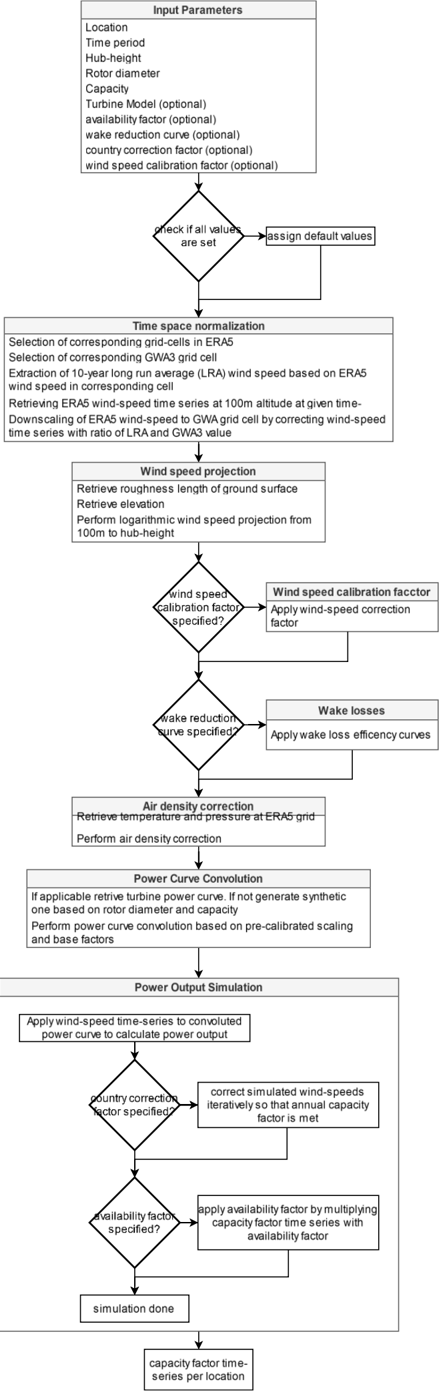
The image is a flowchart illustrating the process of wind power simulation. It starts with input parameters, proceeds through time and space normalization, wind speed projection, air density correction, power curve convolution, and finally, power output simulation. Decision points are included to account for optional parameters and corrections.
### Components/Axes
The flowchart consists of the following components:
1. **Input Parameters:** A list of required and optional inputs for the simulation.
2. **Process Steps:** Rectangular boxes describing the various stages of the simulation.
3. **Decision Points:** Diamond-shaped boxes representing conditional checks.
4. **Flow Direction:** Arrows indicating the sequence of operations.
**Input Parameters:**
* Location
* Time period
* Hub-height
* Rotor diameter
* Capacity
* Turbine Model (optional)
* availability factor (optional)
* wake reduction curve (optional)
* country correction factor (optional)
* wind speed calibration factor (optional)
### Detailed Analysis or ### Content Details
1. **Input Parameters:**
* The process begins with defining the location, time period, hub-height, rotor diameter, and capacity.
* Optional parameters include turbine model, availability factor, wake reduction curve, country correction factor, and wind speed calibration factor.
2. **Initial Check:**
* A decision diamond asks "check if all values are set". If not, the process "assign default values".
3. **Time Space Normalization:**
* Selection of corresponding grid-cells in ERA5.
* Selection of corresponding GWA3 grid cell.
* Extraction of 10-year long run average (LRA) wind speed based on ERA5 wind speed in corresponding cell.
* Retrieving ERA5 wind-speed time series at 100m altitude at given time.
* Downscaling of ERA5 wind-speed to GWA grid cell by correcting wind-speed time series with ratio of LRA and GWA3 value.
4. **Wind Speed Projection:**
* Retrieve roughness length of ground surface.
* Retrieve elevation.
* Perform logarithmic wind speed projection from 100m to hub-height.
5. **Wind Speed Calibration:**
* A decision diamond asks "wind speed calibration factor specified?".
* If yes, "Apply wind-speed correction factor".
6. **Wake Losses:**
* A decision diamond asks "wake reduction curve specified?".
* If yes, "Apply wake loss efficiency curves".
7. **Air Density Correction:**
* Retrieve temperature and pressure at ERA5 grid.
* Perform air density correction.
8. **Power Curve Convolution:**
* If applicable, retrieve turbine power curve. If not, generate synthetic one based on rotor diameter and capacity.
* Perform power curve convolution based on pre-calibrated scaling and base factors.
9. **Power Output Simulation:**
* Apply wind-speed time-series to convoluted power curve to calculate power output.
10. **Country Correction Factor:**
* A decision diamond asks "country correction factor specified?".
* If yes, "correct simulated wind-speeds iteratively so that annual capacity factor is met".
11. **Availability Factor:**
* A decision diamond asks "availability factor specified?".
* If yes, "apply availability factor by multiplying capacity factor time series with availability factor".
12. **Final Output:**
* "simulation done"
* capacity factor time-series per location.
### Key Observations
* The flowchart outlines a comprehensive wind power simulation process, incorporating various corrections and adjustments.
* Several steps are optional, depending on the availability of specific data or the desired level of accuracy.
* The process relies on data from ERA5 and GWA3 datasets.
### Interpretation
The flowchart provides a structured approach to simulating wind power generation. It highlights the importance of considering various factors such as location, time period, turbine characteristics, and environmental conditions. The inclusion of optional parameters and correction factors allows for customization and refinement of the simulation, potentially leading to more accurate and reliable results. The iterative correction of simulated wind speeds based on the country correction factor suggests a feedback loop to ensure the annual capacity factor is met, indicating a focus on achieving realistic performance metrics.