## Multiple Choice Clock Angle Problems
### Overview
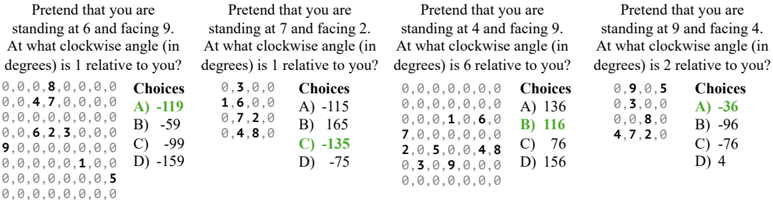
The image contains four distinct clock angle problems, each asking for the clockwise angle (in degrees) between a specified position and a target number, given a starting position and facing direction. Each problem includes multiple-choice answers with one correct option highlighted in green.
---
### Components/Axes
1. **Problem Structure**:
- **Setup**: "Pretend that you are standing at [X] and facing [Y]. At what clockwise angle (in degrees) is [Z] relative to you?"
- **Choices**: Four options labeled A–D, with one correct answer marked in green.
- **Visual Layout**: Each problem is separated by horizontal dividers, with choices listed below the question.
2. **Clock Representation**:
- A circular clock face is depicted for each problem, with numbers 1–12 arranged clockwise.
- The starting position (e.g., "standing at 6") is marked with a bold number, and the facing direction (e.g., "facing 9") is indicated with an arrow or bold text.
---
### Detailed Analysis
#### Problem 1
- **Setup**: Standing at 6, facing 9. Find the angle to 1.
- **Choices**:
- A) -119 ✅
- B) -59
- C) -99
- D) -159
- **Clock Layout**: Numbers 1–12 arranged clockwise. Starting position (6) and facing direction (9) are highlighted.
#### Problem 2
- **Setup**: Standing at 7, facing 2. Find the angle to 1.
- **Choices**:
- A) -115
- B) 165
- C) -135 ✅
- D) -75
- **Clock Layout**: Numbers 1–12 arranged clockwise. Starting position (7) and facing direction (2) are highlighted.
#### Problem 3
- **Setup**: Standing at 4, facing 9. Find the angle to 6.
- **Choices**:
- A) 136
- B) 116 ✅
- C) 76
- D) 156
- **Clock Layout**: Numbers 1–12 arranged clockwise. Starting position (4) and facing direction (9) are highlighted.
#### Problem 4
- **Setup**: Standing at 9, facing 4. Find the angle to 2.
- **Choices**:
- A) -36 ✅
- B) -96
- C) -76
- D) 4
- **Clock Layout**: Numbers 1–12 arranged clockwise. Starting position (9) and facing direction (4) are highlighted.
---
### Key Observations
1. **Negative Angles**: Some answers are negative (e.g., -119, -135), likely indicating directionality relative to the facing orientation.
2. **Consistent Formatting**: All problems use the same structure, with choices listed in a vertical column and a clock diagram below.
3. **Correct Answers**: Highlighted in green, with checkmarks (✅) added in the transcription for clarity.
---
### Interpretation
- **Angle Calculation Logic**:
- Each hour mark on a clock represents 30° (360°/12).
- The angle is calculated clockwise from the **facing direction** to the target number, adjusted for the starting position.
- Negative angles may represent counterclockwise measurements relative to the facing direction.
- **Purpose**: These problems test spatial reasoning and understanding of rotational angles in a circular context.
- **Notable Patterns**:
- Problems with negative answers (e.g., -119, -135, -36) suggest scenarios where the target number is behind the facing direction.
- Positive answers (e.g., 116, 136) occur when the target is ahead of the facing direction.
---
### Conclusion
The image provides a structured set of clock angle problems designed to assess geometric reasoning. Each problem isolates variables (starting position, facing direction, target number) to test the solver’s ability to compute relative angles in a circular system. The consistent formatting and visual aids (clock diagrams) enhance clarity for educational or assessment purposes.