## Diagram: Caffe Architecture
### Overview
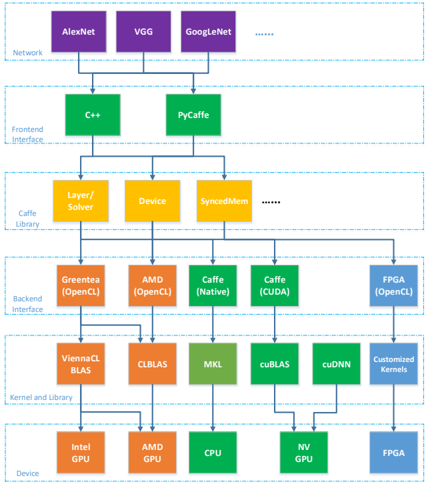
The image is a block diagram illustrating the architecture of the Caffe deep learning framework. It shows the flow of data and operations through different layers, from network models to hardware devices. The diagram is structured in a hierarchical manner, with distinct layers representing different components of the system.
### Components/Axes
The diagram is organized into the following layers, from top to bottom:
1. **Network:** Contains network models.
2. **Frontend Interface:** Provides interfaces for interacting with the Caffe library.
3. **Caffe Library:** Core components of the Caffe framework.
4. **Backend Interface:** Connects the Caffe library to different backend implementations.
5. **Kernel and Library:** Provides optimized kernels and libraries for computation.
6. **Device:** Represents the hardware devices used for computation.
The diagram uses colored blocks to represent different components:
* Purple: Network models
* Green: Software components
* Orange: Hardware components
* Yellow: Caffe library components
* Blue dashed lines: Indicate the flow of data and dependencies between components.
### Detailed Analysis
**Network Layer:**
* AlexNet (Purple block, top-left)
* VGG (Purple block, top-center)
* GoogLeNet (Purple block, top-right)
* Ellipsis (...) indicates that there are more network models.
**Frontend Interface Layer:**
* C++ (Green block, left)
* PyCaffe (Green block, right)
**Caffe Library Layer:**
* Layer/Solver (Yellow block, left)
* Device (Yellow block, center)
* SyncedMem (Yellow block, right)
* Ellipsis (...) indicates that there are more components.
**Backend Interface Layer:**
* Greentea (OpenCL) (Orange block, left)
* AMD (OpenCL) (Orange block, center-left)
* Caffe (Native) (Green block, center)
* Caffe (CUDA) (Green block, center-right)
* FPGA (OpenCL) (Blue block, right)
**Kernel and Library Layer:**
* ViennaCL BLAS (Orange block, left)
* CLBLAS (Orange block, center-left)
* MKL (Green block, center)
* cuBLAS (Green block, center-right)
* cuDNN (Green block, right-center)
* Customized Kernels (Blue block, right)
**Device Layer:**
* Intel GPU (Orange block, left)
* AMD GPU (Orange block, center-left)
* CPU (Green block, center)
* NV GPU (Green block, center-right)
* FPGA (Blue block, right)
### Key Observations
* The diagram shows a clear hierarchical structure, with data flowing from high-level network models down to low-level hardware devices.
* The Caffe framework supports multiple frontends (C++ and PyCaffe), backends (OpenCL, Native, CUDA, FPGA), and hardware devices (Intel GPU, AMD GPU, CPU, NV GPU, FPGA).
* The diagram highlights the modularity of the Caffe framework, with different components that can be combined and configured to support a wide range of deep learning applications.
### Interpretation
The diagram illustrates the architecture of the Caffe deep learning framework, emphasizing its modularity and support for diverse hardware and software configurations. The flow of data and operations is clearly depicted, showing how network models are processed through different layers of the framework and ultimately executed on hardware devices. The diagram demonstrates the flexibility of Caffe, allowing users to choose the most appropriate backend and hardware for their specific needs. The presence of multiple options at each layer (e.g., different network models, frontends, backends, and hardware devices) indicates that Caffe is designed to be adaptable and customizable.