## Chart Type: Line Chart of Average Incorrect Flips per Iteration
### Overview
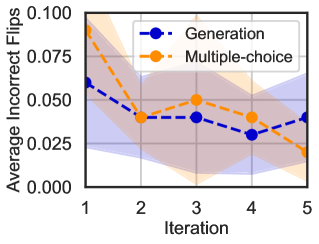
This image displays a 2D line chart illustrating the "Average Incorrect Flips" over "Iteration" for two distinct methods: "Generation" and "Multiple-choice". Each method is represented by a dashed line with circular markers and an associated shaded area indicating variability or uncertainty (likely a confidence interval or standard deviation). The chart tracks the performance of these methods across five iterations, showing how the average incorrect flips change over time.
### Components/Axes
The chart is structured with a horizontal X-axis at the bottom and a vertical Y-axis on the left.
* **X-axis Label**: "Iteration"
* **X-axis Range**: From 1 to 5.
* **X-axis Ticks**: Major ticks are present at 1, 2, 3, 4, and 5.
* **Y-axis Label**: "Average Incorrect Flips"
* **Y-axis Range**: From 0.000 to 0.100.
* **Y-axis Ticks**: Major ticks are present at 0.000, 0.025, 0.050, 0.075, and 0.100.
* **Grid Lines**: Faint gray grid lines extend from each major tick mark on both axes across the plotting area.
* **Legend**: Located in the top-right quadrant of the chart, within the plotting area.
* **Entry 1**: A blue circle marker connected by a blue dashed line, labeled "Generation".
* **Entry 2**: An orange circle marker connected by an orange dashed line, labeled "Multiple-choice".
### Detailed Analysis
The chart presents two data series, each with a line representing the mean and a shaded area representing its variability.
1. **Generation (Blue dashed line with blue circular markers and blue shaded area)**:
* **Trend**: The "Generation" line generally shows a decreasing trend in "Average Incorrect Flips" from Iteration 1 to Iteration 4, followed by a slight increase at Iteration 5.
* **Data Points (approximate)**:
* Iteration 1: Approximately 0.060
* Iteration 2: Approximately 0.040
* Iteration 3: Approximately 0.040
* Iteration 4: Approximately 0.030
* Iteration 5: Approximately 0.040
* **Shaded Area (Uncertainty)**: The blue shaded area is relatively wide at Iteration 1 (spanning roughly 0.04 to 0.09), narrows significantly around Iteration 2-4 (spanning roughly 0.02 to 0.06), and widens again slightly at Iteration 5 (spanning roughly 0.02 to 0.07).
2. **Multiple-choice (Orange dashed line with orange circular markers and orange shaded area)**:
* **Trend**: The "Multiple-choice" line starts at a high value, drops sharply at Iteration 2, then fluctuates before showing a clear decreasing trend towards Iteration 5, ending at the lowest point on the chart.
* **Data Points (approximate)**:
* Iteration 1: Approximately 0.090
* Iteration 2: Approximately 0.040
* Iteration 3: Approximately 0.050
* Iteration 4: Approximately 0.040
* Iteration 5: Approximately 0.020
* **Shaded Area (Uncertainty)**: The orange shaded area is very wide at Iteration 1 (spanning roughly 0.05 to 0.10), narrows considerably at Iteration 2 (spanning roughly 0.02 to 0.06), and continues to narrow towards Iteration 5 (spanning roughly 0.01 to 0.04).
### Key Observations
* **Initial Performance**: At Iteration 1, "Multiple-choice" has a significantly higher "Average Incorrect Flips" (approx. 0.090) compared to "Generation" (approx. 0.060).
* **Rapid Improvement**: "Multiple-choice" shows a much steeper initial drop in incorrect flips between Iteration 1 and Iteration 2, matching "Generation" at Iteration 2 (both around 0.040).
* **Crossover Points**:
* The "Multiple-choice" line crosses below the "Generation" line between Iteration 1 and Iteration 2.
* The "Multiple-choice" line crosses below the "Generation" line again between Iteration 4 and Iteration 5.
* **Final Performance**: By Iteration 5, "Multiple-choice" achieves the lowest "Average Incorrect Flips" (approx. 0.020), outperforming "Generation" (approx. 0.040).
* **Variability**: Both methods exhibit considerable variability, especially at Iteration 1. The uncertainty range for "Multiple-choice" is notably wider at Iteration 1, but it narrows more significantly by Iteration 5 compared to "Generation".
### Interpretation
The data suggests that while the "Multiple-choice" method starts with a higher rate of "Average Incorrect Flips," it demonstrates a more pronounced learning or improvement curve over the iterations, ultimately achieving a lower error rate than the "Generation" method.
The "Generation" method shows a more stable, albeit slower, reduction in incorrect flips, reaching its lowest point at Iteration 4 before a slight regression at Iteration 5. Its performance seems to plateau around 0.030-0.040 after the initial drop.
The wider uncertainty bands, particularly at earlier iterations, indicate greater variability in performance, which could be due to initial instability, diverse participant responses, or the inherent nature of the tasks. The narrowing bands towards later iterations suggest that the methods become more consistent in their performance as iterations progress.
The crossover points are critical: "Multiple-choice" quickly surpasses "Generation" in terms of lower error rates after the first iteration, and maintains this advantage, especially in the final iteration. This implies that for tasks measured by "Incorrect Flips," "Multiple-choice" might be the more effective approach in the long run, despite a potentially weaker start. The "Generation" method, while starting better, does not achieve the same level of error reduction by the fifth iteration.