## Timeline Diagram: Language Acquisition Milestones in Infants (0-14 Months)
### Overview
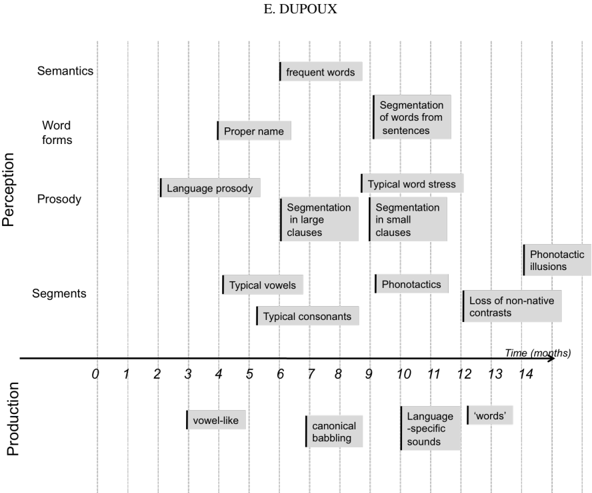
This is a timeline chart illustrating the developmental milestones in infant language acquisition, divided into **Perception** and **Production** domains over the first 14 months of life. The chart is attributed to **E. DUPOUX** (text at the top center). It maps the emergence of various linguistic abilities against a monthly timeline, showing when specific perceptual and productive skills typically appear.
### Components/Axes
* **Horizontal Axis (X-axis):** Labeled **"Time (months)"**. It is a linear scale marked from **0 to 14** in increments of 1 month. Vertical dashed lines extend upward from each month marker to aid in reading the timeline.
* **Vertical Axis (Y-axis):** Categorizes language abilities into two primary domains:
1. **Perception** (top section): Subdivided into four rows:
* **Semantics**
* **Word forms**
* **Prosody**
* **Segments**
2. **Production** (bottom section): A single row below the main timeline axis.
* **Data Representation:** Milestones are represented as **gray rectangular boxes** containing text. The left edge of each box indicates the approximate onset age for that skill. The boxes are placed within their respective category rows.
### Detailed Analysis
**Perception Domain Milestones (from top to bottom):**
* **Semantics:**
* **"frequent words"**: Onset at approximately **6 months**, extending to about **8 months**.
* **Word forms:**
* **"Proper name"**: Onset at approximately **4 months**, extending to about **6 months**.
* **"Segmentation of words from sentences"**: Onset at approximately **9 months**, extending to about **11 months**.
* **Prosody:**
* **"Language prosody"**: Onset at approximately **2 months**, extending to about **4 months**.
* **"Typical word stress"**: Onset at approximately **9 months**, extending to about **11 months**.
* **"Segmentation in large clauses"**: Onset at approximately **6 months**, extending to about **8 months**.
* **"Segmentation in small clauses"**: Onset at approximately **9 months**, extending to about **11 months**.
* **Segments:**
* **"Typical vowels"**: Onset at approximately **4 months**, extending to about **6 months**.
* **"Typical consonants"**: Onset at approximately **5 months**, extending to about **7 months**.
* **"Phonotactics"**: Onset at approximately **9 months**, extending to about **11 months**.
* **"Loss of non-native contrasts"**: Onset at approximately **12 months**, extending to about **14 months**.
* **"Phonotactic illusions"**: Onset at approximately **13 months**, extending beyond **14 months**.
**Production Domain Milestones (below the timeline axis):**
* **"vowel-like"**: Onset at approximately **3 months**, extending to about **5 months**.
* **"canonical babbling"**: Onset at approximately **7 months**, extending to about **9 months**.
* **"Language-specific sounds"**: Onset at approximately **10 months**, extending to about **12 months**.
* **"words"**: Onset at approximately **12 months**, extending to about **14 months**.
### Key Observations
1. **Perception Precedes Production:** All listed perceptual abilities (e.g., recognizing language prosody at ~2 months) emerge significantly earlier than their corresponding productive milestones (e.g., canonical babbling at ~7 months).
2. **Clustering of Milestones:** There are notable clusters of new perceptual abilities around **6 months** (frequent words, segmentation in large clauses) and **9 months** (word segmentation, typical word stress, segmentation in small clauses, phonotactics).
3. **Progression from General to Specific:** Perception develops from broad prosodic contours (~2 months) to specific phonemic categories (vowels ~4 months, consonants ~5 months) and finally to word-level and syntactic segmentation (~9 months).
4. **Production Follows a Classic Sequence:** Production follows the well-documented path from vowel-like sounds (~3 months) to canonical babbling (~7 months), then to language-specific sounds (~10 months), and finally to first words (~12 months).
5. **Specialization and Refinement:** The later perceptual milestones involve **refinement and specialization**, such as the "Loss of non-native contrasts" (~12 months) and the development of "Phonotactic illusions" (~13 months), indicating the infant's auditory system is tuning to the native language's sound system.
### Interpretation
This diagram provides a **Peircean investigative** model of language acquisition, mapping the **signs** (acoustic patterns, word forms) as they are interpreted and then produced by the infant. It demonstrates that language learning is not a single event but a **staged, hierarchical process**.
* **What the data suggests:** The data strongly supports a model where **perceptual groundwork is laid well before production begins**. Infants are sophisticated listeners long before they become speakers. The clustering of milestones suggests **critical or sensitive periods** for acquiring different aspects of language structure.
* **How elements relate:** The vertical separation between Perception and Production visually emphasizes their developmental dissociation. The horizontal timeline shows the **interleaving and overlap** of skills; for instance, perceptual segmentation of words is being refined (~9 months) just as language-specific production sounds are beginning (~10 months).
* **Notable patterns:** The most striking pattern is the **asymmetry** between perception and production. It implies that the cognitive and neural machinery for analyzing speech is operational much earlier than the motor-speech coordination required for imitation. The "Loss of non-native contrasts" is a key example of **neural commitment**, where the brain specializes in the native language at the expense of universal phonetic abilities.
**In essence, the chart illustrates that an infant's journey to speaking is first and foremost a journey of expert listening, with production emerging as a delayed but direct consequence of this perceptual tuning.**