## Diagram: Code Generation and Error Correction
### Overview
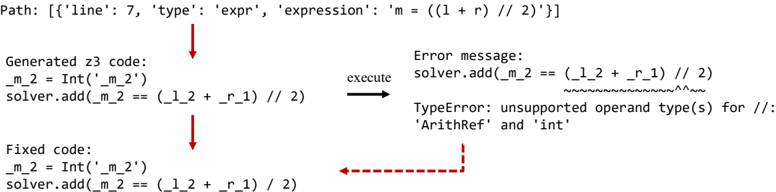
The image depicts a code generation and error correction process. It shows the initial code, the generated z3 code, an error message resulting from the execution of the z3 code, and the corrected code. Arrows indicate the flow of the process.
### Components/Axes
* **Path:** `[{'line': 7, 'type': 'expr', 'expression': 'm = ((1+r) // 2)'}]` - This indicates the origin of the code, specifying line 7 and the expression `m = ((1+r) // 2)`.
* **Generated z3 code:** This section shows the code generated by z3.
* **Error message:** This section displays the error message encountered during execution.
* **Fixed code:** This section shows the corrected code.
* **Arrows:** Red arrows indicate the flow of the process. A black arrow indicates execution.
### Detailed Analysis or ### Content Details
1. **Path:**
* `line`: 7
* `type`: `expr`
* `expression`: `m = ((1+r) // 2)`
2. **Generated z3 code:**
* `_m_2 = Int('_m_2')`
* `solver.add(_m_2 == (_1_2 + _r_1) // 2)`
3. **Error message:**
* `execute` (indicated by a black arrow pointing right)
* `solver.add(_m_2 == (_1_2 + _r_1) // 2)`
* `TypeError: unsupported operand type(s) for //: 'ArithRef' and 'int'`
* A tilde line `~~~~~~~~~~~~~~>>~~` is drawn above the error message.
4. **Fixed code:**
* `_m_2 = Int('_m_2')`
* `solver.add(_m_2 == (_1_2 + _r_1) / 2)`
### Key Observations
* The initial expression involves integer division (`//`).
* The generated z3 code also uses integer division (`//`).
* The error message indicates an unsupported operand type for integer division between `ArithRef` and `int`.
* The fixed code replaces integer division (`//`) with standard division (`/`).
### Interpretation
The diagram illustrates a scenario where the initial code containing integer division leads to a `TypeError` during execution with z3. The error arises because the z3 solver does not support integer division between `ArithRef` and `int`. The fix involves replacing the integer division operator with standard division, which resolves the type incompatibility and allows the code to execute successfully. This highlights the importance of considering type compatibility when generating code for specific solvers or environments.