## Diagram: Z3 Solver Code Debugging Flow
### Overview
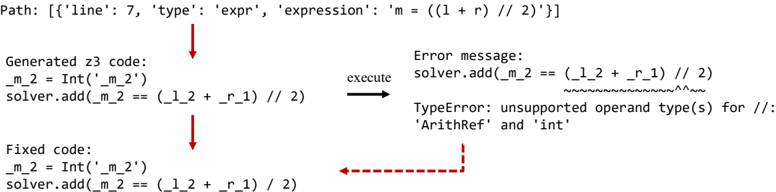
The image illustrates a debugging process for code generated to interact with the Z3 theorem prover. It shows a specific error encountered when executing generated code and the subsequent fix applied to resolve it. The flow is presented vertically with directional arrows indicating the sequence of events.
### Components/Axes
The diagram is segmented into four primary text blocks, connected by arrows:
1. **Top Block (Path):** A single line of text defining a code path or expression.
2. **Left-Middle Block (Generated z3 code):** Two lines of Python-like code using the Z3 API.
3. **Right-Middle Block (Error message):** An error traceback message.
4. **Bottom Block (Fixed code):** Two lines of corrected code.
**Arrows:**
* A solid red arrow points downward from the "Path" to the "Generated z3 code".
* A solid black arrow labeled "execute" points rightward from the "Generated z3 code" to the "Error message".
* A dashed red arrow points from the "Error message" back to the "Fixed code", indicating the corrective action taken.
### Detailed Analysis / Content Details
**1. Path Expression:**
* **Text:** `Path: [{'line': 7, 'type': 'expr', 'expression': 'm = ((l + r) // 2)'}]`
* **Analysis:** This describes a specific line of source code (line 7) which is an expression assigning the result of integer division `(l + r) // 2` to a variable `m`.
**2. Generated Z3 Code:**
* **Line 1:** `_m_2 = Int('_m_2')`
* Declares a Z3 integer variable named `_m_2`.
* **Line 2:** `solver.add(_m_2 == (_l_2 + _r_2) // 2)`
* Adds a constraint to a Z3 solver instance. It asserts that the Z3 integer `_m_2` is equal to the result of the integer division `(_l_2 + _r_2) // 2`.
* **Note:** The variables `_l_2` and `_r_2` are implied to be other Z3 integer variables defined elsewhere.
**3. Error Message:**
* **Text:**
```
Error message:
solver.add(_m_2 == (_l_2 + _r_2) // 2)
~~~~~~~~~~~~~~~~~~~~~~~~~~~~~~~~~~~~~^~~
TypeError: unsupported operand type(s) for //: 'ArithRef' and 'int'
```
* **Analysis:** The error occurs on the second line of the generated code. The caret (`^`) points to the `//` operator. The `TypeError` indicates that the Z3 expression object (`ArithRef`, which is the type of `(_l_2 + _r_2)`) cannot be used with the Python integer division operator `//` when the other operand is a Python `int` (the literal `2`).
**4. Fixed Code:**
* **Line 1:** `_m_2 = Int('_m_2')` (Unchanged)
* **Line 2:** `solver.add(_m_2 == (_l_2 + _r_2) / 2)`
* **Change:** The integer division operator `//` has been replaced with the standard division operator `/`.
* **Analysis:** This fix works because the `/` operator in Python (and by extension, when used with Z3 expressions) typically performs true division, returning a floating-point result. Z3 can handle this operation between an `ArithRef` and a Python `int`, creating a rational number constraint.
### Key Observations
* **Operator Incompatibility:** The core issue is a type mismatch between Z3's symbolic algebraic objects (`ArithRef`) and Python's integer-specific floor division operator (`//`).
* **Spatial Flow:** The diagram uses a clear top-to-bottom flow for the main process (Path -> Code -> Error), with a feedback loop (dashed arrow) from the error to the solution.
* **Visual Cue:** The error message uses a caret (`^`) and tildes (`~`) to visually underline the problematic operator in the code snippet, a common pattern in programming error messages.
### Interpretation
This diagram demonstrates a common pitfall when automatically translating standard programming expressions into constraints for a symbolic solver like Z3. The original source code used integer division (`//`), which is a discrete operation. However, Z3's constraint solver operates in the domain of real arithmetic and rational numbers. The `//` operator is not defined for Z3's symbolic expressions, causing a runtime type error.
The fix replaces `//` with `/`, which aligns with Z3's mathematical model. This changes the semantics from *integer floor division* to *real division*, which is a necessary adaptation for the constraint-solving context. The diagram effectively shows the translation gap between imperative code and declarative constraints, and how a simple operator change bridges that gap. It highlights the importance of understanding the underlying data types and operations supported by the target framework (Z3) when generating code.