\n
## Document: Study Tips
### Overview
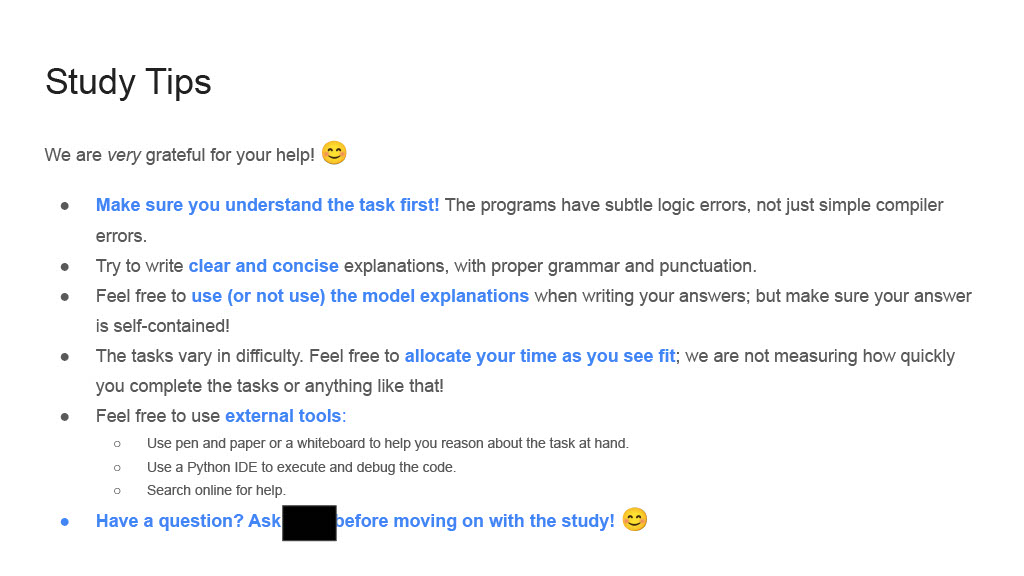
The image presents a document titled "Study Tips" containing advice for completing tasks, likely related to a study or evaluation process. It's a text-based document with bullet points offering guidance.
### Components/Axes
The document consists of a title ("Study Tips") followed by a series of bullet points providing instructions and encouragement. There are also two emoji faces: a smiling face and a slightly smiling face.
### Detailed Analysis or Content Details
The document contains the following text:
"We are very grateful for your help! 😊"
* "Make sure you understand the task first! The programs have subtle logic errors, not just simple compiler errors."
* "Try to write clear and concise explanations, with proper grammar and punctuation."
* "Feel free to use (or not use) the model explanations when writing your answers; but make sure your answer is self-contained!"
* "The tasks vary in difficulty. Feel free to allocate your time as you see fit; we are not measuring how quickly you complete the tasks or anything like that!"
* "Feel free to use external tools:"
* "Use pen and paper or a whiteboard to help you reason about the task at hand."
* "Use a Python IDE to execute and debug the code."
* "Search online for help."
* "Have a question? Ask [REDACTED] before moving on with the study! 😃"
The word "[REDACTED]" appears in the last bullet point, obscuring a name or contact information.
### Key Observations
The document emphasizes understanding the task, clear communication, independent problem-solving, and the use of available resources. The redaction suggests sensitivity around who to contact for questions. The use of emojis adds a friendly tone.
### Interpretation
This document appears to be part of instructions given to participants in a study or evaluation involving programming tasks. The emphasis on logic errors, clear explanations, and self-contained answers suggests the evaluation focuses on reasoning and problem-solving skills, not just correct code output. The encouragement to use external tools indicates a focus on practical problem-solving approaches. The redaction of the contact person's name likely protects their privacy or prevents direct contact outside of the study's designated channels. The overall tone is supportive and aims to create a comfortable environment for participants.