\n
## Text Document: Study Tips
### Overview
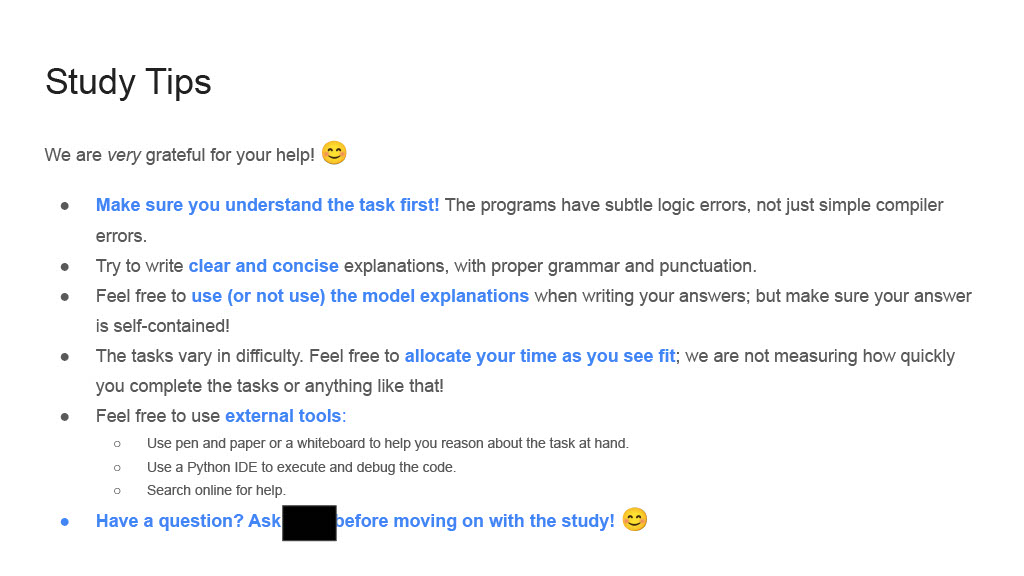
The image displays a text-based document titled "Study Tips." It consists of a thank you message followed by a bulleted list of six main recommendations for individuals engaged in a study or task-based activity, likely related to programming or technical problem-solving. The text is primarily in English, with some phrases highlighted in blue. Two smiling face emojis (😊) are present.
### Components/Axes
This is not a chart or diagram with axes. The components are textual elements arranged in a hierarchical list:
- **Title**: "Study Tips"
- **Introductory Sentence**: "We are very grateful for your help! 😊"
- **Bulleted List**: Six main points, with the fifth point containing three sub-bullets.
- **Formatting**: Certain key phrases within the bullet points are displayed in a blue color, indicating emphasis or possibly hyperlinks in the original context.
- **Visual Elements**: Two 😊 emojis and one black rectangular redaction box obscuring a word or name in the final bullet point.
### Detailed Analysis / Content Details
**Full Text Transcription:**
**Title:** Study Tips
**Introductory Line:** We are very grateful for your help! 😊
**Bullet Points:**
1. **Make sure you understand the task first!** The programs have subtle logic errors, not just simple compiler errors.
2. Try to write **clear and concise** explanations, with proper grammar and punctuation.
3. Feel free to **use (or not use) the model explanations** when writing your answers; but make sure your answer is self-contained!
4. The tasks vary in difficulty. Feel free to **allocate your time as you see fit**; we are not measuring how quickly you complete the tasks or anything like that!
5. Feel free to use **external tools**:
* Use pen and paper or a whiteboard to help you reason about the task at hand.
* Use a Python IDE to execute and debug the code.
* Search online for help.
6. **Have a question? Ask [REDACTED] before moving on with the study! 😊**
**Language:** All text is in English.
**Redaction:** A black box obscures a word or name in the sixth bullet point, following the word "Ask".
### Key Observations
1. **Emphasis on Understanding:** The first and most prominent tip stresses comprehending the task's logic before attempting to solve it, highlighting that errors are subtle and logical, not just syntactic.
2. **Communication Quality:** There is a clear directive to write explanations that are both clear and concise, with attention to grammatical correctness.
3. **Autonomy and Self-Pacing:** The document explicitly grants autonomy to the learner regarding the use of provided model explanations and the allocation of time, stating that speed is not being measured.
4. **Encouragement of Resource Use:** The tips actively encourage the use of external tools and resources, including physical tools (pen/paper), software tools (Python IDE), and online research.
5. **Support Channel:** The final point directs the user to ask questions to a specific entity (whose name is redacted) before proceeding, indicating a supported learning environment.
6. **Tone:** The tone is supportive and grateful, using positive language ("grateful," "feel free") and friendly emojis.
### Interpretation
This document serves as a guideline for participants in a structured learning or evaluation exercise, most likely involving debugging or analyzing code. The Peircean investigation reveals several underlying principles:
* **The Primacy of Comprehension:** The instruction to "understand the task first" is a foundational rule. It suggests that the core challenge is analytical and logical, not merely technical. The mention of "subtle logic errors" implies the tasks are designed to test deep understanding, not surface-level knowledge.
* **Process Over Speed:** By decoupling task completion from time measurement and encouraging deliberate resource use, the guidelines promote a quality-focused, methodical approach. The goal is correct reasoning and solution-finding, not rapid output.
* **Integrated Learning:** The permission to use (or ignore) model explanations and external tools frames the activity as an open-book, real-world problem-solving scenario. It values the ability to synthesize information from various sources (provided materials, personal notes, IDEs, the internet) into a coherent, self-contained answer.
* **Structured Support:** The redacted name in the final point is crucial. It indicates that while autonomy is encouraged, there is a designated point of contact for clarification. This creates a safety net, ensuring learners do not proceed based on fundamental misunderstandings. The redaction itself is an interesting artifact, likely done to anonymize the document for broader distribution.
In essence, the text outlines a pedagogical philosophy that values deep understanding, clear communication, independent problem-solving with resourcefulness, and a supported, non-pressured learning environment.