# Technical Diagram Analysis: Multi-Stream Text Generation Flow
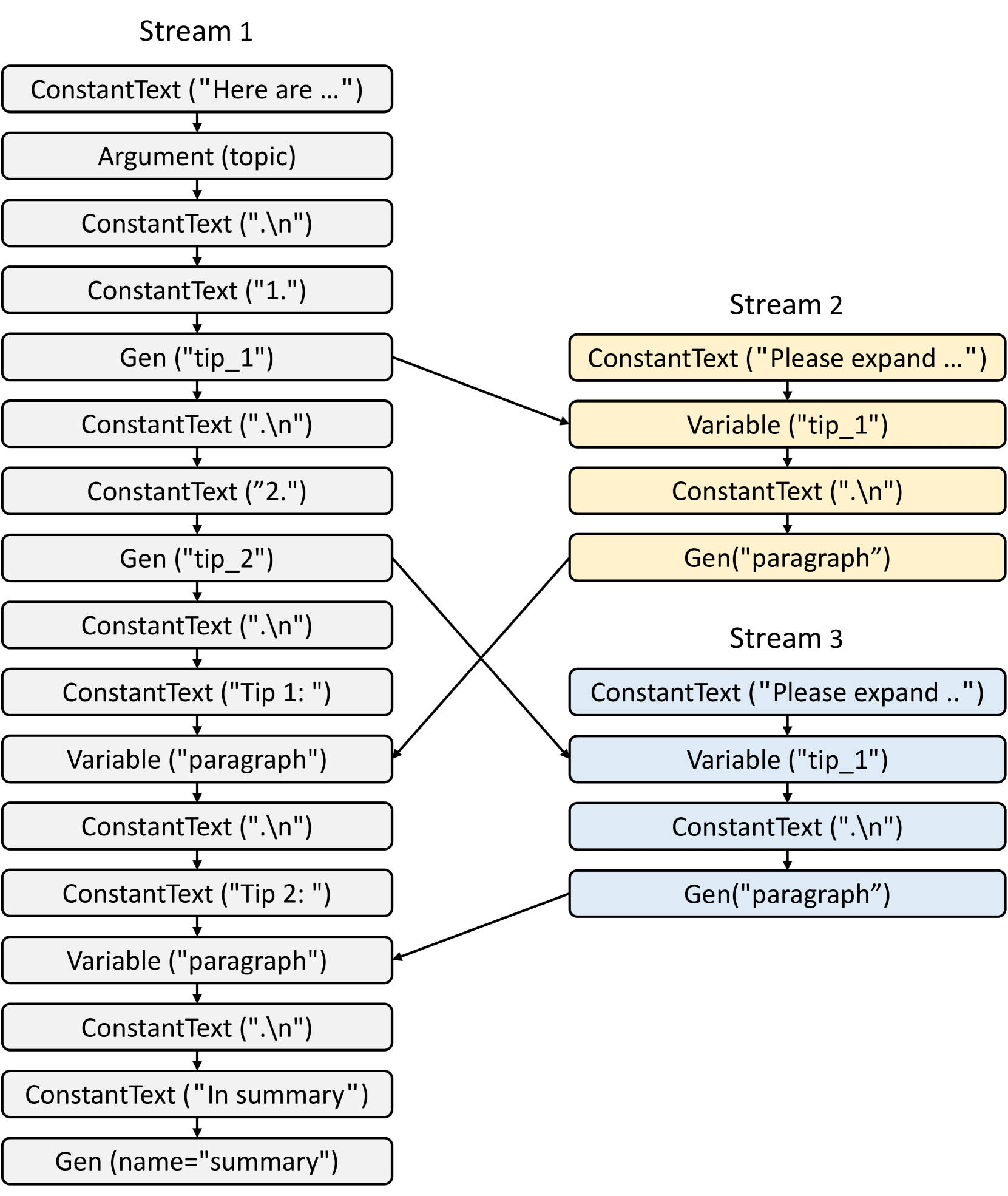
This diagram illustrates a parallelized text generation process involving three distinct streams (Stream 1, Stream 2, and Stream 3). It details the sequential logic of constant text insertion, variable handling, and generation calls, as well as the cross-stream dependencies.
## 1. Component Overview
The diagram consists of three vertical columns representing processing streams. Each stream contains a series of rounded rectangular nodes connected by downward arrows indicating sequential flow. Diagonal arrows indicate data dependencies between streams.
* **Stream 1 (Grey):** The primary control flow and final output assembly.
* **Stream 2 (Yellow):** A secondary generation stream for expanding specific content.
* **Stream 3 (Blue):** A tertiary generation stream for expanding specific content.
---
## 2. Detailed Stream Breakdown
### Stream 1 (Primary)
This stream follows a linear sequence with 17 distinct steps:
1. **ConstantText ("Here are ...")**
2. **Argument (topic)**
3. **ConstantText (".\n")**
4. **ConstantText ("1.")**
5. **Gen ("tip_1")** -> *Output feeds into Stream 2 and Stream 3.*
6. **ConstantText (".\n")**
7. **ConstantText ("2.")**
8. **Gen ("tip_2")** -> *Output feeds into Stream 3.*
9. **ConstantText (".\n")**
10. **ConstantText ("Tip 1: ")**
11. **Variable ("paragraph")** <- *Input received from Stream 2.*
12. **ConstantText (".\n")**
13. **ConstantText ("Tip 2: ")**
14. **Variable ("paragraph")** <- *Input received from Stream 3.*
15. **ConstantText (".\n")**
16. **ConstantText ("In summary")**
17. **Gen (name="summary")**
### Stream 2 (Secondary - Yellow)
Triggered by data from Stream 1, containing 4 steps:
1. **ConstantText ("Please expand ...")**
2. **Variable ("tip_1")** <- *Data sourced from Stream 1, Step 5.*
3. **ConstantText (".\n")**
4. **Gen ("paragraph")** -> *Output feeds back to Stream 1, Step 11.*
### Stream 3 (Tertiary - Blue)
Triggered by data from Stream 1, containing 4 steps:
1. **ConstantText ("Please expand ..")**
2. **Variable ("tip_1")** <- *Data sourced from Stream 1, Step 5.*
3. **ConstantText (".\n")**
4. **Gen ("paragraph")** -> *Output feeds back to Stream 1, Step 14.*
---
## 3. Cross-Stream Data Dependencies (Spatial Grounding)
The diagram uses diagonal arrows to show how generated outputs from one stream become variables in another:
| Source Node | Target Node | Direction |
| :--- | :--- | :--- |
| **Stream 1:** Gen ("tip_1") | **Stream 2:** Variable ("tip_1") | Down-Right |
| **Stream 1:** Gen ("tip_1") | **Stream 3:** Variable ("tip_1") | Down-Right |
| **Stream 1:** Gen ("tip_2") | **Stream 3:** Variable ("tip_1")* | Down-Right |
| **Stream 2:** Gen ("paragraph") | **Stream 1:** Variable ("paragraph") (Step 11) | Down-Left |
| **Stream 3:** Gen ("paragraph") | **Stream 1:** Variable ("paragraph") (Step 14) | Down-Left |
*\*Note: There is a visual overlap where the arrow from Stream 1's Gen ("tip_2") points toward the Variable node in Stream 3, which is labeled "tip_1". This suggests a potential mapping or reuse of the variable slot.*
---
## 4. Summary of Logic
The system initiates by setting a topic and generating two "tips" in Stream 1. These tips are then sent to parallel streams (2 and 3) where they are expanded into full paragraphs. Once the parallel streams complete their generation, the resulting "paragraphs" are pulled back into Stream 1 to be formatted into a final document that concludes with a generated summary.