## Line Graph: Training Loss Over Steps
### Overview
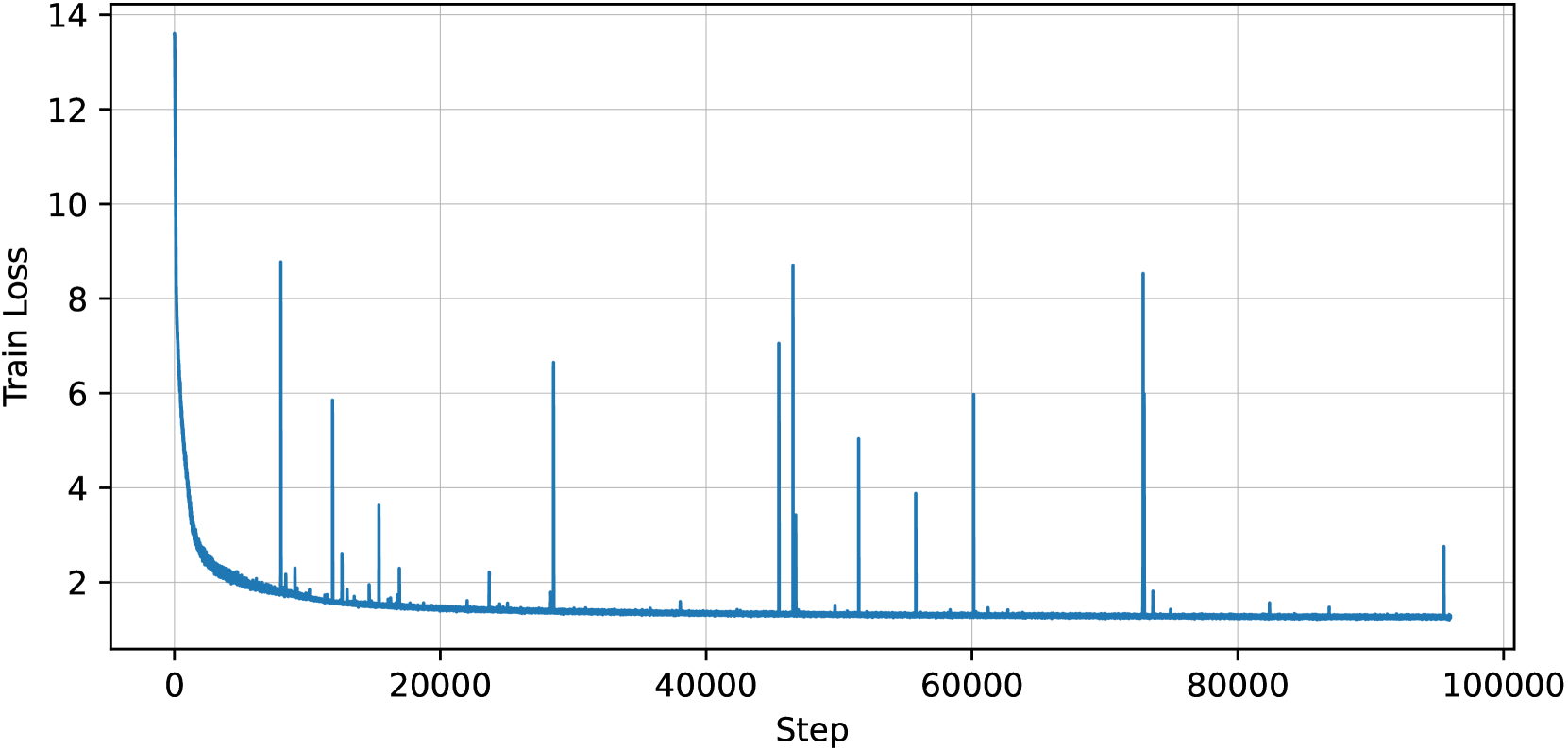
The image depicts a line graph tracking "Train Loss" (y-axis) across training steps (x-axis) from 0 to 100,000. The blue line exhibits an initial sharp decline, followed by intermittent spikes and gradual stabilization. The graph includes grid lines for reference.
### Components/Axes
- **Y-Axis (Train Loss)**: Labeled "Train Loss," scaled from 0 to 14 in increments of 2.
- **X-Axis (Step)**: Labeled "Step," scaled from 0 to 100,000 in increments of 20,000.
- **Legend**: Positioned in the top-right corner (inferred from standard conventions), though no explicit labels are visible in the image. The single blue line corresponds to "Train Loss."
- **Grid**: Light gray grid lines span the plot area for alignment.
### Detailed Analysis
- **Initial Drop**: The line starts at ~14 (step 0) and plunges to ~2 by step 10,000, indicating rapid initial learning.
- **Spikes**:
- Step 20,000: ~6
- Step 30,000: ~7
- Step 40,000: ~8
- Step 50,000: ~5
- Step 60,000: ~6
- Step 70,000: ~8
- Step 80,000: ~5
- Step 90,000: ~2
- **Final Value**: Stabilizes near ~1.5 by step 100,000.
### Key Observations
1. **Rapid Initial Decline**: Train loss decreases by ~90% (14 → 2) within the first 10,000 steps.
2. **Volatility**: Post-10,000 steps, the loss oscillates between ~1.5 and ~8, suggesting instability or overfitting.
3. **Final Convergence**: The loss stabilizes near ~1.5 by step 100,000, indicating eventual model convergence.
### Interpretation
The graph illustrates the training dynamics of a machine learning model. The sharp initial drop reflects effective early learning, while subsequent spikes may stem from:
- **Overfitting**: Temporary increases in loss due to model sensitivity to training data noise.
- **Optimization Challenges**: Local minima or saddle points in the loss landscape.
- **Data Batch Effects**: Variability in loss due to stochastic gradient updates.
The final convergence to ~1.5 suggests the model achieves a stable state, but the persistent fluctuations highlight potential areas for improvement, such as adjusting learning rates or regularization. This pattern is common in deep learning training, where early progress is rapid, but later stages require careful tuning to avoid instability.