## Bar Chart: Model-Specific Occupancy by Token Count
### Overview
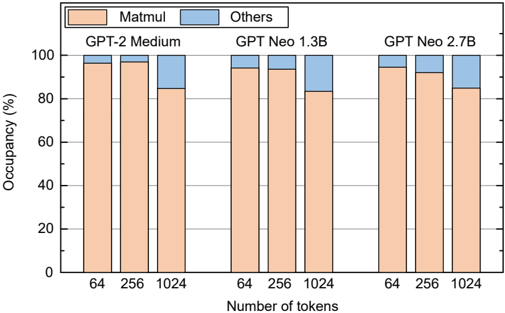
The chart compares occupancy percentages (Matmul vs. Others) across three AI models (GPT-2 Medium, GPT Neo 1.3B, GPT Neo 2.7B) at three token counts (64, 256, 1024). Occupancy is visualized as stacked bars, with Matmul (orange) and Others (blue) segments.
### Components/Axes
- **X-axis**: "Number of tokens" (64, 256, 1024)
- **Y-axis**: "Occupancy (%)" (0–100)
- **Legend**:
- Orange = Matmul
- Blue = Others
- **Model Groups**:
- GPT-2 Medium (leftmost group)
- GPT Neo 1.3B (middle group)
- GPT Neo 2.7B (rightmost group)
### Detailed Analysis
- **GPT-2 Medium**:
- 64 tokens: Matmul ~95%, Others ~5%
- 256 tokens: Matmul ~95%, Others ~5%
- 1024 tokens: Matmul ~85%, Others ~15%
- **GPT Neo 1.3B**:
- 64 tokens: Matmul ~90%, Others ~10%
- 256 tokens: Matmul ~90%, Others ~10%
- 1024 tokens: Matmul ~80%, Others ~20%
- **GPT Neo 2.7B**:
- 64 tokens: Matmul ~90%, Others ~10%
- 256 tokens: Matmul ~85%, Others ~15%
- 1024 tokens: Matmul ~80%, Others ~20%
### Key Observations
1. **Matmul Dominance**: Matmul consistently occupies >80% of total occupancy across all models and token counts.
2. **Token Count Impact**:
- Matmul occupancy decreases slightly as token count increases (e.g., 95% → 85% for GPT-2 Medium at 1024 tokens).
- Others occupancy increases with token count (e.g., 5% → 15% for GPT-2 Medium at 1024 tokens).
3. **Model-Specific Trends**:
- GPT-2 Medium maintains the highest Matmul occupancy.
- GPT Neo 2.7B shows the largest drop in Matmul occupancy (90% → 80%) at 1024 tokens.
### Interpretation
The data suggests that Matmul operations dominate computational resources for smaller token counts, but their efficiency diminishes as token size grows. The increasing share of "Others" (likely non-Matmul operations) at higher token counts implies that larger workloads require more diverse computational resources. GPT-2 Medium appears more Matmul-efficient than the GPT Neo variants, potentially indicating architectural differences in how these models handle matrix operations. The trend of declining Matmul efficiency with scale aligns with expectations for memory-bound workloads, where larger token sizes may introduce overhead from data movement or non-linear operations.