## Linguistic Model Diagram
### Overview
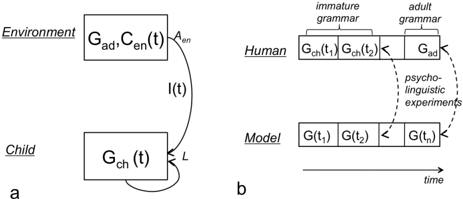
The image presents two diagrams illustrating models of language acquisition. Diagram 'a' shows a cyclical interaction between the environment and a child, while diagram 'b' compares the development of grammar in humans and a simplified model over time.
### Components/Axes
**Diagram a:**
* **Nodes:**
* Environment: Labeled "Environment" with the expression "G<sub>ad</sub>, C<sub>en</sub>(t)" inside a rectangular box. "G<sub>ad</sub>" likely refers to adult grammar, and "C<sub>en</sub>(t)" to environmental context as a function of time.
* Child: Labeled "Child" with the expression "G<sub>ch</sub>(t)" inside a rectangular box. "G<sub>ch</sub>(t)" likely refers to child grammar as a function of time.
* **Edges:**
* An arrow labeled "A<sub>en</sub>" points from the "Environment" box to the start of a curved arrow labeled "I(t)" that points to the "Child" box. "A<sub>en</sub>" likely represents environmental input. "I(t)" represents the input to the child as a function of time.
* A curved arrow labeled "L" points from the "Child" box back to itself. "L" likely represents learning or feedback.
**Diagram b:**
* **Horizontal Axis:** Represents time, indicated by an arrow labeled "time".
* **Vertical Labels:**
* Human: Shows a sequence of grammar stages: "G<sub>ch</sub>(t<sub>1</sub>)", "G<sub>ch</sub>(t<sub>2</sub>)", and "G<sub>ad</sub>". "G<sub>ch</sub>" likely refers to child grammar, and "G<sub>ad</sub>" to adult grammar. The first two stages are grouped under "immature grammar", and the last stage is under "adult grammar".
* Model: Shows a sequence of grammar stages: "G(t<sub>1</sub>)", "G(t<sub>2</sub>)", and "G(t<sub>n</sub>)".
* **Arrows:**
* "<" symbols indicate the progression of grammar stages in both the Human and Model sequences.
* A dashed curved arrow labeled "psycho-linguistic experiments" points from the "G<sub>ad</sub>" stage in the Human sequence to the "G(t<sub>n</sub>)" stage in the Model sequence.
### Detailed Analysis or ### Content Details
**Diagram a:**
* The "Environment" node represents the linguistic environment to which the child is exposed. The expression "G<sub>ad</sub>, C<sub>en</sub>(t)" suggests that this environment consists of adult grammar and contextual information that changes over time.
* The "Child" node represents the child's current grammar. The expression "G<sub>ch</sub>(t)" indicates that the child's grammar evolves over time.
* The arrow "I(t)" represents the input from the environment to the child.
* The arrow "L" represents the child's learning process, which modifies their grammar based on the input they receive.
* The arrow "A<sub>en</sub>" represents the attention the child gives to the environment.
**Diagram b:**
* The "Human" sequence represents the stages of grammar development in a human child, progressing from immature grammar ("G<sub>ch</sub>(t<sub>1</sub>)", "G<sub>ch</sub>(t<sub>2</sub>)") to adult grammar ("G<sub>ad</sub>").
* The "Model" sequence represents a simplified model of grammar development, progressing through a series of stages "G(t<sub>1</sub>)", "G(t<sub>2</sub>)", ..., "G(t<sub>n</sub>)".
* The dashed arrow labeled "psycho-linguistic experiments" suggests that the model is validated or informed by data from psycho-linguistic experiments.
### Key Observations
* Diagram 'a' illustrates a feedback loop between the environment and the child, where the child's grammar is influenced by the environment, and the child's output may, in turn, influence the environment.
* Diagram 'b' compares the development of grammar in humans and a simplified model, highlighting the progression from immature to adult grammar.
* The "psycho-linguistic experiments" arrow suggests that the model is grounded in empirical data.
### Interpretation
The diagrams present a simplified model of language acquisition, emphasizing the interaction between the environment and the child. Diagram 'a' highlights the cyclical nature of this interaction, while diagram 'b' compares the developmental stages in humans and a simplified model. The model is likely used to simulate or understand the process of language acquisition, and the "psycho-linguistic experiments" arrow suggests that the model is validated or informed by empirical data. The model simplifies the complex process of language acquisition into discrete stages, which may not fully capture the nuances of human language development.