## Line Chart: MathVista Accuracy (%) vs. # Solutions per Problem
### Overview
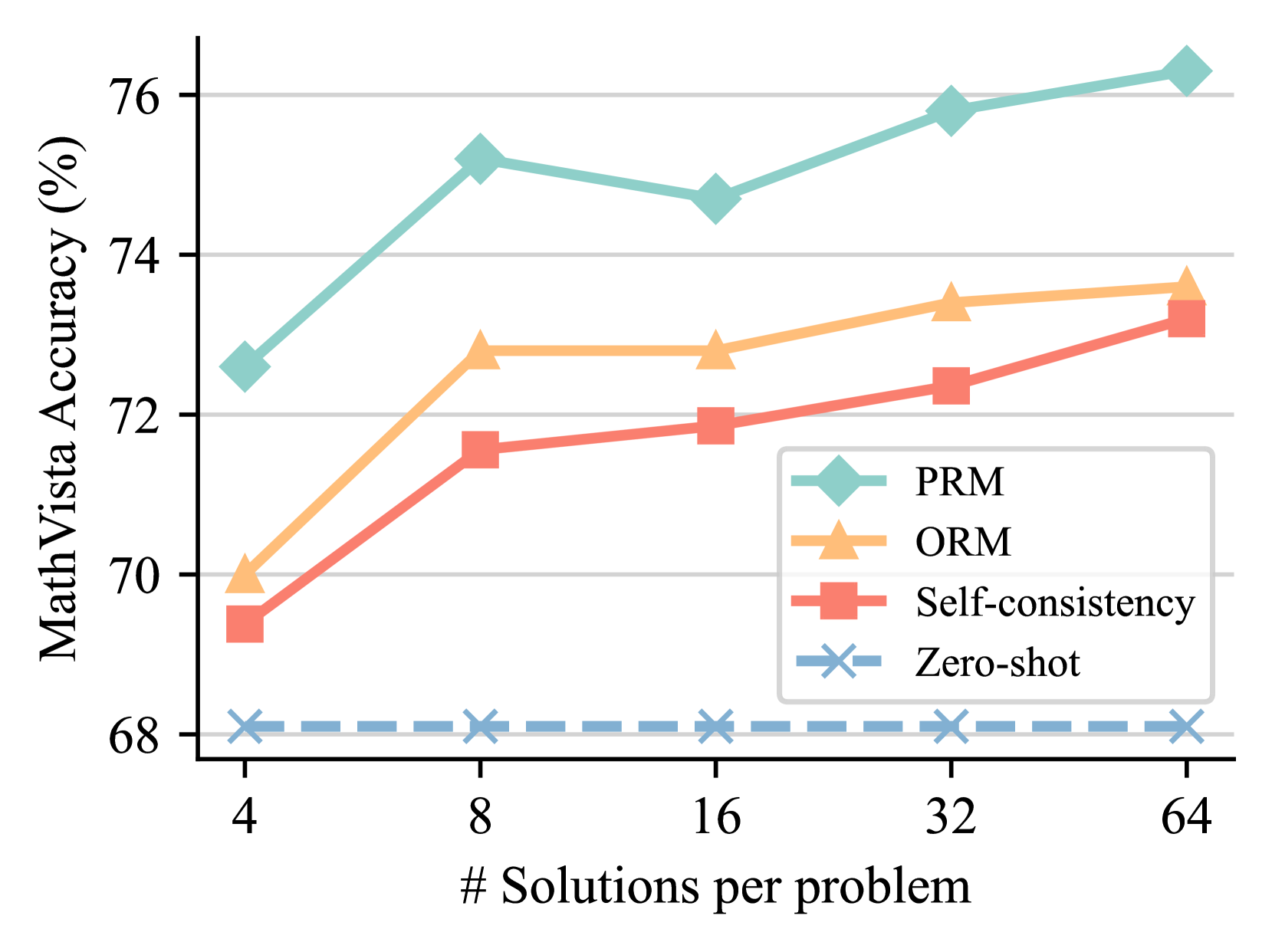
The chart compares the accuracy of four methods (PRM, ORM, Self-consistency, Zero-shot) across varying numbers of solutions per problem (4, 8, 16, 32, 64). Accuracy is measured in percentage, with PRM achieving the highest values and Zero-shot remaining constant.
### Components/Axes
- **X-axis**: "# Solutions per problem" (logarithmic scale: 4, 8, 16, 32, 64).
- **Y-axis**: "MathVista Accuracy (%)" (68% to 76%).
- **Legend**:
- **PRM**: Teal diamond line (highest accuracy).
- **ORM**: Orange triangle line.
- **Self-consistency**: Red square line.
- **Zero-shot**: Dashed blue cross line (baseline at 68%).
### Detailed Analysis
1. **PRM (Teal)**:
- Starts at ~72.5% (4 solutions), peaks at ~76.5% (64 solutions).
- Steady upward trend with minor fluctuations (e.g., slight dip at 16 solutions).
2. **ORM (Orange)**:
- Begins at ~70% (4 solutions), rises to ~73.5% (64 solutions).
- Gradual increase with minor plateaus (e.g., stable at 16 and 32 solutions).
3. **Self-consistency (Red)**:
- Starts at ~69.5% (4 solutions), ends at ~73% (64 solutions).
- Consistent upward trajectory with no dips.
4. **Zero-shot (Blue)**:
- Flat line at ~68% across all solution counts.
### Key Observations
- **PRM dominates** in accuracy, outperforming all methods by ~3–4% at 64 solutions.
- **ORM and Self-consistency** show similar improvement patterns but lag behind PRM.
- **Zero-shot** remains unchanged, serving as a static baseline.
- **Divergence grows** with more solutions: PRM’s lead over others widens significantly (e.g., ~3.5% gap at 64 solutions vs. ~2% at 4 solutions).
### Interpretation
The data suggests that **increasing the number of solutions per problem improves accuracy** for PRM, ORM, and Self-consistency, with PRM being the most scalable method. Zero-shot’s stagnation implies it lacks adaptive mechanisms to leverage additional solutions. The logarithmic x-axis hints at exponential scaling benefits for PRM, potentially due to its architecture (e.g., iterative refinement). ORM and Self-consistency may rely on simpler heuristics, limiting their gains. This trend underscores the importance of solution quantity in optimizing performance for complex tasks.