\n
## Diagram: API Comparison Triangle
### Overview
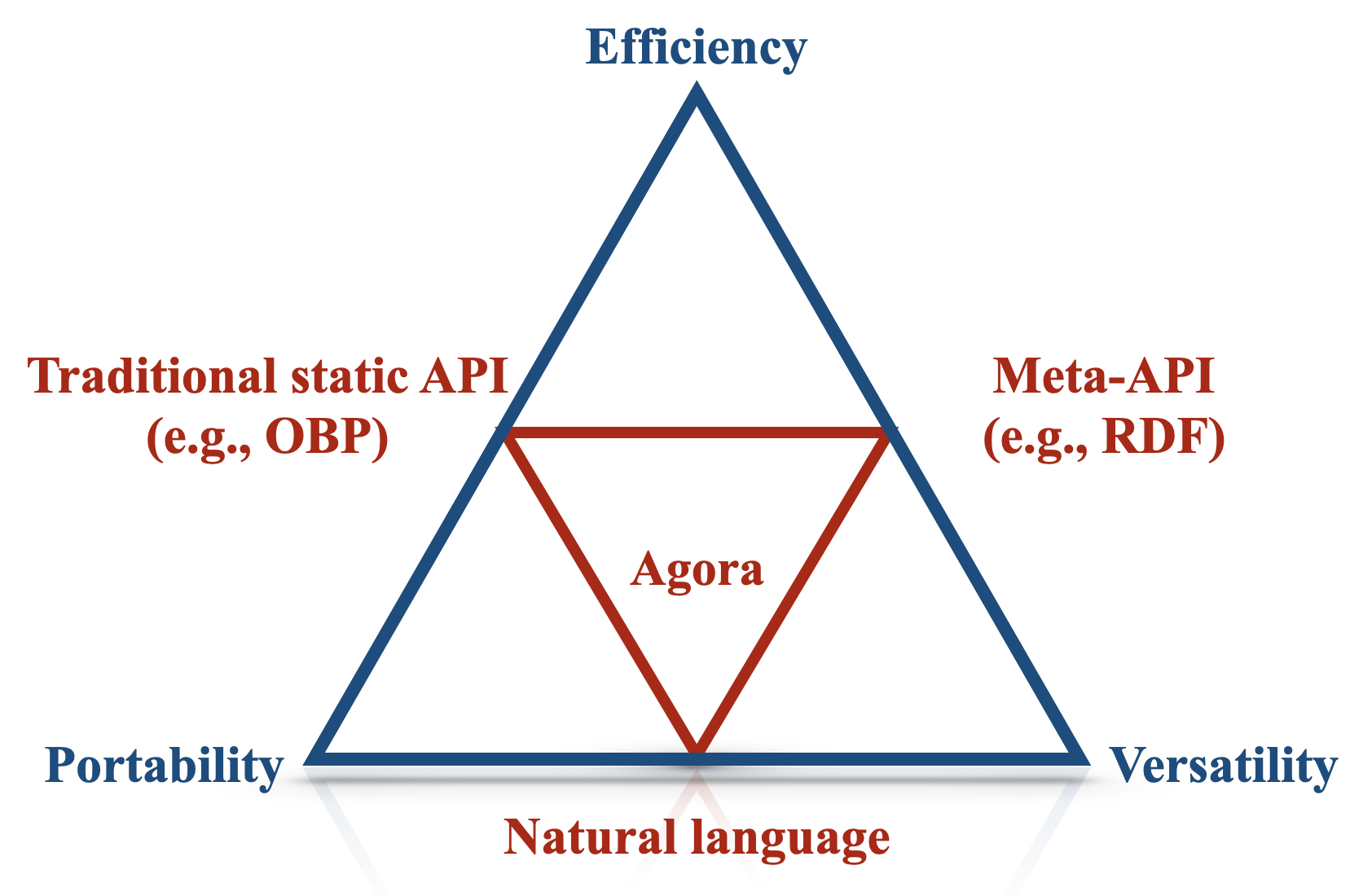
The image is a triangular diagram illustrating a comparison between three API approaches: Traditional static API (with OBP as an example), Meta-API (with RDF as an example), and Agora. The triangle's vertices represent three key characteristics: Efficiency, Portability, and Versatility. The diagram visually represents the trade-offs and strengths of each API type across these characteristics.
### Components/Axes
The diagram consists of an equilateral triangle with the following labels:
* **Vertices:**
* Top: "Efficiency"
* Bottom-Left: "Portability"
* Bottom-Right: "Versatility"
* **Sides:** Each side is labeled with an API type:
* Top-Left: "Traditional static API (e.g., OBP)" - colored in dark red.
* Top-Right: "Meta-API (e.g., RDF)" - colored in dark red.
* Bottom: "Natural language" - colored in dark red.
* **Center:** "Agora" - colored in dark red.
### Detailed Analysis
The diagram doesn't contain numerical data, but rather a visual representation of relative strengths.
* **Traditional static API (OBP):** This API type is positioned along the "Efficiency" and "Portability" axes. It suggests a strong focus on these two characteristics, potentially at the expense of "Versatility".
* **Meta-API (RDF):** This API type is positioned along the "Efficiency" and "Versatility" axes. It suggests a strong focus on these two characteristics, potentially at the expense of "Portability".
* **Agora:** Located in the center of the triangle, Agora appears to represent a balance between all three characteristics – Efficiency, Portability, and Versatility. It occupies the intersection of all three API types.
* **Natural Language:** This is positioned along the "Portability" and "Versatility" axes. It suggests a strong focus on these two characteristics, potentially at the expense of "Efficiency".
### Key Observations
* The diagram highlights a trade-off between the three characteristics. No single API type excels in all three areas.
* Agora is presented as a solution that attempts to bridge the gap and offer a more balanced approach.
* The examples provided (OBP and RDF) are used to anchor the positions of the Traditional and Meta-APIs, respectively.
### Interpretation
The diagram suggests that choosing an API involves prioritizing certain characteristics over others. Traditional static APIs are efficient and portable, but may lack versatility. Meta-APIs are efficient and versatile, but may be less portable. Agora aims to provide a more holistic solution by balancing all three characteristics. The inclusion of "Natural language" suggests that this approach prioritizes portability and versatility, but may be less efficient.
The diagram is a conceptual model, and doesn't provide quantitative data. It's a qualitative representation of the strengths and weaknesses of different API approaches. The positioning of each API type within the triangle is subjective and based on the designer's assessment of their relative strengths. The diagram implies that Agora is a novel approach that attempts to overcome the limitations of traditional and meta-APIs by offering a more balanced set of features.