\n
## Diagram: API Design Trade-off Triangle
### Overview
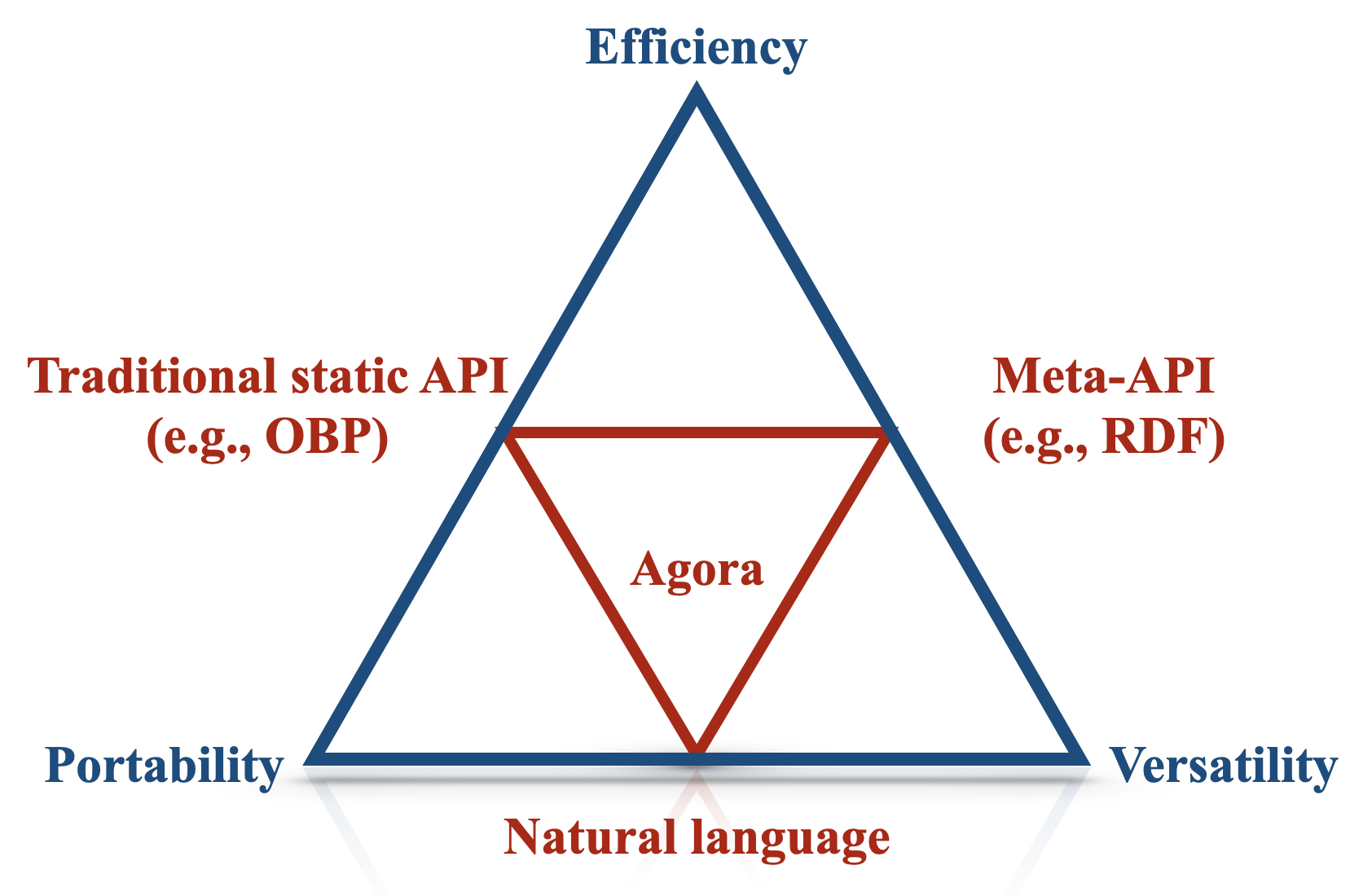
The image displays a conceptual diagram illustrating the trade-offs and relationships between different API design paradigms. It uses a nested triangle structure to position various approaches relative to three core attributes: Efficiency, Portability, and Versatility. The diagram suggests that different API styles prioritize different combinations of these attributes, with a central system named "Agora" attempting to balance them.
### Components/Axes
The diagram consists of two main geometric components and several text labels.
**1. Outer Triangle (Blue Outline):**
* **Vertices (Core Attributes):**
* **Top Vertex:** "Efficiency"
* **Bottom-Left Vertex:** "Portability"
* **Bottom-Right Vertex:** "Versatility"
* These three labels form the primary axes of the trade-off space.
**2. Inner Triangle (Red Outline):**
* This smaller, inverted triangle is centered within the larger one.
* **Central Label:** "Agora"
* The vertices of this inner triangle point towards the midpoints of the outer triangle's sides, suggesting a balanced or integrative position.
**3. Surrounding Paradigm Labels (Red Text):**
These labels are placed outside the main triangle, adjacent to its sides, indicating API styles or approaches associated with specific trade-offs.
* **Left Side (Adjacent to the Portability-Efficiency axis):** "Traditional static API (e.g., OBP)"
* **Right Side (Adjacent to the Versatility-Efficiency axis):** "Meta-API (e.g., RDF)"
* **Bottom Side (Adjacent to the Portability-Versatility axis):** "Natural language"
### Detailed Analysis
The diagram is a spatial metaphor for conceptual relationships, not a data chart with numerical values. The analysis focuses on the positioning and implied connections.
* **Spatial Grounding & Relationships:**
* The **"Traditional static API (e.g., OBP)"** label is positioned on the left, between the "Portability" and "Efficiency" vertices. This implies such APIs are strong in these two areas but may lack versatility.
* The **"Meta-API (e.g., RDF)"** label is positioned on the right, between the "Versatility" and "Efficiency" vertices. This implies such APIs are strong in versatility and efficiency but may sacrifice portability.
* The **"Natural language"** label is positioned at the bottom, between the "Portability" and "Versatility" vertices. This implies natural language interfaces are highly portable and versatile but may be less efficient.
* **"Agora"** is placed at the very center of the diagram, inside the inner red triangle. Its central position suggests it is designed to achieve a balance or synthesis of all three core attributes (Efficiency, Portability, Versatility), potentially overcoming the trade-offs inherent in the other paradigms.
* **Visual Trend/Flow:** The diagram creates a visual flow from the outer, specialized paradigms towards the inner, balanced solution. The inner triangle's vertices point outward, connecting Agora's balanced core to the midpoints of the trade-off axes defined by the outer triangle.
### Key Observations
1. **Triangular Trade-off Model:** The use of a triangle is a classic way to represent a three-way trade-off, where optimizing for two points often comes at the expense of the third.
2. **Color Coding:** Blue is used for the foundational attributes (the axes), while red is used for the specific API paradigms and the central "Agora" system, creating a clear visual distinction between the framework and the instances within it.
3. **Centrality of Agora:** The most prominent visual feature is the placement of "Agora" at the geometric center, framed by its own red triangle. This is a strong visual statement positioning it as the integrative or optimal solution within this conceptual space.
4. **Example-Driven Labels:** The paradigms are not just named but given concrete examples ("e.g., OBP", "e.g., RDF"), grounding the abstract concepts in real-world technologies.
### Interpretation
This diagram presents a conceptual framework for evaluating API design philosophies. It argues that traditional approaches force a compromise:
* **Traditional Static APIs** (like a hypothetical OBP) are efficient and portable but not versatile.
* **Meta-APIs** (like RDF) are efficient and versatile but not portable.
* **Natural Language** interfaces are portable and versatile but not efficient.
The diagram's central thesis is that a system named **"Agora"** is designed to transcend this trilemma. By occupying the central space, it claims to successfully integrate all three desirable properties—Efficiency, Portability, and Versatility—without the severe trade-offs of the other models. The diagram is therefore a persuasive tool, using spatial logic to position Agora as a superior, holistic solution in the landscape of API and interaction design. It suggests that Agora's approach may involve a novel synthesis of structured APIs and flexible, natural-language-like interaction.