## Triangle Diagram: API Design Trade-offs
### Overview
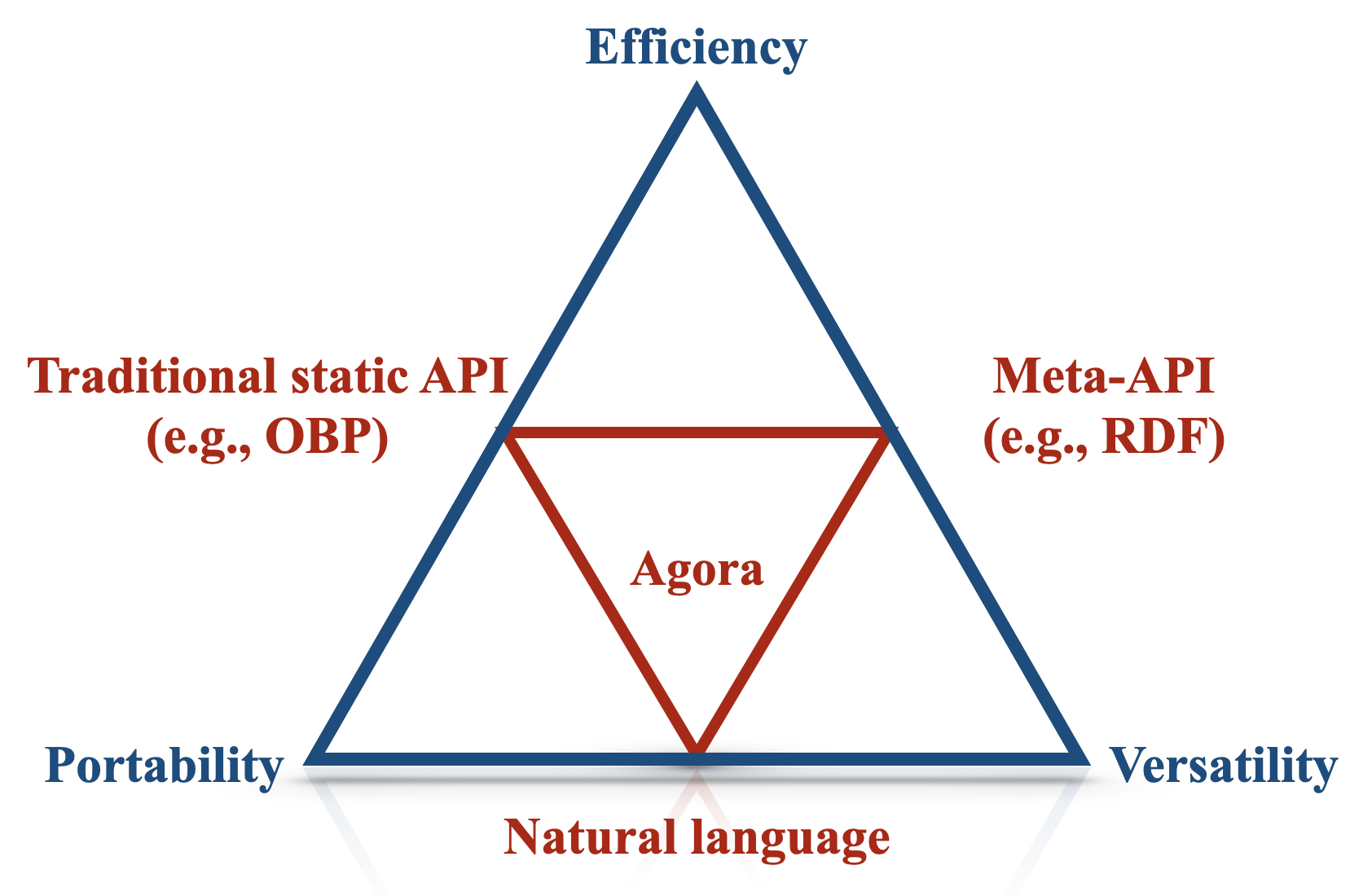
The image presents a triangular diagram comparing two API design paradigms: **Traditional static API (e.g., OBP)** and **Meta-API (e.g., RDF)**. The diagram uses a blue outer triangle and a red inner inverted triangle to represent trade-offs between three axes: **Efficiency**, **Portability**, and **Versatility**. A smaller inverted triangle labeled **"Agora"** is centered within the main triangle, with **"Natural language"** positioned at the bottom of the inner triangle.
---
### Components/Axes
1. **Main Triangle (Blue)**:
- **Vertices**:
- **Top**: **Efficiency**
- **Bottom-left**: **Portability**
- **Bottom-right**: **Versatility**
- **Sides**:
- **Left side**: **Traditional static API (e.g., OBP)**
- **Right side**: **Meta-API (e.g., RDF)**
- **Legend**: Blue represents the outer triangle (Traditional static API).
2. **Inner Inverted Triangle (Red)**:
- **Label**: **Agora**
- **Bottom vertex**: **Natural language**
- **Legend**: Red represents the inner triangle (Agora).
---
### Detailed Analysis
- **Axes and Labels**:
- The three axes (**Efficiency**, **Portability**, **Versatility**) form the primary framework for evaluating API design.
- The **Traditional static API (OBP)** is associated with the left side of the triangle, while the **Meta-API (RDF)** is linked to the right side.
- The **Agora** label is placed centrally within the inner triangle, suggesting a balanced or hybrid approach.
- **Natural language** is positioned at the bottom of the inner triangle, possibly indicating a foundational or contextual layer for API design.
- **Color Coding**:
- **Blue**: Outer triangle (Traditional static API).
- **Red**: Inner inverted triangle (Agora).
- **Spatial Relationships**:
- The **Agora** triangle is smaller and inverted, positioned centrally within the main triangle.
- **Natural language** is anchored at the bottom of the inner triangle, aligning with the **Portability** axis of the main triangle.
---
### Key Observations
1. **Trade-off Visualization**:
- The outer triangle emphasizes the trade-offs between **Efficiency**, **Portability**, and **Versatility** for traditional and meta-APIs.
- The inner triangle (Agora) suggests a middle ground or optimized balance between these axes.
2. **Natural Language Role**:
- The placement of **Natural language** at the bottom of the inner triangle implies it may serve as a unifying or contextual element for API design, bridging the gap between technical and human-centric considerations.
3. **Color Significance**:
- The use of **blue** for the outer triangle and **red** for the inner triangle visually distinguishes the two API paradigms and their respective trade-offs.
---
### Interpretation
- **API Design Paradigms**:
- The diagram contrasts **Traditional static APIs** (e.g., OBP) with **Meta-APIs** (e.g., RDF), highlighting their differing priorities in terms of efficiency, portability, and versatility.
- **Agora** represents a hybrid or optimized approach that balances these trade-offs, potentially integrating the strengths of both paradigms.
- **Natural Language as a Foundation**:
- The inclusion of **Natural language** at the bottom of the inner triangle suggests it may act as a foundational layer, enabling APIs to be more human-readable, context-aware, or adaptable across domains.
- **Design Implications**:
- The inverted triangle for **Agora** could symbolize a departure from rigid trade-offs, emphasizing flexibility or innovation in API design.
- The central positioning of **Agora** implies it may represent an ideal or aspirational model for future API development.
---
### Conclusion
This diagram illustrates the complex trade-offs in API design, contrasting traditional and meta-API approaches while introducing **Agora** as a balanced or innovative paradigm. The inclusion of **Natural language** at the base of the inner triangle highlights its potential role in bridging technical and human-centric aspects of API development. The use of color and spatial positioning reinforces the relationships between these concepts, offering a framework for evaluating API design strategies.