## Diagram: Evolution of Knowledge Dissemination Technologies
### Overview
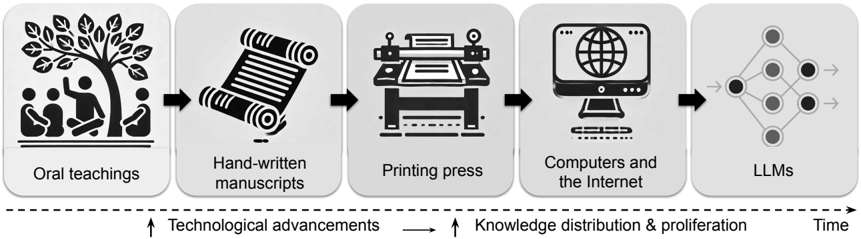
The image is a horizontal flowchart illustrating the historical progression of technologies used for the creation, storage, and distribution of human knowledge. It presents a linear timeline from left to right, showing five distinct technological stages, each represented by a symbolic icon and a label. A timeline axis at the bottom contextualizes this progression.
### Components/Axes
**Main Flowchart Components (Left to Right):**
1. **Stage 1:** Icon of a tree with several human figures beneath it. Label: **"Oral teachings"**.
2. **Stage 2:** Icon of an unrolled scroll. Label: **"Hand-written manuscripts"**.
3. **Stage 3:** Icon of a mechanical printing press. Label: **"Printing press"**.
4. **Stage 4:** Icon of a desktop computer monitor displaying a globe. Label: **"Computers and the Internet"**.
5. **Stage 5:** Icon of a neural network diagram (nodes connected by lines). Label: **"LLMs"**.
**Connectors:** Solid black arrows point from each stage to the next, indicating a direct sequential progression.
**Timeline Axis (Bottom):**
* A horizontal dashed line runs the full width of the diagram.
* The right end of the line is labeled **"Time"**.
* Two upward-pointing arrows originate from the dashed line:
* The left arrow is labeled **"Technological advancements"**.
* The right arrow is labeled **"Knowledge distribution & proliferation"**.
* This axis indicates that both technological advancement and the scale of knowledge distribution increase over time as one moves from left to right through the stages.
### Detailed Analysis
The diagram presents a clear, five-step model of technological evolution in knowledge management:
1. **Oral teachings:** Represents the earliest, pre-literate form of knowledge transfer, dependent on direct human interaction and memory.
2. **Hand-written manuscripts:** Marks the advent of recorded knowledge, allowing for physical storage and limited replication, though still labor-intensive and rare.
3. **Printing press:** A pivotal technological leap enabling the mass production and widespread distribution of standardized texts, democratizing access to information.
4. **Computers and the Internet:** Represents the digital revolution, enabling instantaneous global communication, vast data storage, and the creation of a interconnected, accessible repository of human knowledge.
5. **LLMs (Large Language Models):** The final stage shown, symbolizing the current era of artificial intelligence capable of processing, synthesizing, and generating human-like text and knowledge at an unprecedented scale and speed.
The visual flow is strictly linear and unidirectional, suggesting a model of cumulative progress where each technology builds upon the capabilities of the previous one.
### Key Observations
* **Iconography:** Each icon is a simplified, universally recognizable symbol for its respective technology (e.g., scroll for manuscripts, globe on screen for the internet).
* **Progression Logic:** The sequence follows a logical historical and technological order, from human-centric to machine-assisted to AI-driven processes.
* **Dual-Axis Growth:** The bottom timeline explicitly correlates the passage of time with two parallel trends: increasing technological sophistication and increasing capacity for knowledge distribution.
* **LLMs as Culmination:** Placing "LLMs" as the final stage positions modern AI as the latest and most advanced paradigm in this historical continuum.
### Interpretation
This diagram is a conceptual model arguing that the history of human knowledge is inextricably linked to the history of communication technology. It suggests a Peircean progression where each new technology (an *interpretant*) creates a new relationship between humanity (the *object*) and knowledge itself (the *representamen*).
The core message is that technological advancements are the primary driver for expanding the reach, accessibility, and volume of shared knowledge. The progression from oral to digital to AI-mediated knowledge implies an exponential increase in the speed and scale of information proliferation. By ending with LLMs, the diagram implies that we are currently in a transformative phase where AI is not just a tool for distributing existing knowledge but is becoming an active agent in its synthesis and generation, potentially altering the very nature of how knowledge is created and understood. The model is teleological, presenting this evolution as a forward march toward greater efficiency and scale.