## Flowchart: Evolution of Knowledge Dissemination Technologies
### Overview
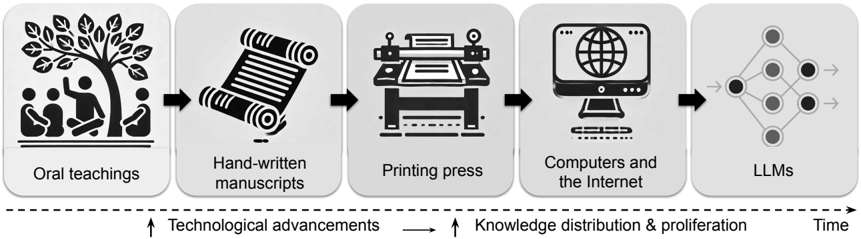
The image depicts a horizontal flowchart illustrating the progression of knowledge dissemination technologies over time. It traces the evolution from oral traditions to modern AI-driven systems, emphasizing technological advancements and their impact on knowledge distribution.
### Components/Axes
- **Horizontal Axis**: Time (left to right progression)
- **Vertical Arrows**:
- "Technological advancements" (upward)
- "Knowledge distribution & proliferation" (upward)
- **Stages**:
1. **Oral teachings** (icon: group of people under a tree)
2. **Hand-written manuscripts** (icon: scroll)
3. **Printing press** (icon: mechanical press)
4. **Computers and the Internet** (icon: computer with globe)
5. **LLMs** (icon: interconnected nodes)
### Detailed Analysis
- **Flow Direction**: All stages are connected by rightward arrows, indicating chronological progression.
- **Technological Advancements**: Vertical upward arrows link each stage to the next, emphasizing incremental improvements in technology.
- **Knowledge Distribution**: Vertical upward arrows also highlight increasing accessibility and reach of knowledge at each stage.
- **Icons/Text**: Each stage includes a minimalist icon and label, with no additional textual data or numerical values.
### Key Observations
- **Linear Progression**: Knowledge dissemination technologies evolve in a clear, sequential manner.
- **Dual Axes**: The diagram visually reinforces that technological progress and knowledge proliferation are interdependent.
- **Modern Focus**: The final stage (LLMs) is represented by an abstract network diagram, suggesting complexity and interconnectedness.
### Interpretation
This flowchart demonstrates how each technological leap (from oral traditions to LLMs) has exponentially increased the speed, scale, and accessibility of knowledge sharing. The upward vertical arrows imply that advancements in technology directly correlate with broader societal access to information. The transition from physical (scrolls, printing presses) to digital (computers, internet) and finally to AI-driven systems (LLMs) reflects a shift from localized, manual processes to global, automated networks. The absence of quantitative data suggests the focus is on conceptual rather than statistical evolution.