## Flowchart: Proof Generation and Verification Process
### Overview
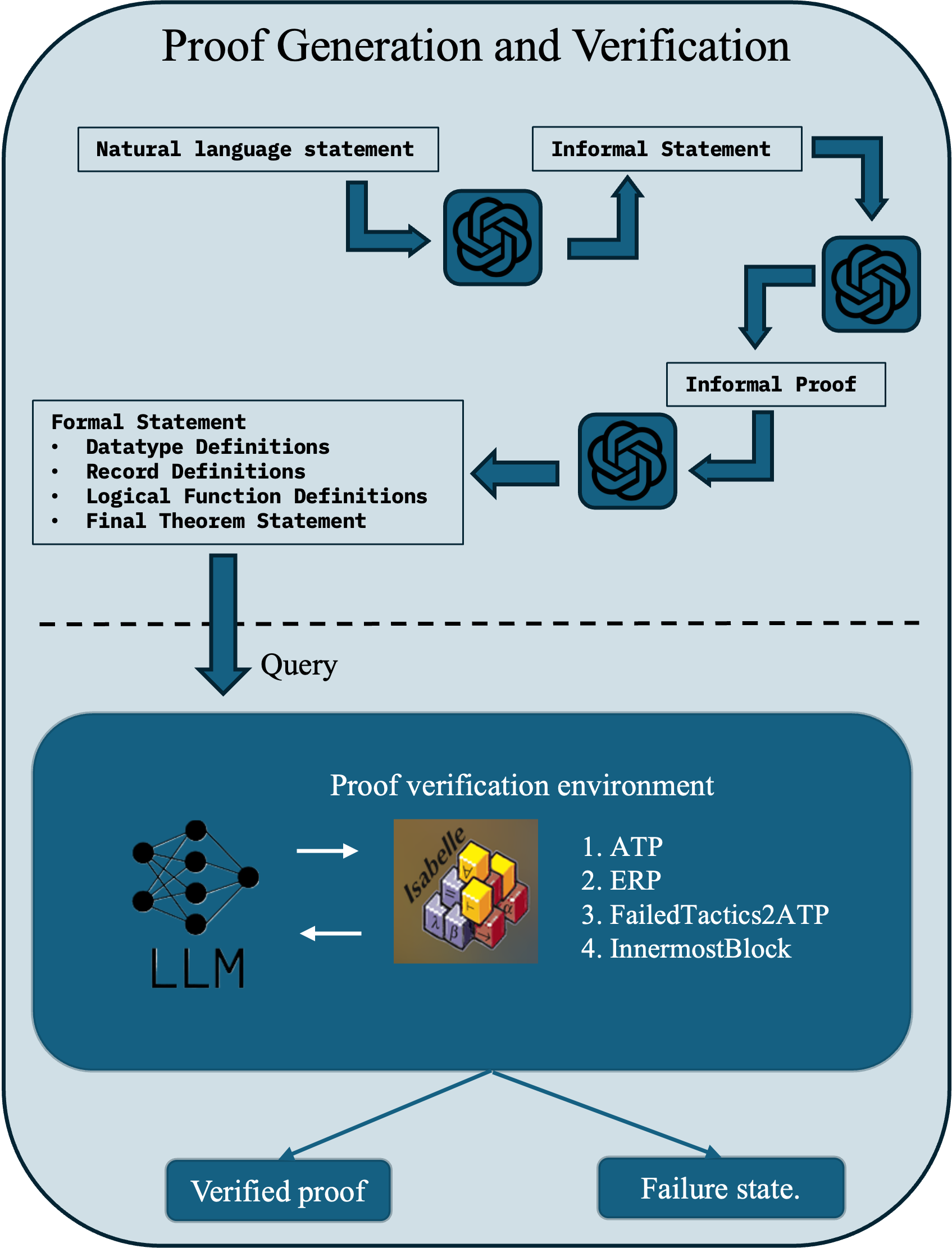
The diagram illustrates a bidirectional workflow for generating and verifying formal proofs, starting from natural language statements and progressing through formalization, proof construction, and verification. It includes components for logical reasoning, automated theorem proving, and error handling.
### Components/Axes
1. **Input/Output Flow**:
- **Natural language statement** → **Informal Statement** → **Formal Statement** (with sub-components: Datatype Definitions, Record Definitions, Logical Function Definitions, Final Theorem Statement).
- **Informal Proof** feeds back into the **Proof verification environment**.
- **Query** connects the Formal Statement to the verification process.
- **Verified proof** and **Failure state** are terminal outcomes.
2. **Verification Environment**:
- **LLM** (Large Language Model) processes inputs.
- **ATP** (Automated Theorem Prover), **ERP** (Error Resolution Protocol), **FailedTactics2ATP**, and **InermostBlock** represent verification steps.
3. **Visual Elements**:
- **Dashed line**: Indicates a query or intermediate step.
- **Circular icons**: Represent transformation nodes (e.g., "Informal Statement" to "Formal Statement").
- **Block diagram**: Depicts the verification environment with interconnected steps.
### Detailed Analysis
- **Natural Language to Formalization**:
- Natural language statements are first converted into informal statements, which are then formalized into structured definitions and theorems.
- The formal statement includes explicit datatype, record, and logical function definitions, culminating in a final theorem statement.
- **Proof Verification**:
- The formal statement is queried into the **Proof verification environment**, which uses an **LLM** to process inputs.
- The verification process involves sequential steps:
1. **ATP** (Automated Theorem Prover)
2. **ERP** (Error Resolution Protocol)
3. **FailedTactics2ATP** (Retrying failed tactics with the ATP)
4. **InermostBlock** (Final verification check)
- Outcomes depend on the success of these steps, leading to either a **Verified proof** or a **Failure state**.
- **Feedback Loop**:
- The **Informal Proof** generated during the process feeds back into the verification environment, enabling iterative refinement.
### Key Observations
1. **Bidirectional Flow**: The process allows refinement between informal and formal statements, suggesting an iterative approach to proof construction.
2. **Modular Verification**: The verification environment breaks down into discrete, sequential steps (ATP → ERP → FailedTactics2ATP → InermostBlock), emphasizing systematic error checking.
3. **LLM Centrality**: The Large Language Model acts as the core engine for transforming and verifying statements, integrating natural language understanding with formal logic.
### Interpretation
This diagram represents a hybrid approach to formal proof generation, combining natural language processing (via LLM) with automated theorem proving. The feedback loop between informal and formal statements highlights the importance of human-AI collaboration in refining proofs. The verification environment’s modular design ensures robustness, with multiple checks to handle errors and edge cases. The presence of "FailedTactics2ATP" and "InermostBlock" suggests a focus on resilience, allowing the system to retry failed steps or isolate critical components for deeper analysis. The process ultimately aims to bridge the gap between intuitive human reasoning and machine-verified formalism, critical for applications in mathematics, computer science, and AI safety.