## Stacked Area Chart: Successful Rebuilds by Status (2018-2023)
### Overview
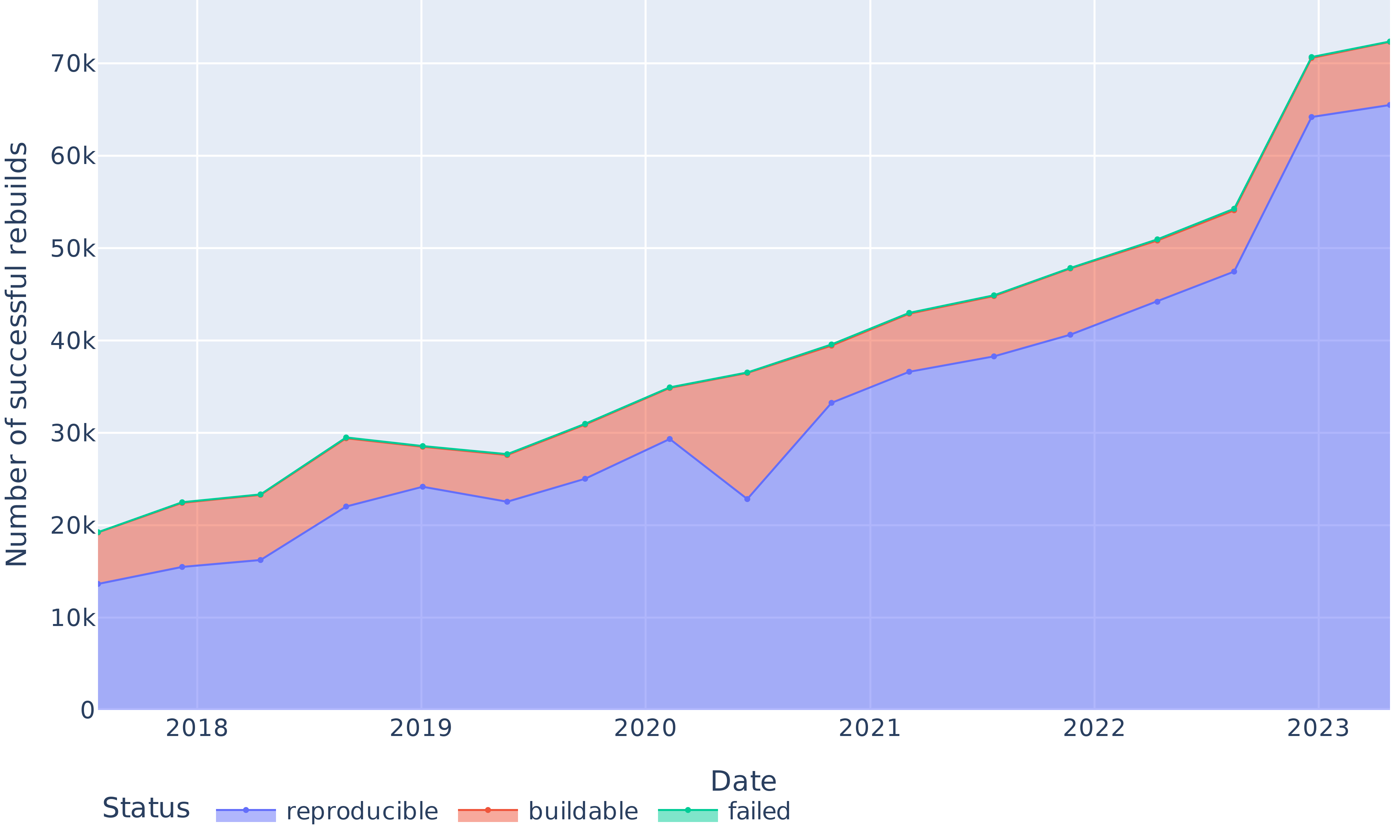
This is a stacked area chart tracking the number of successful software or system rebuilds over a period from approximately early 2018 to mid-2023. The chart categorizes rebuilds by their final status: "reproducible," "buildable," and "failed." The data shows a general upward trend in total rebuilds, with a significant acceleration in growth starting in 2022.
### Components/Axes
* **Chart Type:** Stacked Area Chart.
* **X-Axis (Horizontal):** Labeled "Date". It displays years from 2018 to 2023, with major tick marks at the start of each year. The data appears to be plotted at quarterly or semi-annual intervals.
* **Y-Axis (Vertical):** Labeled "Number of successful rebuilds". The scale is linear, ranging from 0 to 70,000 (70k), with major gridlines at intervals of 10,000.
* **Legend:** Located at the bottom center of the chart, titled "Status". It defines three data series:
* **reproducible:** Represented by a blue line and a semi-transparent blue filled area beneath it.
* **buildable:** Represented by a salmon/orange line and a semi-transparent salmon/orange filled area stacked on top of the "reproducible" area.
* **failed:** Represented by a teal/green line and a semi-transparent teal/green filled area stacked on top of the "buildable" area. The top edge of this green area represents the total number of rebuilds (reproducible + buildable + failed).
### Detailed Analysis
**Trend Verification:**
* **reproducible (Blue Line/Area):** Shows a general upward trend with some volatility. It dips notably in mid-2020 before recovering and then rising sharply from 2022 onward.
* **buildable (Orange Line/Area):** The thickness of this band (the difference between the orange and blue lines) remains relatively consistent until 2022, after which it widens slightly, indicating a growing number of builds in this category.
* **failed (Green Line/Area):** The top line (total) follows a similar upward trajectory to the "reproducible" line. The thickness of the green band (failed builds) appears relatively stable as a proportion of the total over time.
**Data Point Extraction (Approximate Values):**
Values are estimated based on the gridlines. The "reproducible" value is read directly from the blue line. The "buildable" value is the difference between the orange and blue lines. The "failed" value is the difference between the green and orange lines. The total is the value of the green line.
| Date (Approx.) | Total (Green Line) | reproducible (Blue) | buildable (Orange - Blue) | failed (Green - Orange) |
| :--- | :--- | :--- | :--- | :--- |
| Early 2018 | ~19,000 | ~14,000 | ~5,000 | ~0 (line starts here) |
| Mid 2018 | ~22,000 | ~15,500 | ~6,500 | ~0 |
| Late 2018 | ~23,000 | ~16,000 | ~7,000 | ~0 |
| Early 2019 | ~29,500 | ~22,000 | ~7,500 | ~0 |
| Mid 2019 | ~28,500 | ~24,000 | ~4,500 | ~0 |
| Late 2019 | ~27,500 | ~22,000 | ~5,500 | ~0 |
| Early 2020 | ~31,000 | ~25,000 | ~6,000 | ~0 |
| Mid 2020 | ~35,000 | ~29,500 | ~5,500 | ~0 |
| Late 2020 | ~36,500 | ~22,500 | ~14,000 | ~0 |
| Early 2021 | ~39,500 | ~33,000 | ~6,500 | ~0 |
| Mid 2021 | ~42,500 | ~36,500 | ~6,000 | ~0 |
| Late 2021 | ~45,000 | ~38,000 | ~7,000 | ~0 |
| Early 2022 | ~48,000 | ~40,500 | ~7,500 | ~0 |
| Mid 2022 | ~51,000 | ~44,000 | ~7,000 | ~0 |
| Late 2022 | ~54,000 | ~47,500 | ~6,500 | ~0 |
| Early 2023 | ~70,500 | ~64,000 | ~6,500 | ~0 |
| Mid 2023 | ~72,000 | ~65,500 | ~6,500 | ~0 |
**Note on "failed" data:** The legend includes "failed," but the green line appears to be the top boundary of the stacked area. The visual representation suggests the green line is the sum of all three categories. The "failed" category, as a distinct band, is not visibly present in the stack, implying its value is zero or negligible throughout the period shown. The green line's label may be misleading; it likely represents the "Total" of all statuses.
### Key Observations
1. **Overall Growth:** The total number of rebuilds (green line) increased from approximately 19,000 in early 2018 to over 72,000 by mid-2023, representing nearly a 280% increase.
2. **Sharp Acceleration:** The most dramatic growth occurs between late 2022 and early 2023, where the total jumps from ~54,000 to ~70,500.
3. **Volatility in "reproducible":** The "reproducible" category shows a significant dip in late 2020 (down to ~22,500 from ~29,500 earlier that year) before beginning a sustained and steep climb.
4. **Stable "buildable" Band:** The number of "buildable" (but not reproducible) rebuilds remains in a relatively narrow band (roughly 4,500 to 7,500) for most of the timeline, with a possible outlier spike in late 2020.
5. **Legend/Data Discrepancy:** The "failed" category listed in the legend does not correspond to a visible, separate data series in the chart. The green line is the cumulative total.
### Interpretation
This chart demonstrates a robust and accelerating adoption or activity in a rebuild process (likely in software engineering, such as package builds or continuous integration) over a five-year period. The consistent growth suggests increasing scale, reliability, or monitoring of these processes.
The relationship between the categories is key: "reproducible" builds form the vast majority of the total, indicating a high standard of build quality and determinism. The "buildable" category represents a smaller, stable subset of builds that succeed but lack full reproducibility. The absence of a visible "failed" band is a strong positive indicator, suggesting either an extremely low failure rate or that the chart's green line is mislabeled and actually represents the sum of "reproducible" and "buildable" only.
The notable dip in "reproducible" builds in late 2020 could indicate a systemic issue, a change in measurement methodology, or a period of transition in the underlying systems. The subsequent sharp recovery and explosive growth from 2022 onward point to a successful resolution of that issue and/or a major scaling-up of operations. The data suggests a system that has matured significantly, achieving both higher volume and a strong emphasis on reproducibility.