\n
## Diagram: Agent Architecture Overview
### Overview
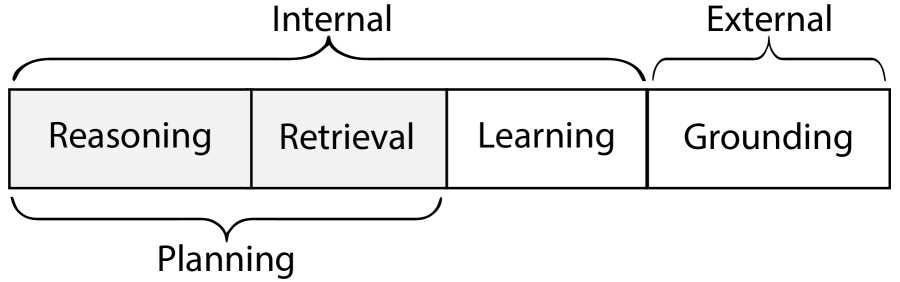
The image depicts a block diagram illustrating an agent architecture, segmented into four primary components: Reasoning, Retrieval, Learning, and Grounding. These are further categorized under "Internal" and "External" processing, and all are encompassed by a "Planning" layer. The diagram is a high-level conceptual representation of an agent's cognitive processes.
### Components/Axes
The diagram consists of four rectangular blocks, each labeled with a specific function:
* **Reasoning:** Located at the far left.
* **Retrieval:** Positioned adjacent to Reasoning.
* **Learning:** Situated next to Retrieval.
* **Grounding:** Located at the far right.
Above the blocks "Reasoning" and "Retrieval" is a curved bracket labeled "Internal". Above "Learning" and "Grounding" is a curved bracket labeled "External". Below all four blocks is a curved bracket labeled "Planning".
### Detailed Analysis or Content Details
The diagram is purely conceptual and does not contain numerical data or specific values. It presents a structural organization of components. The blocks are arranged horizontally, suggesting a sequential or interconnected flow of information.
* **Reasoning:** This block represents the agent's ability to deduce, infer, and solve problems.
* **Retrieval:** This block represents the agent's ability to access and utilize stored knowledge.
* **Learning:** This block represents the agent's ability to acquire new knowledge and improve performance.
* **Grounding:** This block represents the agent's ability to connect internal representations to the external world.
* **Planning:** This block represents the overarching process of setting goals and determining actions.
* **Internal:** Represents processes happening within the agent's core.
* **External:** Represents processes involving interaction with the environment.
### Key Observations
The diagram highlights a clear distinction between internal cognitive processes (Reasoning, Retrieval, Learning) and external interaction (Grounding). The "Planning" layer suggests that all four components contribute to the agent's overall decision-making process. The arrangement implies a potential flow of information from reasoning and retrieval to learning and grounding, although the diagram does not explicitly define this flow.
### Interpretation
This diagram illustrates a common architecture for intelligent agents, particularly in the field of Artificial Intelligence and Robotics. The separation of "Internal" and "External" processes is crucial for understanding how an agent interacts with its environment. The "Planning" layer emphasizes the importance of goal-directed behavior. The diagram suggests a cyclical process where the agent reasons, retrieves information, learns from experience, and grounds its actions in the real world, all while being guided by a planning process. The diagram is a simplified representation and does not specify the details of how these components interact or the specific algorithms used within each component. It serves as a high-level conceptual framework for designing and understanding intelligent agents.