## Diagram: Cognitive Process Framework
### Overview
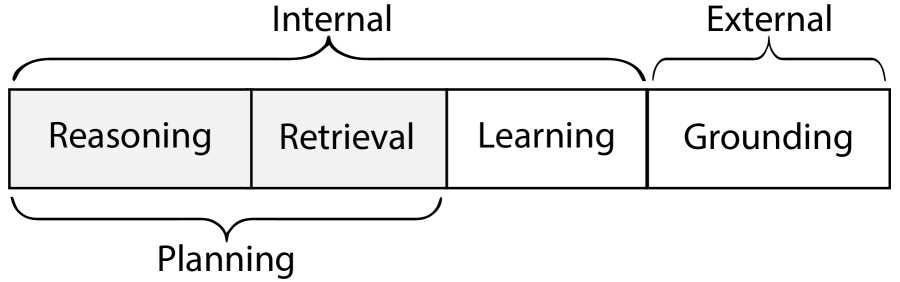
The diagram illustrates a structured workflow divided into **Internal** and **External** processes, with a foundational **Planning** phase. It consists of four sequential components: **Reasoning**, **Retrieval**, **Learning**, and **Grounding**, arranged horizontally.
### Components/Axes
- **Horizontal Axis**: Represents the sequence of processes (left to right).
- **Vertical Labels**:
- **Internal**: Grouping for the first two components (**Reasoning**, **Retrieval**).
- **External**: Grouping for the last two components (**Learning**, **Grounding**).
- **Footer Label**: **Planning** (positioned below the first two components).
### Detailed Analysis
1. **Planning**:
- Positioned at the bottom-left, connected via a curved line to **Reasoning** and **Retrieval**.
- Acts as a precursor to the Internal processes.
2. **Reasoning & Retrieval (Internal)**:
- **Reasoning**: First component under "Internal," suggesting logical analysis or decision-making.
- **Retrieval**: Second component, likely involving data or memory access.
- Both share the "Internal" label, indicating they operate within a closed system or cognitive framework.
3. **Learning & Grounding (External)**:
- **Learning**: Third component, positioned under "External," implying adaptation or knowledge acquisition from external sources.
- **Grounding**: Final component, suggesting integration of learned information into practical or real-world contexts.
- Both share the "External" label, indicating reliance on external inputs or environments.
### Key Observations
- **Flow Direction**: The diagram implies a left-to-right progression: Planning → Reasoning/Retrieval → Learning/Grounding.
- **Internal vs. External**: The split between "Internal" and "External" processes suggests a dichotomy between self-contained cognitive operations and interactions with external systems.
- **No Numerical Data**: The diagram is conceptual, with no quantitative values or trends.
### Interpretation
This framework likely represents a model for cognitive or AI systems, where:
1. **Planning** initiates the process, defining goals or strategies.
2. **Reasoning** and **Retrieval** (Internal) handle logical analysis and data access within the system.
3. **Learning** and **Grounding** (External) enable adaptation to new information and real-world application.
The separation of "Internal" and "External" processes highlights a balance between autonomous decision-making and external dependency, critical for systems requiring both autonomy and contextual awareness. The absence of numerical data emphasizes its role as a conceptual blueprint rather than a measurable workflow.