## Matrix Diagram: Technology Domains and Trade-offs
### Overview
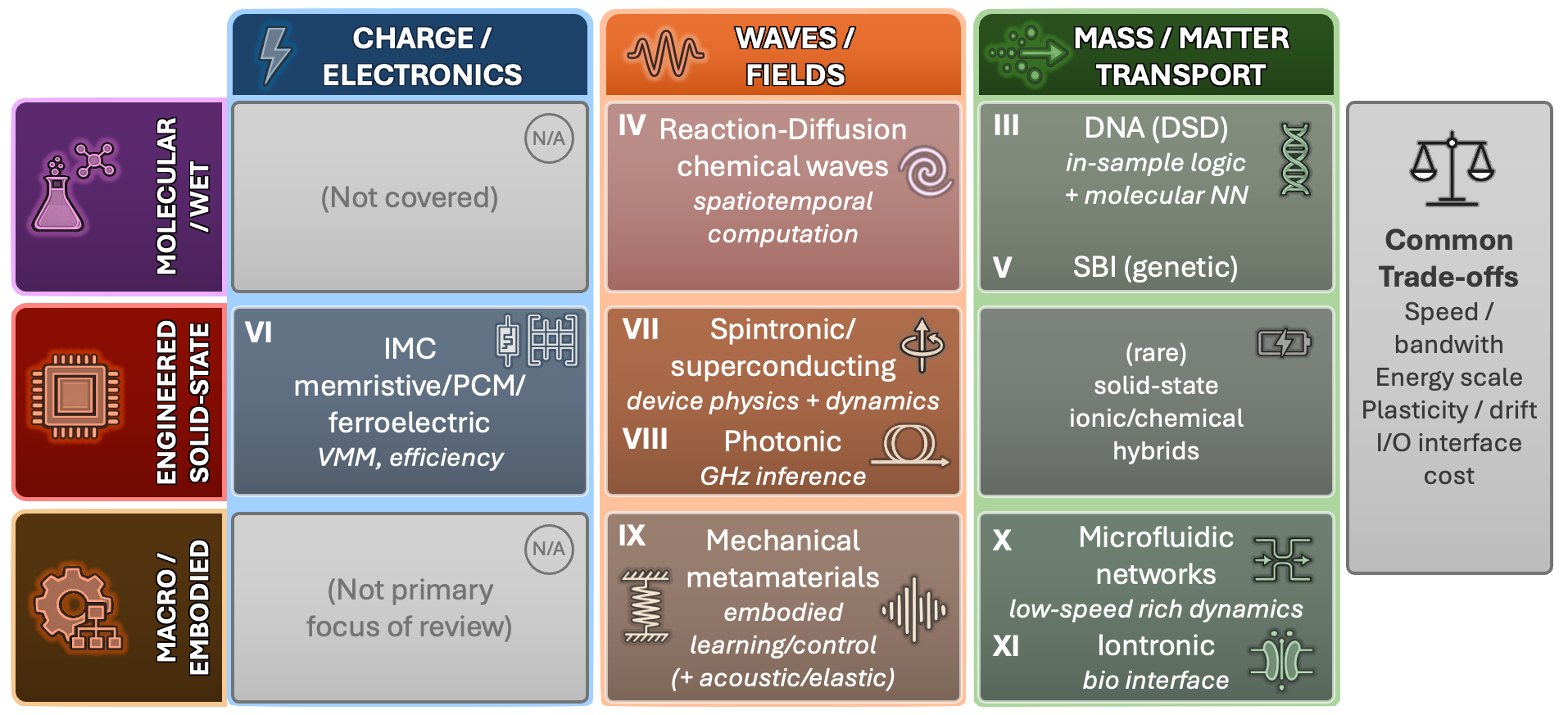
The image presents a structured matrix diagram categorizing technologies across three primary physical domains: **CHARGE/ELECTRONICS**, **WAVES/FIELDS**, and **MASS/MATTER TRANSPORT**. Each domain is subdivided into specific technological areas, with a right-hand sidebar listing **Common Trade-offs** (e.g., Speed/Bandwidth, Energy scale). The diagram uses color-coded boxes, icons, and labels to organize information hierarchically.
---
### Components/Axes
#### Main Columns (Physical Domains)
1. **CHARGE/ELECTRONICS** (Blue)
- **MOLECULAR/WET** (Purple): Icon of beaker with bubbles; text: "Not covered."
- **ENGINEERED SOLID-STATE** (Red): Icon of IC chip; text: "IMC memristive/PCM/ferroelectric VMM, efficiency."
- **MACRO/EMBODIED** (Brown): Icon of gear with flowchart; text: "Not primary focus of review."
2. **WAVES/FIELDS** (Orange)
- **IV Reaction-Diffusion chemical waves** (Brown): Icon of spiral; text: "spatiotemporal computation."
- **VII Spintronic/superconducting device physics** (Brown): Icon of superconducting symbol; text: "device physics + dynamics."
- **VIII Photonic GHz inference** (Brown): Icon of photonic waveguide; text: "GHz inference."
3. **MASS/MATTER TRANSPORT** (Green)
- **III DNA (DSD)** (Green): Icon of DNA helix; text: "in-sample logic + molecular NN."
- **V SBI (genetic)** (Green): Icon of DNA; text: "SBI (genetic)."
- **X Microfluidic networks** (Green): Icon of microfluidic channels; text: "low-speed rich dynamics."
- **XI Lontronic bio interface** (Green): Icon of cell membrane; text: "lontronic bio interface."
#### Sidebar (Trade-offs)
- **Common Trade-offs** (Gray): Icon of balance scale; text:
- Speed / bandwidth
- Energy scale
- Plasticity / drift
- I/O interface cost
---
### Detailed Analysis
#### CHARGE/ELECTRONICS
- **MOLECULAR/WET**: Explicitly marked as "Not covered," suggesting exclusion from current scope.
- **ENGINEERED SOLID-STATE**: Focuses on memory/compute materials (IMC, memristive, PCM, ferroelectric) with efficiency metrics.
- **MACRO/EMBODIED**: Deferred for review, indicating lower priority or incomplete analysis.
#### WAVES/FIELDS
- **Reaction-Diffusion chemical waves**: Links chemical wave dynamics to spatiotemporal computation.
- **Spintronic/superconducting**: Combines device physics with dynamic behavior, emphasizing superconducting materials.
- **Photonic GHz inference**: Highlights photonic systems for high-frequency processing.
#### MASS/MATTER TRANSPORT
- **DNA (DSD)**: Integrates DNA-based logic with molecular neural networks.
- **SBI (genetic)**: Focuses on genetic-level signal processing.
- **Microfluidic networks**: Emphasizes low-speed, high-complexity fluidic systems.
- **Lontronic bio interface**: Combines ionic/chemical hybrids with biological interfaces.
#### Trade-offs
- Balances competing metrics (e.g., Speed vs. Bandwidth) across domains, implying optimization challenges.
---
### Key Observations
1. **Domain Segmentation**: Technologies are grouped by physical principles (charge, waves, mass), reflecting interdisciplinary boundaries.
2. **Iconography**: Visual symbols (e.g., DNA helix, superconducting icon) reinforce categorical themes.
3. **Deferred Topics**: "Not covered" and "Not primary focus" indicate gaps or prioritization in the review scope.
4. **Trade-off Emphasis**: The sidebar underscores systemic compromises in technology development.
---
### Interpretation
The diagram maps emerging technologies to their foundational physical domains, highlighting both specialization and interdependencies. For example:
- **CHARGE/ELECTRONICS** dominates with memory/compute materials, suggesting a focus on solid-state advancements.
- **WAVES/FIELDS** bridges classical physics (e.g., photonic GHz inference) with novel paradigms like spintronics.
- **MASS/MATTER TRANSPORT** emphasizes bio-hybrid systems (DNA, microfluidics), aligning with trends in biocomputing.
The "Not covered" and "Not primary focus" labels reveal intentional exclusions, possibly due to nascent research stages or scope limitations. Trade-offs like "Energy scale" vs. "Plasticity" suggest that optimizing one metric often compromises another, a critical consideration for system design. The inclusion of "lontronic bio interface" hints at speculative or interdisciplinary research beyond conventional boundaries.