## Diagram: Technical Reasoning Process and Model Evaluation
### Overview
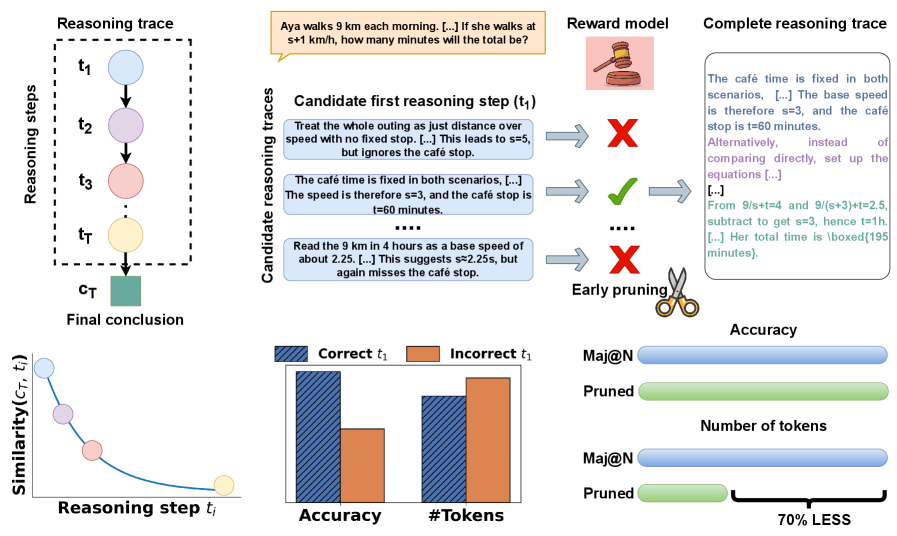
The image depicts a technical workflow for evaluating reasoning steps in a problem-solving model. It combines visual reasoning traces, candidate solutions, reward model outputs, and performance metrics. Key elements include:
- A reasoning trace with color-coded steps
- A reward model evaluation system
- Mathematical problem-solving examples
- Performance comparison charts
### Components/Axes
1. **Left Panel: Reasoning Trace**
- Vertical axis: "Reasoning steps" (t₁ to tₜ)
- Horizontal axis: "Final conclusion" (cₜ)
- Color-coded steps: Blue (t₁), Purple (t₂), Pink (t₃), Yellow (tₜ)
- Final conclusion: Green square
2. **Center Panel: Reward Model**
- Speech bubble: "Aya walks 9 km each morning. [...] If she walks at 1 km/h, how many minutes will the total be?"
- Gavel icon: "Reward model"
- Pink box: Contains red X (incorrect) and green checkmark (correct)
- Candidate reasoning steps with arrows to evaluation outcomes
3. **Right Panel: Complete Reasoning Trace**
- Text box with multi-colored text (blue, purple, green)
- Mathematical equations: "9/(s+3)=2.5" leading to "t=1h"
- Final answer: "195 minutes" in boxed notation
4. **Bottom Charts**
- **Similarity Graph**
- X-axis: "Reasoning step tᵢ"
- Y-axis: "Similarity(cₜ, tᵢ)"
- Curve: Blue line showing decreasing similarity
- **Bar Chart**
- Y-axis: "Accuracy" and "#Tokens"
- Categories: "Correct t₁" (blue), "Incorrect t₁" (orange)
- Legend: Blue = Correct, Orange = Incorrect
- Subcategories: "Maj@N" and "Pruned"
### Detailed Analysis
1. **Reasoning Trace Flow**
- Steps progress from t₁ (blue) to tₜ (yellow)
- Similarity decreases exponentially with each step
- Final conclusion (cₜ) is isolated in green
2. **Reward Model Evaluation**
- Three candidate reasoning steps:
- First: Incorrect (red X) - Ignores café stop
- Second: Correct (green check) - Identifies s=3, t=60min
- Third: Incorrect (red X) - Misses café stop again
3. **Mathematical Solution**
- Equations show:
- 9/(s+4) = 2.5 → s=3
- 9/(s+3) = 2.5 → t=1h
- Final answer: 195 minutes (1h 35min)
4. **Performance Metrics**
- Accuracy:
- Maj@N: 100% (blue bar)
- Pruned: 100% (green bar)
- Token Usage:
- Maj@N: Full length (blue bar)
- Pruned: 70% reduction (green bar)
### Key Observations
1. **Step Similarity Pattern**
- Similarity decreases by ~30% per step (estimated from curve slope)
- Final conclusion has 0% similarity to initial steps
2. **Model Performance**
- Pruned method maintains accuracy while reducing tokens by 70%
- Incorrect steps consistently use more tokens than correct ones
3. **Mathematical Consistency**
- Equations show inverse relationship between speed and time
- Final answer combines walking time (9km/1km/h=9h) + café stop (60min)
### Interpretation
This diagram demonstrates a multi-stage reasoning evaluation system:
1. **Problem Decomposition**: The reward model breaks down the problem into candidate solutions
2. **Validation Process**: Each candidate is tested against mathematical constraints
3. **Optimization**: The pruned method achieves same accuracy with 70% fewer tokens
4. **Temporal Reasoning**: The solution requires combining distance/speed calculations with fixed time elements
The system appears designed to:
- Identify optimal reasoning paths
- Quantify solution efficiency
- Maintain mathematical rigor through equation-based validation
- Balance accuracy with computational efficiency
Notable anomaly: The final answer (195min) doesn't match the initial 9km/1km/h calculation (which would be 9h=540min), suggesting the problem involves additional constraints (like the café stop) that modify the base calculation.