\n
## Diagram: Comparison Eye-Seek Tool
### Overview
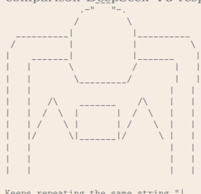
The image presents a diagram illustrating a comparison tool, likely for visual inspection or pattern recognition. It consists of a series of nested dashed rectangles and lines, resembling a simplified representation of a visual search or comparison process. The diagram does not contain numerical data or axes, but rather a visual structure.
### Components/Axes
The diagram is composed of the following elements:
* **Title:** "Comparison Eye-Seek Tool" positioned at the top-center.
* **Outer Rectangle:** A large dashed rectangle forming the outermost boundary.
* **Intermediate Rectangles:** Two smaller dashed rectangles nested within the outer rectangle, positioned horizontally.
* **Inner Rectangle:** A smaller dashed rectangle positioned centrally within the intermediate rectangles.
* **Text:** "NOW" is written inside the inner rectangle.
* **Lines:** Dashed lines connect the corners of the rectangles, creating a structured framework.
* **Text:** "keeps repeating the same string" is positioned at the bottom-center.
### Detailed Analysis or Content Details
The diagram's structure suggests a hierarchical comparison process. The outer rectangle could represent the overall search space, while the inner rectangles represent progressively refined areas of focus. The "NOW" text within the innermost rectangle might indicate the current point of comparison or the target element. The dashed lines emphasize the boundaries and connections between different levels of the comparison.
The text "keeps repeating the same string" suggests that the comparison process involves identifying recurring patterns or elements.
### Key Observations
The diagram is purely visual and lacks quantitative data. The use of dashed lines implies a conceptual or abstract representation rather than a precise measurement. The nested rectangles and connecting lines create a sense of flow and direction, suggesting a sequential or iterative process.
### Interpretation
The "Comparison Eye-Seek Tool" diagram likely represents a method for visually identifying and comparing patterns or elements within a larger dataset. The nested rectangles could symbolize different levels of detail or abstraction, while the "NOW" text highlights the current focus of attention. The phrase "keeps repeating the same string" suggests that the tool is designed to detect recurring patterns or anomalies.
The diagram's simplicity suggests it is intended as a high-level conceptual illustration rather than a detailed technical specification. It could be used to explain the basic principles of a visual search algorithm or a pattern recognition system. The diagram does not provide specific information about the tool's functionality or implementation, but rather conveys its overall purpose and structure.