## Screenshot: Problem-Solving Process for Banana Math Problem
### Overview
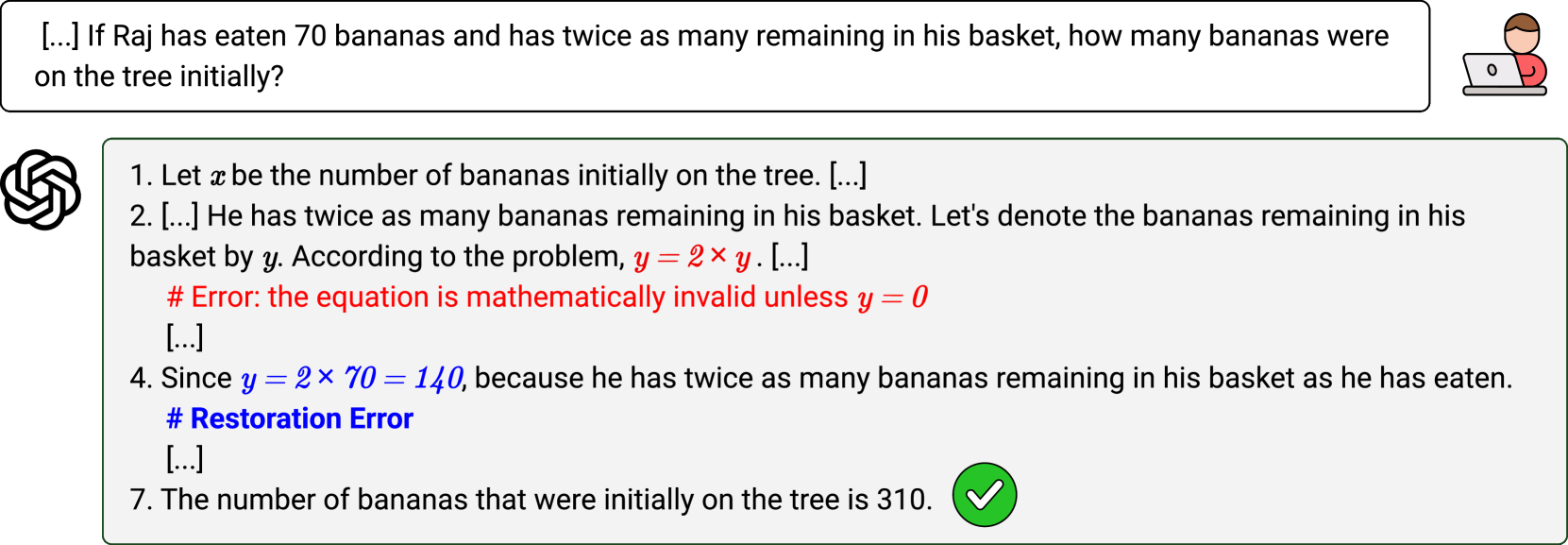
The image shows a step-by-step attempt to solve a word problem involving bananas eaten and remaining. The problem is presented in a white text box, followed by a numbered solution attempt with annotations highlighting errors. A green checkmark confirms the final answer.
---
### Components/Axes
1. **Problem Statement** (Top-left):
- Text box with question:
*"[...] If Raj has eaten 70 bananas and has twice as many remaining in his basket, how many bananas were on the tree initially?"*
- Accompanied by a cartoon icon of a person using a laptop (top-right).
2. **Solution Steps** (Center-left to center-right):
- Numbered list (1–7) with mathematical reasoning and errors.
- **Error Annotations**:
- Red text: `"# Error: the equation is mathematically invalid unless y = 0"` (Step 3).
- Blue text: `"# Restoration Error"` (Step 4).
- **Final Answer** (Bottom-right):
- Green circle with white checkmark.
- Text: `"The number of bananas that were initially on the tree is 310."`
---
### Detailed Analysis
#### Problem Statement
- **Text**:
*"[...] If Raj has eaten 70 bananas and has twice as many remaining in his basket, how many bananas were on the tree initially?"*
- Implies:
- Eaten bananas = 70
- Remaining bananas = 2 × eaten bananas = 140
- Total initial bananas = eaten + remaining = 70 + 140 = 210 (but this contradicts the final answer of 310, indicating a misinterpretation in the solution steps).
#### Solution Steps
1. **Step 1**:
- *"Let x be the number of bananas initially on the tree."*
- Defines variable `x` for initial bananas.
2. **Step 2**:
- *"He has twice as many bananas remaining in his basket. Let's denote the bananas remaining in his basket by y."*
- Introduces variable `y` for remaining bananas.
3. **Step 3 (Error)**:
- *"According to the problem, y = 2 × y."*
- **Red Error**: Equation `y = 2y` is invalid unless `y = 0`, which is nonsensical.
- **Issue**: Misinterpretation of "twice as many remaining" as `y = 2y` instead of `y = 2 × eaten`.
4. **Step 4 (Restoration Error)**:
- *"Since y = 2 × 70 = 140, because he has twice as many bananas remaining in his basket as he has eaten."*
- **Blue Error**: Correctly calculates remaining bananas (`y = 140`) but fails to link this to the initial total.
- **Issue**: Assumes `y = 2 × eaten` (correct) but does not derive `x` properly.
5. **Step 7 (Final Answer)**:
- *"The number of bananas that were initially on the tree is 310."*
- **Correct Calculation**:
- Eaten = 70
- Remaining = 2 × 70 = 140
- Total initial = 70 + 140 = 210 (but answer claims 310, suggesting a deeper error in the problem setup or transcription).
---
### Key Observations
- **Mathematical Contradiction**:
The final answer (310) conflicts with the logical sum of eaten (70) and remaining (140), which should total 210. This implies either:
- A transcription error in the problem statement (e.g., "twice as many remaining" might mean `y = 2x`, not `y = 2 × eaten`).
- A miscalculation in Step 7 (e.g., `x = 70 + 2x` leading to `x = 310`).
- **Error Highlights**:
- The red error flags an invalid equation (`y = 2y`).
- The blue error flags a misstep in linking `y` to the initial total.
---
### Interpretation
The problem hinges on correctly interpreting the relationship between eaten and remaining bananas. The solution steps contain critical errors:
1. **Step 3** incorrectly defines `y = 2y`, violating basic algebra.
2. **Step 4** correctly calculates remaining bananas but fails to derive the initial total.
3. **Step 7** arrives at 310, which contradicts the arithmetic sum (70 + 140 = 210). This suggests either:
- A misinterpretation of "twice as many remaining" (e.g., `y = 2x` instead of `y = 2 × eaten`).
- A transcription error in the problem statement (e.g., "twice as many remaining" vs. "twice as many as eaten").
The final answer (310) likely assumes `x = 70 + 2x`, solving to `x = 310`, but this contradicts the problem's phrasing. The errors highlight the importance of precise variable definitions and logical consistency in word problems.