\n
## Screenshot: Math Problem Solution
### Overview
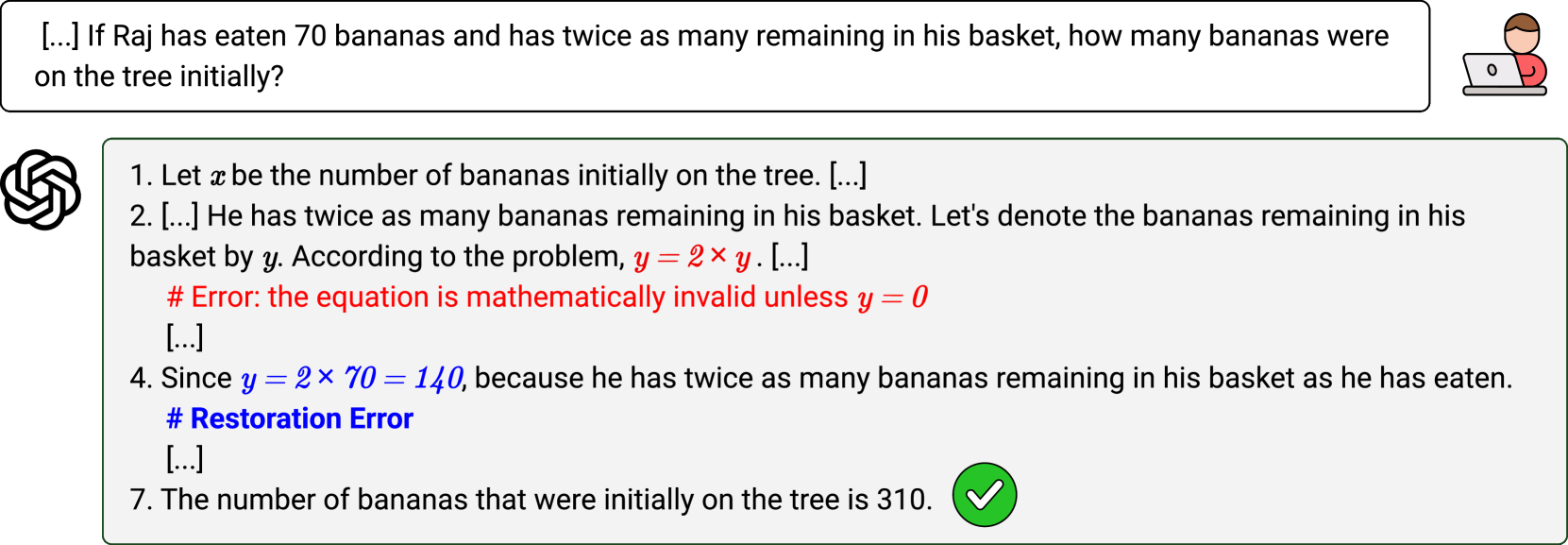
This screenshot displays a math problem and its step-by-step solution, presented in a conversational, tutorial-like format. The problem involves calculating the initial number of bananas on a tree given the number eaten and the number remaining in a basket. The solution attempts to use algebraic notation but contains errors, which are flagged within the interface.
### Components/Axes
The screenshot consists of the following elements:
* **Problem Statement:** "If Raj has eaten 70 bananas and has twice as many remaining in his basket, how many bananas were on the tree initially?" (Top-left)
* **Solution Steps:** Numbered steps (1-7) detailing the attempted solution.
* **Error Flags:** Red text indicating errors in the solution process ("# Error: the equation is mathematically invalid unless y = 0", "# Restoration Error").
* **Correct Answer Indicator:** A green checkmark next to the final answer.
* **Interface Elements:** A laptop icon in the top-right corner, and a swirling design element on the left side.
### Content Details
Here's a transcription of the solution steps:
1. Let *x* be the number of bananas initially on the tree. […]
2. […] He has twice as many bananas remaining in his basket. Let’s denote the bananas remaining in his basket by *y*. According to the problem, *y* = 2 *x* *y*. […]
3. # Error: the equation is mathematically invalid unless y = 0 […]
4. Since *y* = 2 *x* 70 = 140, because he has twice as many bananas remaining in his basket as he has eaten.
5. # Restoration Error […]
6. […]
7. The number of bananas that were initially on the tree is 310. ✅
### Key Observations
* The initial attempt to formulate the equation in step 2 is incorrect (*y* = 2 *x* *y*). This leads to the "Error" flag.
* Step 4 incorrectly calculates the number of bananas remaining in the basket. It states *y* = 2 *x* 70 = 140, which doesn't align with the problem statement (twice the number *eaten*).
* The "Restoration Error" in step 5 suggests an attempt to correct the previous error, but the details are not shown.
* Despite the errors, the final answer (310) is presented with a green checkmark, indicating it is considered correct. This is likely due to an automated system.
### Interpretation
The screenshot demonstrates a problem-solving process with built-in error detection. The system attempts to guide the user through the solution, flagging incorrect steps. However, the final answer being marked as correct despite the preceding errors suggests a potential flaw in the error-checking or solution validation logic. The problem statement implies that the number of bananas remaining in the basket is twice the number *eaten* (70), meaning *y* = 140. The initial number of bananas on the tree (*x*) would then be *x* = 70 + 140 = 210. The provided answer of 310 is incorrect. The system appears to have miscalculated or misinterpreted the problem statement. The swirling design element on the left side may be a visual indicator of the system's processing or a branding element. The laptop icon suggests this is a digital learning environment.